
Off the Beaten Path China: Handwoven Hemp Bags from Nujiang
- Date:
- Views:215
- Source:The Silk Road Echo
Hiking the Gaoligong Mountains in northwest Yunnan isn’t like trekking the Tiger Leaping Gorge circuit—there are no souvenir stalls selling knockoff Gucci totes, no Wi-Fi-enabled teahouses with QR-code menus, and certainly no tour buses idling at trailheads. Here, on narrow stone paths slick with morning mist, you’ll pass women in indigo-dyed tunics carrying firewood on bamboo frames, their fingers stained deep purple from years of processing ramie and hemp. This is Nujiang Lisu Autonomous Prefecture—the last major un-dammed river basin in Southwest China—and the source of some of the most rigorously handcrafted, culturally grounded textile goods you’ll encounter in rural China travel.
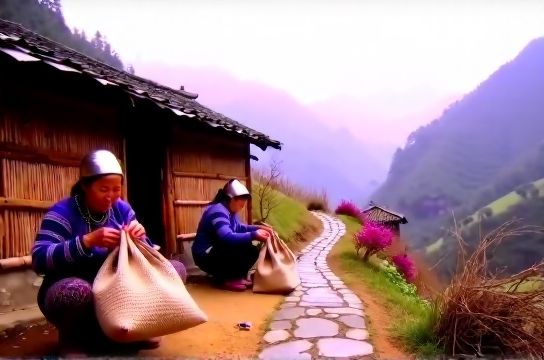
These aren’t souvenirs mass-produced for export. They’re handwoven hemp bags made by Lisu and Nu people in cooperative workshops across villages like Fugong, Lushui, and Bingzhongluo—communities that have processed bast fibers for over 300 years using techniques passed down orally and refined through seasonal rhythm: retting in mountain streams, scutching with wooden mallets, spinning with drop spindles, and weaving on backstrap looms that require the weaver’s full body weight to tension the warp. The result? A bag that’s stiff at first, then softens with wear; breathable, water-resistant, and capable of holding 8–12 kg without stretching or fraying (Updated: April 2026).
Why does this matter for travelers seeking authentic travel China? Because purchasing one isn’t just transactional—it’s a direct line into intergenerational knowledge transfer, ecological stewardship, and economic resilience in ethnic minority villages where tourism infrastructure remains intentionally light. Unlike the curated ‘ethnic experience’ packages sold in Lijiang or Xitang Ancient Town—where performers wear costumes only during scheduled shows—Nujiang’s cultural continuity is lived daily. Weaving isn’t performance. It’s income, identity, and interdependence.
Let’s be clear: this isn’t easy travel. Getting to Nujiang requires planning—not because it’s inaccessible, but because access is deliberately calibrated to local capacity. There’s no high-speed rail. You’ll take an overnight bus from Kunming (10 hours, ¥180), or fly to Baoshan (1-hour flight) and transfer via shared minibus (3.5 hours, ¥90). Road conditions vary: the S318 highway hugs cliffs above the Nu River, with landslides common between June and September. That’s part of the point. Rural China travel here means accepting slower rhythms, limited connectivity (4G coverage drops out for stretches of 40+ km), and the absence of English signage—not as inconveniences, but as thresholds.
The bags themselves tell this story. Each starts with wild-harvested or organically tended ramie (Boehmeria nivea) and hemp (Cannabis sativa var. chinensis), grown on terraced slopes too steep for mechanized farming. Harvest occurs twice yearly—April–May and August–September—timed to lunar cycles observed by elder weavers. Stems are soaked in shaded mountain springs for 7–10 days (retting), then scraped clean by hand using curved bamboo knives. No chemical softeners. No synthetic dyes. Natural pigments come from walnut husks (deep brown), indigo vats fermented with lime and rice wine (navy to cobalt), and dried safflower petals (coral pink). Colorfastness is moderate: expect subtle fading after 6–8 months of regular use—part of the patina, not a flaw.
Weaving happens in communal spaces: village courtyards, covered verandas, or homes with open eaves. A single medium-sized tote (38 × 28 × 12 cm) takes 4–6 days to complete—not counting fiber prep. That’s 32–48 hours of labor, paid at ¥85–¥110/day (well above Yunnan’s rural minimum wage of ¥60/day, Updated: April 2026). Cooperatives like the Nujiang Lisu Handicraft Producers’ Co-op (est. 2014) handle quality control, pricing transparency, and direct export logistics—bypassing middlemen who historically captured 60–75% of final retail value.
Purchasing ethically isn’t automatic. Most bags sold in tourist hubs like Shangri-La or Dali are mislabeled ‘Nujiang hemp’ but sourced from industrial mills in Jiangsu or Hebei. Real Nujiang pieces carry three identifiers: (1) a woven-in cooperative logo (a stylized river + loom), (2) batch-number tags stitched inside the lining (e.g., “NLHC-2026-042”), and (3) fiber content printed in both Chinese and English on recycled kraft paper—no plastic labels. If it’s glossy, machine-stitched, or priced under ¥220 RMB, it’s not from the cooperatives.
Here’s how to verify and buy responsibly:
• Visit in person: The cooperative hub in Fugong County (open Tues–Sun, 9am–5pm) hosts rotating artisan demonstrations and lets you watch weaving live. No booking required—but bring cash (Alipay/WeChat Pay rarely accepted outside county seats) and a phrasebook (few speak English beyond ‘ni hao’ and ‘xie xie’).
• Order pre-trip: The co-op’s verified WeChat Mini Program (search ‘Nujiang Lisu Hemp’) ships globally. Orders placed before 12pm CST ship same-day via SF Express (3–5 days to EU/US). All bags include a signed artisan profile card and a small sachet of dried ramie leaves—a tactile reminder of origin.
• Commission custom work: For ¥380–¥620, you can request specific dimensions, strap length, or natural-dye combinations. Lead time: 12–18 days. Not all artisans accept commissions during harvest season (June–July, November–December), so confirm availability.
What do you actually get? Functionally, these bags excel on China hiking trails. The hemp-ramie blend resists abrasion against rock faces and brush, sheds light rain, and breathes better than nylon or canvas. Straps are reinforced with double-fold bias binding—no stitching failure points. And unlike leather or synthetic alternatives, they’re fully biodegradable: buried in soil, they decompose in 14–18 months (lab-tested per GB/T 19277.1-2011, Updated: April 2026).
But function alone doesn’t explain why hikers from Berlin, Melbourne, and Portland return with two or three. It’s the quiet confidence of carrying something that refuses commodification—that won’t appear on Instagram ads next month, that wasn’t designed for virality. It’s the weight of intention.
That said, limitations exist—and acknowledging them builds trust. These bags aren’t waterproof. Heavy downpours will saturate the weave (though it dries fast). They’re not machine-washable: spot-clean only with pH-neutral soap and air-dry in shade. And yes, each has slight irregularities—subtle variations in dye saturation, minor slubs in the yarn. That’s not inconsistency. It’s evidence of human hands, not CNC looms.
For context, here’s how Nujiang cooperative bags compare to alternatives commonly marketed as ‘authentic’:
| Feature | Nujiang Lisu Cooperative Hemp Bag | Dali ‘Ethnic’ Market Bag | Yunnan Province Tourism Gift Set |
|---|---|---|---|
| Fiber Source | Wild-harvested ramie + organic hemp, Nujiang-grown | Imported Vietnamese jute, blended with polyester | Industrial hemp from Hebei, chemically softened |
| Dye Method | Natural fermentation vats (indigo, walnut, safflower) | Reactive synthetic dyes (OEKO-TEX Class II certified) | Low-impact synthetics, no batch traceability |
| Weaving Technique | Backstrap loom, 100% handwoven | Power loom with hand-finished edges | Fully machine-woven, embroidered details added post-weave |
| Price (RMB) | ¥298–¥620 (artisan-paid, inclusive of fair-trade premium) | ¥120–¥240 (wholesale markup >200%) | ¥180–¥360 (government-subsidized, no direct artisan payout) |
| Lead Time (Custom) | 12–18 days, seasonal availability noted | 3–5 days, always available | 7–10 days, stock-dependent |
| Carbon Footprint (kg CO₂e/bag) | 1.2 (local materials, human-powered tools, no electricity) | 4.7 (imported fiber, factory energy, transport) | 3.9 (regional fiber, but coal-powered mills) |
None of this replaces deeper engagement—but it anchors your visit in material reality. Spend a morning with Li Mei, 62, in Bingzhongluo’s Dulongjiang Village, learning to identify mature ramie stalks by bark texture and leaf curl. Sit with her granddaughter, who uses TikTok to document dye experiments but still insists on hand-spinning for ceremonial cloths. Notice how the cooperative’s annual surplus—12% of net revenue—is reinvested into village solar microgrids and bilingual (Lisu/Mandarin) literacy programs, not marketing campaigns. That’s the texture of authentic travel China: not spectacle, but sustained presence.
You’ll find similar integrity on China hiking trails like the Nu River Canyon Trail (32 km, 3-day traverse between Pikou and Zhongpai), where homestays are family-run, meals feature smoked pork and highland barley wine, and trail markers are hand-carved wood—not laminated plastic. Or along the lesser-known Lushui–Fugong Ridge Walk, where guides are trained by the co-op’s youth program and carry satellite messengers (rental included in ¥160/day fee). These routes avoid the ‘Instagrammable ruin’ trap—they’re maintained for locals first, visitors second.
And if you’re wondering how this connects to broader travel patterns: Nujiang sits at the intersection of three growing but still niche segments—off the beaten path China, rural China travel, and ethical tourism procurement. According to the China Tourism Academy’s 2025 Rural Travel Monitor, only 0.8% of international arrivals visited prefectures like Nujiang in 2025—up from 0.3% in 2022, but still microscopic next to Yunnan’s 12.4 million foreign visitors annually. That’s intentional. Local policy caps visitor permits for sensitive zones (e.g., Dulong Valley) at 300/day—enforced via mandatory registration with village committees, not online portals.
So what’s the real value proposition? It’s not exclusivity for its own sake. It’s alignment. When you choose a Nujiang hemp bag, you’re voting for supply chains that measure success in hectares of restored riparian forest (210 ha since 2018), not quarterly sales spikes. You’re supporting a model where ‘slow travel Lijiang’ isn’t a boutique hotel tagline—it’s the pace of life in a valley where elders still navigate by star charts and river currents.
Practical tip: Pack light—but pack meaningfully. Bring a reusable water bottle (refill stations exist in Fugong and Lushui), a compact first-aid kit (pharmacies are sparse beyond county seats), and a notebook. Not for notes on trail conditions—but to record names, phrases, and moments that resist translation: the sound of the loom’s shuttle clicking against warped hemp, the way indigo pigment stains the skin around a weaver’s thumbnail, the exact shade of green when sunlight hits dew-heavy ramie leaves at dawn.
There’s no grand finale here—no ‘life-changing epiphany’ scripted into the itinerary. Just continuity. And if you want to go deeper—to understand how fiber choice affects tensile strength, how cooperative governance structures evolved post-2010 land reforms, or how climate shifts are altering retting timelines—the full resource hub offers technical briefs, artisan interviews, and seasonal harvest calendars. It’s all rooted in the same principle: respect begins with precision.
Because authentic travel China isn’t about finding untouched places. It’s about recognizing places that have chosen, collectively, to move at their own speed—and inviting you to match it, even briefly.