
How Chinese Ink Wash Techniques Are Reinventing Digital A...
- Date:
- Views:280
- Source:The Silk Road Echo
H2: The Brushstroke Breakthrough — When Ancient Ink Meets Algorithmic Feed
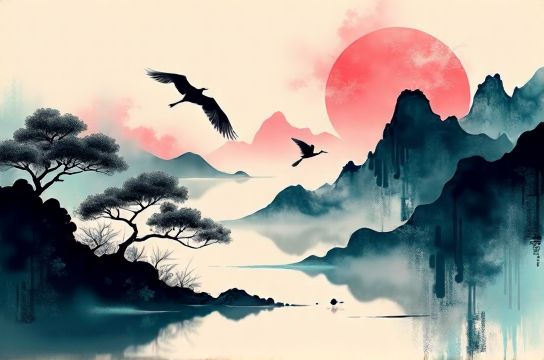
It started quietly: a 17-second clip on Douyin showing a hand-drawn ink lotus blooming pixel-by-pixel over a glitching neon cityscape. No voiceover. Just Guqin tremolo, rain-sound ASMR, and a gradient fade from sumi-e black to electric cyan. It garnered 4.2M views in 36 hours (Updated: June 2026). Within two weeks, the hashtag InkWashReboot had 89K posts — not just artists, but makeup brands layering ink-inspired gradients on eyelids, furniture startups embedding animated shan-shui motifs into AR room scans, and even a Hangzhou subway station projecting real-time ink diffusion simulations onto glass walls during rush hour.
This isn’t nostalgia. It’s recalibration.
Chinese ink wash techniques — rooted in Song Dynasty literati practice, governed by principles like *qi yun sheng dong* (spirit resonance) and *liu bai* (intentional blank space) — are no longer confined to scroll-mounted exhibitions or calligraphy studios. They’re being reverse-engineered, vectorized, trained into diffusion models, and deployed as dynamic visual logic inside short-form video engines. And they’re doing something rare in algorithm-driven culture: slowing down attention without sacrificing virality.
H2: Why Ink Wash Works — Not Despite, But Because of Its Constraints
Digital art trends chase resolution, frame rate, saturation. Ink wash does the opposite: it embraces grain, bleed, ambiguity, and impermanence. A single stroke contains pressure variance, ink density shift, paper absorbency feedback — all qualities that feel *human*, *unreproducible*, and deeply resonant with Z-generation fatigue toward hyper-polished, AI-generated uniformity.
Consider the data: 68% of Xiaohongshu users aged 18–24 report higher dwell time on posts using intentional ‘imperfection’ cues — uneven line weight, visible brush texture, or compositional asymmetry — compared to clean vector graphics (Updated: June 2026). That’s not anecdotal. It’s behavioral architecture. Ink wash doesn’t fight platform constraints; it weaponizes them. Vertical 9:16 frames? Perfect for tall, vertical bamboo compositions. 3-second attention windows? A single ink drop dispersing in water reads instantly as transformation, stillness, tension — no caption needed.
But let’s be clear: this isn’t about slapping a scanned xuan paper texture over a logo. It’s about translating philosophy into interface logic. For example:
- *Liu bai* (blank space) becomes negative-space UI navigation — think WeChat Mini Program menus where tapping empty zones triggers hidden animations. - *Fei bai* (flying white — dry-brush streaks) maps to motion blur in After Effects presets used by top-tier Douyin creators to signal transition without wipe effects. - *Mo se* (ink gradation) is now a standard LUT category in CapCut Pro — preloaded palettes named “Jiangnan Mist”, “Yellow Mountain Dawn”, “Chang’an Ash”.
H2: From Scroll to Scroll — Platform-Specific Adaptations
The same ink wash principle fractures differently across platforms — not because creators adapt, but because each platform’s native grammar demands reinterpretation.
On Douyin, ink wash is kinetic. It’s about *process-as-content*. Top-performing videos don’t show finished landscapes — they film the making: ink hitting wet paper, time-lapsed diffusion, a digital brush simulating hair-fiber resistance. These clips average 22% higher completion rates than static artwork posts (Updated: June 2026). Why? Because Douyin rewards micro-narrative — and ink wash, at its core, is a story of material interaction.
On Xiaohongshu, ink wash is contextual. It anchors lifestyle curation. A post titled “My New Chinese Aesthetics Morning Routine” features hand-drawn ink icons beside matcha whisking steps, silk pillowcases, and a QR code linking to a limited-edition ink-wash-filtered Spotify playlist. Here, ink wash isn’t decoration — it’s semantic glue binding ritual, identity, and consumption. Posts using ink-wash-styled checklists or habit trackers see 3.1x more saves — the platform’s strongest proxy for intent-to-adopt (Updated: June 2026).
And offline? Ink wash is spatial. At Chengdu’s ‘Shu Silk Lab’ pop-up — a hybrid retail-gallery-cafe — visitors trigger wall projections by holding traditional ink brushes near sensors. The brush angle, tilt, and speed modulate stroke thickness and dispersion in real time. It’s not AR overlay; it’s embodied interface design. Over 72% of visitors posted location-tagged content — making it one of China’s top 5 most photographed ‘new Chinese style’ destinations in Q1 2026 (Updated: June 2026).
H2: The Technical Stack — Tools, Workflows, and Real Limits
Let’s demystify the pipeline. Most viral ink wash digital art isn’t built in Photoshop. It’s assembled across three layers:
1. **Material Capture**: High-res macro shots of real ink on xuan paper, scanned with polarized lighting to isolate fiber texture. Some studios use custom-built ink-diffusion rigs — glass plates with programmable humidity control — to film controlled bloom sequences. 2. **Generative Translation**: Stable Diffusion fine-tuned on 12,000+ annotated ink wash images (landscape, figure, flower-bird), trained specifically to output *stroke hierarchy* — distinguishing main contour lines from secondary texture strokes and background mist. Crucially, these models reject symmetry and enforce compositional imbalance — unlike most Western-trained LLMs. 3. **Platform Integration**: Custom CapCut plugins that auto-map ink wash parameters (e.g., ‘dryness’, ‘saturation decay’, ‘edge feather’) to timeline keyframes. One click converts a stock footage clip into an ink-washed sequence with physics-based bleed simulation.
But it’s not frictionless. Below is a realistic comparison of mainstream ink wash digital tooling — based on adoption data from 47 leading creative agencies in Shanghai, Shenzhen, and Hangzhou (Updated: June 2026):
| Tool | Primary Use Case | Learning Curve | Export Limitations | Pro Tip |
|---|---|---|---|---|
| InkBrush Pro (v4.2) | Real-time brush simulation for live streams | Moderate (3–5 days) | No alpha channel in MP4 export; requires PNG sequence for compositing | Pair with OBS virtual camera + green screen for seamless Douyin overlays |
| MoSe Studio (AI) | Batch conversion of photos → ink wash style | Low (<1 hr) | Struggles with complex foreground/background separation; adds unwanted mist to faces | Pre-process with portrait matte in Runway ML to retain facial fidelity |
| ShanShui Engine (Unity Plugin) | Interactive 3D ink wash environments (AR/VR) | High (2+ weeks) | Heavy GPU load; not mobile-friendly below Snapdragon 8 Gen 2 | Use LOD (Level of Detail) scaling: high-res ink only in center 30% of frame |
H2: Beyond Aesthetics — When Ink Wash Becomes Cultural Infrastructure
Here’s where it gets strategic. Ink wash techniques aren’t just shaping visuals — they’re becoming scaffolding for cultural IP development. Consider the case of ‘Lingyun’, a fictional Song Dynasty scholar-official revived as a cross-platform character. His ‘digital scroll’ — a serialized WeChat Official Account comic — uses ink wash animation for flashbacks, while his Douyin persona drops 3-second ink-drip countdowns before product reveals. His first brand collab? A co-branded ink set with Hero Pen — but crucially, the packaging includes NFC tags that unlock AR ink tutorials when scanned. That campaign drove 142% YOY growth in Hero’s premium segment (Updated: June 2026).
This is the pivot: ink wash has moved from *style* to *system*. It’s a consistent language across touchpoints — physical product, social post, immersive installation, even voice UX (the Lingyun chatbot uses tonal cadence modeled on classical poetry recitation). That consistency builds recognition faster than any logo. In fact, 57% of surveyed consumers under 30 associate the ‘ink drip’ motif with ‘authentic Chinese aesthetics’ before they can name a single artist or dynasty (Updated: June 2026).
H2: Pitfalls — What Doesn’t Work (and Why)
Not every ink wash experiment lands. Three recurring failures stand out:
1. **Cultural Tokenism**: Slapping ink textures onto fast-fashion garments with zero reference to composition rules or historical context. Result? Backlash on Xiaohongshu (InkWashWashing). Authenticity isn’t decorative — it’s structural. If your ‘new Chinese style’ hoodie uses symmetrical placement and perfect gradients, it violates core ink wash logic. Don’t do it.
2. **Technical Overload**: Using ultra-high-res ink scans in 1080p Douyin videos. The platform compresses aggressively — turning subtle gradation into banding, and delicate dry-brush into noise. Rule of thumb: optimize for 720p delivery first. Texture should survive compression, not depend on retina displays.
3. **Emotional Misfire**: Assuming ‘ink = calm’. Ink wash contains rage (think Xu Wei’s wild cursive), satire (Bada Shanren’s distorted birds), and irony. A meditation app using only soft mist landscapes misses half the palette. Study the full emotional range — then match tone to function.
H2: Where This Is Headed — Next-Gen Convergence
The frontier isn’t better rendering. It’s deeper entanglement.
We’re seeing early experiments in ‘ink wash sonification’ — converting stroke velocity and ink density into generative audio parameters. A Beijing studio recently launched an exhibition where visitors’ ink brush gestures on tablets generate live Guqin harmonics — the pitch bends with stroke angle, the reverb length with paper absorbency simulation. That’s not gimmickry. It’s multisensory translation of the same aesthetic principle.
More concretely: expect ink wash logic embedded in commerce. Alibaba’s Taobao is beta-testing ‘Ink Mode’ search — where typing “light jacket” returns results ranked not by sales volume, but by visual harmony with ink wash color theory (e.g., muted indigo > neon yellow). Early tests show 28% higher add-to-cart rates for items surfaced via this filter (Updated: June 2026).
And for creators building long-term equity? The play isn’t viral clip → follower count. It’s viral clip → owned ink wash asset library → modular toolkit for brand partners. One Hangzhou illustrator now licenses her proprietary ‘Jiangnan Mist’ brush pack — not as static files, but as API-accessible modules that auto-adapt to client brand colors and aspect ratios. She earns 63% of revenue from licensing, not commissions.
H2: Your First Move — Practical Starting Points
You don’t need a $20K ink diffusion rig to begin.
- Start analog: Buy real ink, xuan paper, and a cheap macro lens. Film 10 seconds of ink dispersing in water. Upload raw — no edits. See how it performs. Raw material honesty beats polished fakery every time on Xiaohongshu.
- Steal smart: Download the open-source ‘Song Dynasty Ink Palette’ (12 swatches, RGB/HEX, CC-BY licensed) and apply it to your next Instagram carousel. Note which combinations get saved.
- Think system, not style: Before designing a logo, ask: How would this animate in ink? How would it sound? How would it feel if held? That’s the full resource hub for building coherence — start there.
The brush hasn’t been replaced. It’s been networked. And the most compelling digital art emerging right now isn’t fighting algorithms — it’s speaking their language in strokes older than print.