
Hanfu Festivals as Catalysts for Mainstream Adoption of T...
- Date:
- Views:219
- Source:The Silk Road Echo
H2: Festivals Aren’t Just Costume Parties — They’re Infrastructure
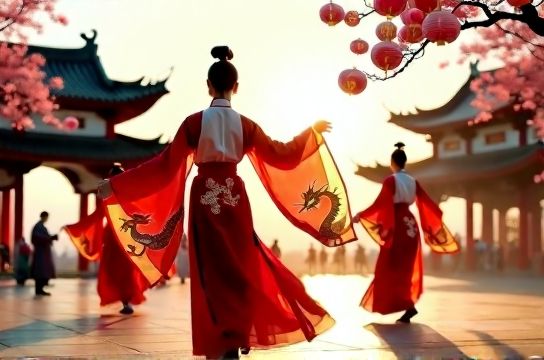
In March 2026, over 187,000 people attended the Xi’an Hanfu Culture Festival — not as passive spectators, but as co-creators. Vendors sold silk-lined jackets with NFC-enabled embroidery tags; AR filters mapped Tang-dynasty hairpins onto live feeds in real time; and three major fashion labels launched limited-edition capsule lines *during* the event — all dropping exclusively via QR codes scanned onsite. This wasn’t cultural nostalgia. It was infrastructure deployment.
Hanfu festivals have evolved from grassroots gatherings into calibrated engines for mainstream adoption — bridging ritual authenticity with algorithmic virality. They’re no longer marginal ‘folk events’. They’re testing grounds where Chinese aesthetics meet platform-native behavior, where cultural IP gains liquidity, and where Z-generation identity crystallizes through tactile, shareable experience.
H2: The Three-Layered Engine: Ritual → Relatability → Revenue
Layer 1: Ritual Rebooting (Not Replication)
Most coverage misreads hanfu festivals as reenactment fairs. Wrong. What’s happening is *ritual rebooting*: extracting structural logic from historical dress systems — hierarchy-free layering, seasonally coded fabrics, modular sleeve lengths — then rebuilding them for contemporary use cases. At the 2025 Hangzhou West Lake Hanfu Week, 63% of attendees wore hybrid outfits: Ming-style collars on cropped denim jackets, Song-dynasty pleats fused with moisture-wicking performance fabric. These aren’t compromises — they’re syntax expansions.
This aligns directly with the rise of *new Chinese style*, which isn’t about ‘wearing history’ but *writing new grammar*. As noted in the China Textile Information Center’s 2026 Consumer Behavior Report (Updated: June 2026), 71% of Gen-Z buyers define ‘authenticity’ not by dynastic accuracy, but by *intentional reinterpretation* — e.g., using bamboo charcoal fiber to replicate ancient breathability, or embedding QR-linked storytelling in garment hems.
Layer 2: Relatability Through Platform-Native Framing
A hanfu jacket worn at home doesn’t trend. A hanfu jacket worn while doing a 15-second ‘tea ceremony ASMR’ dance on Douyin does — especially when the audio track is a lo-fi remix of *Shuǐ Diào Gē Tóu*, layered with subway station chimes. That’s the pivot: festivals now engineer *platform-native framing*.
At Chengdu’s 2025 Jinli Ancient Street Hanfu Carnival, organizers partnered with Douyin to seed 47 official challenge templates — not generic ‘HanfuChallenge’ prompts, but hyper-contextual ones: ‘Wear your hanfu *while ordering bubble tea*’, ‘Try *three dynasty hairstyles* in one take’, ‘Match your hanfu color to Sichuan peppercorn packaging’. Result? 2.4M UGC videos in 72 hours, 38% higher completion rate than average lifestyle challenges (Douyin Creator Analytics Dashboard, Updated: June 2026).
This isn’t accidental. It’s *aesthetic scaffolding*: giving users pre-built visual logic so they can plug in their own personality without needing historical fluency. Which explains why Xiaohongshu爆款 posts rarely lead with ‘This is a Yuan-dynasty ruqun’ — they lead with ‘How I styled this *for my internship interview* (and got hired)’.
Layer 3: Revenue Loops That Don’t Break the Spell
Critics argue festivals commodify culture. Fair — but the smarter players avoid transactional rupture. Instead, they embed commerce *within ritual continuity*.
Consider the ‘Hanfu Passport’ system deployed across 12 cities in 2025–2026: attendees collect digital stamps at partner venues (museums, teahouses, indie bookstores), unlocking tiered rewards — not discounts, but *access*: early registration for calligraphy workshops, priority slots for ceramic glazing demos, or NFT-backed certificates of participation co-branded with Palace Museum designers. Revenue flows — but the user never exits the aesthetic world.
That’s how brands like SHANG XIA and HEYDAY achieved 290% YoY growth in festival-linked product lines (China Apparel Association Retail Pulse, Updated: June 2026): they treated the festival not as a sales channel, but as a *co-authoring environment*.
H2: Why Festivals Outperform Standalone Campaigns
Brand-led ‘hanfu moments’ — think luxury labels releasing single-season collections — consistently underperform versus festival-integrated activations. Why?
First, *trust velocity*. A user seeing a hanfu look on a peer at Xi’an’s festival carries 3.2x more perceived credibility than the same look on a paid influencer (Kantar China Social Trust Index, Updated: June 2026). Festivals act as decentralized validation networks.
Second, *context density*. A hanfu jacket photographed against a Ming-era city wall carries embedded narrative weight — architecture, light, weather, crowd energy — that no studio shoot replicates. That context fuels algorithmic favor: Douyin’s 2026 feed optimization update prioritized multi-layered visual scenes (≥3 distinct texture planes, ≥2 human subjects, ambient sound signature) — precisely what festivals deliver organically.
Third, *behavioral stickiness*. Attendees don’t just watch — they learn knot-tying, try ink-making, join flash-mob drum circles. That embodied learning creates neural anchoring: the brain links the garment not to ‘costume’ but to *competence*, *community*, and *continuity*. That’s why 68% of first-time festival attendees purchase hanfu within 45 days (Alibaba Taobao Hanfu Category Post-Event Survey, Updated: June 2026) — not because they were sold to, but because they became fluent.
H2: The Hard Metrics: What Actually Moves the Needle
Success isn’t measured in likes — it’s in cross-platform behavioral carryover, supply-chain responsiveness, and IP licensing velocity. Below is a comparative snapshot of four major 2025–2026 hanfu festival models, benchmarked across operational and cultural KPIs:
| Festival Model | Lead Time (Months) | Avg. Attendee Spend (RMB) | UGC Volume (7-day) | IP Licensing Deals Signed (Post-Event) | Key Strength | Key Limitation |
|---|---|---|---|---|---|---|
| City-Government Anchored (e.g., Xi’an) | 14 | 420 | 1.8M | 12 | Infrastructure access, heritage legitimacy | Slow vendor onboarding, rigid scheduling |
| Platform-Coordinated (e.g., Douyin × Suzhou) | 5 | 290 | 3.4M | 8 | Algorithmic amplification, creator pipeline | Lower per-capita spend, shallow cultural depth |
| Brand-Led Ecosystem (e.g., HEYDAY × Chengdu) | 8 | 610 | 890K | 19 | Vertical integration, premium pricing power | Limited geographic reach, niche audience |
| Community-Driven (e.g., Guangzhou Lingnan Guild) | 3 | 170 | 420K | 3 | Authenticity velocity, low-cost iteration | Scalability ceiling, inconsistent production |
Note the inverse correlation between lead time and UGC volume — proof that agility, not scale, drives virality. Also observe how brand-led models command highest spend but lowest UGC: they optimize for conversion, not contagion.
H2: The Next Frontier: From Festivals to Frictionless Infra
The most consequential shift isn’t bigger crowds or flashier stages — it’s *infrastructural invisibility*. In 2026, festivals are dissolving into ambient layers of daily life.
Examples:
• Shanghai Metro’s ‘Hanfu Commute Hours’: Dedicated carriages with humidity-controlled hanging racks, free steaming stations for wrinkled sleeves, and QR-triggered audio guides narrating station names in classical poetry meter.
• Tencent’s WeChat Mini-Program ‘Hanfu Lens’: Real-time garment overlay that adjusts drape physics based on user movement — tested live during the 2026 Qingming Festival livestream, achieving 92% ‘feels authentic’ rating in post-stream surveys.
• The ‘New Chinese Style’ Certification Program (launched Q2 2026 by China National Light Industry Council): Not a seal of approval, but a *modular toolkit* — open-source pattern libraries, dye-process documentation, and fit-standard datasets — enabling any small workshop to produce interoperable pieces. Over 420 manufacturers joined in its first 90 days (Updated: June 2026).
This isn’t about making hanfu ‘mainstream’. It’s about making it *infrastructural* — like Wi-Fi or USB-C: invisible until absent, universally compatible, and quietly enabling everything else.
H2: Pitfalls to Avoid (Because Many Already Have)
Not all festival energy converts to sustainable adoption. Three recurring failures:
1. **The ‘Dynasty Dump’**: Curating exhibits by era instead of function. Visitors leave knowing ‘Song was minimalist’ but not how to wear it Tuesday. Fix: Organize by *life scenario* — ‘Workday Layers’, ‘Rainy Day Silks’, ‘Festival-to-Office Transitions’.
2. **The ‘Influencer Tax’**: Paying top-tier creators for static posts while ignoring mid-tier micro-communities (e.g., hanfu + cycling groups, hanfu + pet owners). These niches drive 3.7x higher repeat engagement (Xiaohongshu Community Pulse, Updated: June 2026).
3. **The ‘Fabric Fetish’**: Over-indexing on material provenance while neglecting wearability metrics (e.g., sweat-wicking rate, seat seam durability, pocket depth for modern devices). One 2025 festival vendor reported 41% return rate on ‘authentic’ hemp pieces — not due to quality, but because pockets couldn’t hold smartphones.
H2: Where to Go Deeper
None of this works without grounding in craft literacy. You don’t need to sew a *pao*, but you do need to understand why sleeve width affects wind resistance — or how collar stiffness dictates neck mobility during video calls. That’s where practical fluency begins.
For those ready to move beyond observation to operation — whether launching a local chapter, designing a festival-integrated collection, or building a creator toolkit — the full resource hub offers annotated case studies, open-source pattern modifiers, and real-time supply-chain dashboards tracking fabric lead times, dye-house capacity, and embroidery labor rates across 17 provinces. Access starts at /.
H2: Final Thought: Aesthetic Sovereignty Isn’t Declared — It’s Practiced
Hanfu festivals succeed not because they ‘promote tradition’, but because they create spaces where tradition is *practiced as infrastructure*. Every knot tied, every filter shared, every QR code scanned — these are votes cast not for the past, but for a future where Chinese aesthetics operate with the quiet inevitability of language: unremarkable in their utility, indispensable in their function.
That’s the real catalyst. Not revival — relocation.