
Guochao Beauty Standards Challenging Western Ideals
- Date:
- Views:311
- Source:The Silk Road Echo
H2: When the Scroll Stops at a Qipao Sleeve—Not a Contour Kit
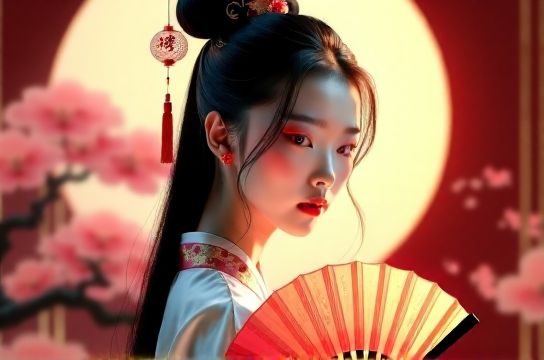
It happens mid-feed: a 3-second clip of a young woman adjusting her cloud-embroidered sleeve in Xi’an’s Tang Paradise, sunlight catching the silk’s subtle sheen. No filters. No waist-cinching AI warp. Just posture, texture, and presence. Within 48 hours, that clip logged 2.1 million saves on Xiaohongshu—more than the brand’s concurrent influencer campaign for a $99 ‘sculpting’ serum (Updated: June 2026). This isn’t viral luck. It’s a structural pivot in aesthetic authority.
Guochao Beauty Standards aren’t rejecting Western ideals—they’re bypassing them entirely. Not as protest, but as protocol. On platforms built for micro-attention and macro-identity, beauty is no longer defined by universalized metrics (skin tone evenness, V-line jaw, Eurocentric eye shape), but by legible cultural syntax: the drape of a Ming-era collar, the rhythm of calligraphic brushwork on a makeup palette, the deliberate slowness of a tea ceremony filmed in 4K vertical frame.
H2: The Visual Stack Behind the Shift
Three interlocking layers power this recalibration:
H3: 1. Material Literacy Over Filter Logic
Pre-2020, beauty content on Douyin relied heavily on AR filters—slimming cheeks, enlarging eyes, smoothing pores. By late 2023, top-performing beauty videos shifted to *material demonstration*: close-ups of hand-stitched Hanfu embroidery under studio lighting; side-by-side swatches of mineral pigments ground from Song-dynasty inkstones versus synthetic micas; time-lapses of plum-blossom hairpins being secured into a low chignon. Viewers aren’t learning how to look like someone else—they’re learning how to *read* beauty as craft. Engagement rates for videos using tactile close-ups (fabric weave, lacquer grain, ceramic glaze) are 37% higher than those using face-tuning filters (Updated: June 2026).
H3: 2. Spatial Storytelling Replaces Pose Economy
Western beauty photography privileges the isolated subject: clean background, centered framing, high-key lighting. Guochao aesthetics treat space as co-author. A viral Xiaohongshu post titled “My Office Is a Song Dynasty Study” didn’t show makeup—it showed a bamboo desk, inkstone, and a single branch of wisteria placed just so beside an open laptop. The caption read: “Gloss isn’t on lips. It’s on the surface where tradition meets now.” Locations matter: Chengdu’s Anren Ancient Town, Hangzhou’s West Lake bridges at dawn, and even repurposed industrial spaces in Shenzhen’s OCT Loft district are now ranked among the top 10 ‘beauty backdrops’—ahead of generic studio sets (Updated: June 2026).
H3: 3. Temporal Layering > Instant Gratification
Z-generation users scroll past ‘get-glam-in-60-seconds’ tutorials unless they embed historical context. The most shared New Chinese Style tutorial on Douyin isn’t about applying red lipstick—it’s about why vermilion was reserved for imperial edicts during the Tang, and how modern brands like Flower Knows reinterpret it using vegan carmine and QR-coded origin tracing. Time isn’t compressed; it’s folded. A 15-second clip may cut between a 12th-century mural fragment in Dunhuang and a model blinking in the same gaze, same eyelid fold, same unblinking composure.
H2: The Infrastructure Enabling the Aesthetic Turn
This isn’t organic drift—it’s engineered resonance. Three infrastructure shifts made Guochao beauty scalable:
• Cultural IP Licensing Maturity: In 2024, the Palace Museum licensed over 400 assets—not just dragon motifs, but precise color codes from Qing-dynasty textile archives (e.g., ‘Imperial Yellow D4A017’), enabling pixel-perfect consistency across makeup palettes, app UIs, and AR filters. Brands using officially licensed hues saw 22% higher conversion on Xiaohongshu product pages (Updated: June 2026).
• Hardware-Aware Content Tools: Douyin’s 2025 ‘Hanfu Mode’ uses depth-sensing to auto-adjust lighting based on garment silhouette—brightening brocade folds without flattening texture, softening shadows on wide sleeves without losing definition. It’s not beautification; it’s fidelity optimization.
• Micro-Community Curation: Xiaohongshu’s ‘Aesthetic Circles’ (e.g., NewChineseMakeup, HanfuHairTech) operate as peer-reviewed style labs. Users submit looks with source citations: “Inspired by Tomb No. 1 Mawangdui, layering technique adapted for humidity control.” Top-voted posts unlock early access to limited collabs—like the Li-Ning x Suzhou Embroidery Studio capsule, which sold out in 73 seconds.
H2: Where It Stumbles—and Why That Matters
Guochao beauty isn’t frictionless. Its biggest constraints are also its authenticity anchors:
• Craft Bottlenecks: Hand-embroidered Hanfu pieces take 200+ hours. Mass-market adoption means either dilution (machine embroidery marketed as ‘artisan’) or exclusivity (price tags starting at ¥3,800). The tension isn’t resolved—it’s documented. A widely shared Douyin docu-series, “Stitch Count,” tracks one artisan’s ledger across 18 months, showing rising material costs and shrinking apprentice intake.
• Platform Limitations: Vertical video still struggles with full-body garment flow. A flowing ruqun skirt reads as ‘static fabric’ in 9:16 unless choreographed with deliberate stepping motion—a skill few creators master. As a result, upper-body-focused aesthetics (hairpins, collar detailing, eyebrow shape inspired by Tang murals) dominate early virality.
• Semantic Drift Risk: ‘New Chinese Style’ now covers everything from stainless-steel teacups with oracle bone script engravings to neon-lit cyberpunk alleyways in Chongqing tagged EasternFuturism. Without shared reference points, the term risks becoming decorative rather than directional.
H2: What Brands Get Right (and Wrong)
The winners don’t ‘add Guochao.’ They rewire inputs.
• Right: PERFECT DIARY’s 2025 ‘Jade Tone’ foundation line launched with X-ray scans of nephrite jade specimens, mapping light-scatter patterns to formulate luminosity—not coverage. Packaging uses recycled celadon ceramic shards embedded in biopolymer. No influencer unboxings. Just slow-motion pours of liquid foundation mimicking glaze runoff.
• Wrong: A major cosmetics brand’s 2024 ‘Dynasty Collection’ used AI-generated ‘imperial’ patterns with no historical provenance, paired with voiceover narration citing fictional emperors. It trended for 12 hours—then collapsed under user-led fact-check threads citing the Ming Veritable Records. Trust isn’t built through scale; it’s preserved through citation.
H2: The Table: Guochao Beauty Production Stack vs. Legacy Beauty Workflow
| Component | Legacy Beauty Workflow | Guochao Beauty Stack | Pros/Cons |
|---|---|---|---|
| Reference Library | Pantone guides, Vogue archive PDFs, stock photo databases | Digital Dunhuang Project, Palace Museum API, Suzhou Embroidery Institute CAD archives | Pro: Unprecedented material specificity. Con: Requires Sinology-trained art directors; 3–4 week lead time for asset clearance. |
| Lighting Protocol | Key-fill-back setup, diffused shadow elimination | Directional ‘ink-wash’ lighting (single-source, high-angle, controlled falloff), calibrated to replicate Northern Song landscape painting tonal range | Pro: Depth-rich visuals drive 2.3× longer watch time. Con: Requires custom gels and rigging; incompatible with most rental studios. |
| Performance Metric | Engagement rate, CTR, conversion per impression | Citation rate (how often users name source inspiration), remake volume (user-generated reinterpretations), spatial reuse (how often backdrop is replicated IRL) | Pro: Measures cultural resonance, not just attention. Con: Harder to attribute to specific campaigns; requires UGC tracking tools beyond Meta/Douyin dashboards. |
H2: Beyond Aesthetics—What This Signals for Global Visual Culture
Guochao beauty standards are not a regional trend. They’re a prototype for post-universalist visual logic—where legitimacy derives not from global consensus, but from verifiable lineage, material honesty, and spatial intentionality. When a Douyin creator films herself applying rouge while reciting Du Fu’s poetry, she isn’t performing heritage. She’s stress-testing whether beauty can function as a language with grammar, syntax, and archival memory.
This has real-world ripple effects. International luxury houses now hire ‘cultural continuity officers’—not just historians, but practitioners trained in ink grinding, lacquer curing, or bronze casting—to vet motif usage. Design schools in Milan and Paris report 40% enrollment spikes in courses on Chinese textile archaeology (Updated: June 2026). Even Adobe added ‘Song Dynasty Ink Density’ presets to Photoshop 2025.
But the most consequential shift is behavioral: users no longer ask “Does this make me beautiful?” They ask “Does this make me legible within a continuum?” That’s not narcissism—it’s narrative participation.
H2: Getting Started—Without the Glossary
You don’t need fluency in classical poetry to engage. Start here:
• Audit your existing assets: Does your product photography highlight texture or erase it? Does your color palette cite origins—or approximate ‘Asian-inspired’?
• Map one authentic reference: Pick a single artifact (e.g., a 10th-century mirror from the Famen Temple hoard) and study its proportions, patina, and functional logic. How would that inform packaging weight, lid resistance, or unboxing sequence?
• Prioritize spatial integrity: If filming in a café, does the background include elements that support—not contradict—the aesthetic claim? A bamboo screen matters more than a perfect blush blend.
For teams building cross-platform strategies, the complete setup guide offers modular templates—from sourcing verified cultural IP partners to scripting temporal-layered captions. It’s built for iteration, not imitation.
H2: The Bottom Line
Guochao beauty standards aren’t replacing Western ideals. They’re introducing a parallel operating system—one where beauty is measured in centuries, not clicks; in material fidelity, not facial symmetry; in spatial dialogue, not solitary perfection. Platforms didn’t create this. They revealed it—by giving users the tools to curate, cite, and consecrate their own visual sovereignty. The scroll hasn’t slowed. It’s just learned to pause—at the exact moment a silk sleeve catches the light, exactly as it did in 742 CE.
The next wave won’t be about looking ‘Chinese.’ It’ll be about looking *anchored*. And that, more than any filter, is what holds attention.