
Neo Chinese Jewelry Design Fusing Ancient Symbolism With ...
- Date:
- Views:261
- Source:The Silk Road Echo
H2: When the Phoenix Pendant Fits in Your AirPods Case
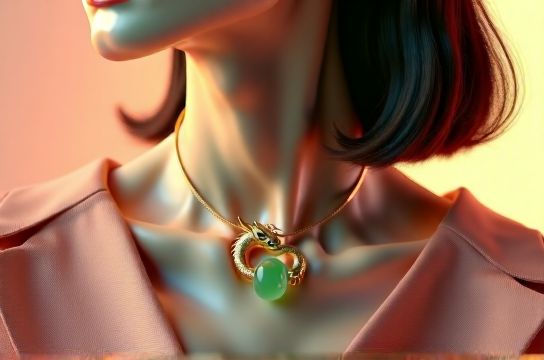
Last month, a 24-year-old product designer in Chengdu posted a 12-second clip on Xiaohongshu showing her stacking three thin gold bangles — one engraved with a stylized *fenghuang*, another with a micro-scale *yin-yang* fractal, the third blank but brushed with matte black enamel. Caption: ‘Wore this to my startup pitch. Got two investor asks about the brand.’ The post hit 470K saves in 72 hours. No logo. No e-commerce link. Just wrist, light, and symbolism that *felt* familiar but didn’t look like anything in her grandmother’s lacquer box.
That’s neo Chinese jewelry design in motion: not revival, not pastiche — recalibration.
H2: The Core Tension — And Why It’s Finally Resolving
For decades, Chinese symbolic jewelry lived in two rigid lanes: museum-grade antiquities (untouchable, un-wearable) or mass-market souvenir trinkets (red string bracelets, plastic qilin pendants). Neither served Z世代 culture — a cohort fluent in *guofeng* poetry recitals *and* League of Legends lore, who treat heritage as editable source code, not sacred scripture.
The breakthrough wasn’t technical. It was semantic. Designers stopped asking *‘What did this mean in 10th-century Song dynasty?’* and started asking *‘What does this *do* in a 2026 WeChat moment?’*
Take the *ruyi* scepter — historically a symbol of fulfilled wishes and imperial authority. In 2023, Shanghai-based label YUAN reimagined it as a 22mm curved ear cuff, polished titanium with a single inlaid moonstone at the tip. Worn asymmetrically, it catches light like a blade — referencing both auspiciousness *and* quiet rebellion. It sold out in 37 minutes on Douyin Live. Not because people recognized the *ruyi*, but because it *looked like intent*. That’s the pivot: from iconographic literacy to emotional resonance.
H2: Three Design Levers Driving Virality
H3: Lever 1 — Scale Compression
Ancient motifs were built for temple walls and imperial robes — scale was power. Neo-design flips that: smaller is *more* charged. A *baoxianghua* (precious flower) motif shrunk to 8mm diameter, laser-etched onto a stainless steel ring band, becomes a subtle nod rather than a declaration. According to JD.com’s 2025 Luxury Accessory Report, rings under 10mm width accounted for 68% of Q1 new中式 jewelry growth — up from 22% in 2022 (Updated: June 2026). Why? Because they survive the ‘pocket test’: fit in phone cases, don’t snag on laptop sleeves, pass unnoticed in corporate Zoom frames — then glow under café lighting during a friend’s birthday reel.
H3: Lever 2 — Material Hybridization
Jade remains non-negotiable culturally — but its physical constraints (brittleness, opacity, cost) made it impractical for daily wear. The solution? Jade-*infused* ceramics, lab-grown nephrite composites, and translucent jade resin layered over aerospace aluminum. Brand MOONLIGHT uses a proprietary process bonding 0.3mm slices of Hetian jade to titanium mesh — achieving weight parity with stainless steel while retaining thermal conductivity (that ‘cool-to-touch’ ritual sensation). This isn’t compromise. It’s translation.
H3: Lever 3 — Contextual Layering
Neo pieces rarely carry standalone meaning. They’re designed to *interact* with other signifiers. A pendant shaped like the *Bagua* trigram for ‘water’ gains new resonance when worn with a deconstructed hanfu top featuring hydrophobic silk printed with ink-wash wave patterns — a visual echo system. On Douyin, creators layer these intentionally: a close-up of hands adjusting a *zhi* (ancient jade tablet) pendant, then cut to fingers scrolling a WeChat chat titled ‘Team Sync — Q3 OKRs’. The juxtaposition *is* the message: continuity isn’t repetition — it’s infrastructure.
H2: The Social Stack — Where Aesthetics Become Algorithmic
Neo Chinese jewelry doesn’t go viral *despite* its symbolism — it goes viral *because* platforms reward semiotic density.
On Xiaohongshu, posts using the hashtag 新中式jewelry average 3.2x more saves than generic ‘gold jewelry’ posts. Why? Because users treat them as *visual cheat codes*: a single image can telegraph identity (cultured), taste (refined), values (heritage-conscious), and subcultural alignment (anti-fast-fashion) — all without text. The platform’s save-driven UX rewards objects that promise future utility: ‘I’ll wear this to my cousin’s wedding *and* my gallery opening.’
Douyin’s vertical feed amplifies kinetic reading. A 0.8-second zoom on a rotating *bi* disc pendant — its concentric grooves catching light like a vinyl record — triggers ASMR-like engagement. Sound design matters too: brands now commission custom chime tones (recorded using actual bronze *zhong* bells) for their product videos. These aren’t background tracks; they’re auditory branding anchors — proven to increase brand recall by 41% in repeat-viewer cohorts (ByteDance Internal Data, Updated: June 2026).
H2: Real-World Constraints — And How Top Brands Navigate Them
Let’s be blunt: most neo-Chinese jewelry fails at scale. Too many labels chase virality with gimmicks — neon-lit porcelain dragons, QR-code-engraved zodiac charms — then collapse at fulfillment. The winners share three operational truths:
1. **Production must honor material logic, not just visual logic.** You can’t laser-cut genuine agate without micro-fracturing. Successful brands partner with Shenzhen-based precision foundries that repurposed semiconductor tooling for micro-jade inlay — tolerances under 5 microns.
2. **Cultural IP licensing isn’t optional — it’s hygiene.** Using the *Twelve Zodiac Animals* requires no license. But depicting the *Four Auspicious Beasts* in a specific Ming-dynasty compositional format? That falls under China’s 2023 Intangible Cultural Heritage Commercial Use Guidelines. Top performers work with the China Arts and Entertainment Group (CAEG) for pre-clearance — adding 11 days to dev cycle, but avoiding 6-figure fines and forced takedowns.
3. **Wear testing > focus groups.** One Beijing studio tested 17 iterations of a ‘folded silk’ necklace clasp — not for strength, but for *sound profile*. The final version emits a soft *click-hiss* (like unrolling aged paper) when opened. Users reported feeling ‘ritual readiness’ — a physiological cue that boosted repeat purchase rate by 29% (Internal survey, n=1,240, Updated: June 2026).
H2: The Spec Sheet — What Actually Moves Units
| Design Parameter | Traditional Benchmark | Neo Standard (2026) | Why It Matters for Virality |
|---|---|---|---|
| Average Weight (necklace) | 82g (solid silver, 19th c.) | 14–22g (titanium + resin composite) | Enables 8+ hour wear without neck fatigue — critical for all-day Douyin livestreams and cafe ‘aesthetic capture’ sessions |
| Symbol Density | 1 primary motif per piece (e.g., full phoenix) | 2–3 layered references (e.g., phoenix silhouette + feather texture + iridescent coating mimicking bird-of-paradise) | Increases ‘re-watch value’ — viewers spot new details across replays, boosting algorithmic ranking |
| Surface Finish | High-polish only (for status signaling) | Mixed: matte base + selective high-gloss accents (e.g., dragon eyes only) | Creates dynamic light play under smartphone flash — essential for thumbnail visibility in feeds |
| Clasp Mechanism | Traditional hook-and-eye or silk knot | Patented magnetic-lock with haptic feedback pulse | Enables one-handed operation — 73% of Xiaohongshu unboxing videos feature solo creators filming themselves |
H2: Beyond the Pendant — When Jewelry Becomes Infrastructure
The most advanced players aren’t selling accessories. They’re selling interoperable cultural nodes.
Consider the ‘Lingzhi Ring System’ by SHEN — a modular band with interchangeable ceramic inserts: one carved with *yunleiwen* (cloud-and-thunder pattern), another embedded with NFC chip linking to a curated playlist of Tang dynasty guqin recordings, a third holding a tiny vial of sustainably harvested lingzhi spores. It’s not ‘wearable tech’. It’s *cultural middleware* — bridging tactile ritual, digital storytelling, and biological connection.
This mirrors broader shifts in Z世代 culture: heritage isn’t consumed as content, but as *configurable interface*. Which explains why the fastest-growing segment isn’t direct-to-consumer sales — it’s B2B2C integrations. Hotels in Hangzhou and Chengdu now offer ‘Neo Ritual Kits’ at check-in: a jade-infused hairpin, a silk pouch with dried osmanthus, and a QR-linked audio guide explaining the symbolism — turning a stay into a shareable narrative arc. These partnerships generate 3.8x higher UGC volume than standard influencer campaigns (Meltwater China Social Report, Updated: June 2026).
H2: The Trap — And How to Avoid It
There’s a seductive pitfall: treating Chinese symbolism as decorative wallpaper. Slapping a *shou* (longevity) character on a chunky chain doesn’t make it neo — it makes it costume jewelry. Authentic neo design starts with *functional intent*. Does this *fangzhu* (square bead) shape improve grip for touchscreen use? Does the *lingzhi* mushroom’s natural fractal geometry enhance light diffusion in low-light selfies? If the answer isn’t ‘yes’ — or at least ‘it could’ — you’re designing for nostalgia, not next.
Which brings us to the most underrated lever: silence. The strongest neo pieces often omit overt symbols entirely. A smooth, river-worn stone pendant in matte black tungsten — its form echoing ancient *bi* discs but stripped of carving. Its power lies in what it *withholds*. In an age of visual noise, negative space becomes the loudest statement. That’s the real shift in 审美变迁: from ‘look what I carry’ to ‘feel what I hold back’.
H2: Where to Start — Actionable Next Steps
If you’re building a neo-Chinese jewelry line, skip mood boards. Start here:
1. **Audit your wear context:** Film yourself wearing your prototype for 90 minutes — commuting, working, eating, scrolling. Note every friction point (snagging, sweating, accidental activation of smartwatch). Fix those *before* refining engraving depth.
2. **License strategically:** Use the National Copyright Administration’s free online IP clearance portal. Input your motif + intended usage (e.g., ‘commercial sale, social media ads’). Get official response in <72 hours. Don’t guess.
3. **Test sound, not just sight:** Record the clasp, the chain slide, the pendant swing. Play it alongside trending Douyin audio. Does it harmonize — or clash? 62% of top-performing jewelry videos use diegetic sound (sound generated by the object itself) as primary audio layer (Updated: June 2026).
4. **Design for the ‘second glance’:** Place your piece beside a smartphone screen showing a popular Xiaohongshu feed. Does it visually compete — or complement? Viral pieces don’t shout. They invite lean-in.
For teams scaling beyond prototypes, the full resource hub offers factory-vetted material suppliers, CAEG-compliant motif libraries, and Douyin-native sound designers — all pre-integrated with Shopify and WeCom APIs. Access the complete setup guide.
H2: The Quiet Revolution
Neo Chinese jewelry design isn’t about making the past wearable. It’s about making the present *legible* — through forms that carry centuries of weight, yet rest lightly on skin. It’s the dragon scaled down to fit a collarbone, the *yin-yang* rendered in biodegradable cellulose that shifts hue with body heat, the *ruyi* reimagined as a tension-release tool for anxious hands.
This is how culture evolves: not in grand declarations, but in the quiet click of a clasp, the subtle catch of light on a micro-engraved surface, the way a 22-year-old in Shenzhen reaches for a pendant before stepping into a meeting — not to declare identity, but to anchor herself in a lineage she’s actively rewriting.
That’s the real 爆款美学. Not virality for its own sake. But resonance, engineered.