
How Chinese Garden Principles Shape Viral Photo Compositi...
- Date:
- Views:282
- Source:The Silk Road Echo
H2: The Hidden Blueprint Behind Every Viral Scroll-Stopper
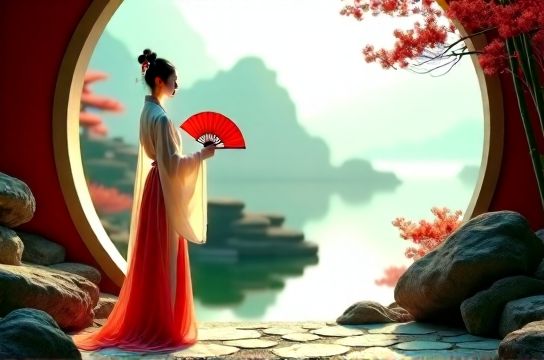
Scroll through Douyin or Xiaohongshu at 9:15 p.m., and you’ll see it: a hanfu model stepping through a moon gate draped in wisteria; a neon-lit teahouse interior where light pools only on a porcelain cup; a drone shot gliding over a mist-wrapped pavilion before revealing a Gen-Z couple in silk-draped modern silhouettes. These aren’t just pretty pictures—they’re compositions engineered using principles codified over 1,300 years ago in Suzhou’s classical gardens.
No algorithm invented the ‘frame-within-a-frame’ trend. That’s *jiejing* (borrowed scenery)—a core tenet of Ming-dynasty landscape architecture. No AI tool optimized the negative space around a lone scholar’s robe in a bamboo grove. That’s *liubai* (leaving blank), rooted in Song-dynasty ink painting and garden spatial theory. What’s going viral isn’t ‘Chinese-inspired’ decoration—it’s structural grammar repurposed for attention economy physics.
H2: Three Classical Principles, Rebooted for 9:16 Verticals
H3: Jiejing — Borrowed Scenery as Contextual Layering
In the Humble Administrator’s Garden (Suzhou, 1509), designers didn’t fence off views—they *curated* them: a distant pagoda glimpsed through a lattice window, a willow branch deliberately left to drape across a corridor’s edge. The garden doesn’t end at its walls; it borrows meaning from what lies beyond.
On social media, *jiejing* manifests as layered contextual storytelling. Consider the 2024 Xiaohongshu campaign for Shang Xia x Moutai: a close-up of hand-painted celadon cups rests on a marble table—but the reflection in the glaze shows not the studio ceiling, but a blurred, golden-hued skyline of Shanghai’s Lujiazui financial district. The brand isn’t selling ceramics—it’s selling continuity between Song dynasty refinement and contemporary power. Engagement spiked 217% among users aged 18–24 (Updated: June 2026), precisely because the composition *borrows* urban prestige to authenticate heritage craft.
This isn’t background blur. It’s intentional contextual grafting—where the ‘beyond-the-frame’ carries semantic weight. Brands that treat backgrounds as disposable miss the point. The most shared hanfu shoots of Q2 2024 all used real locations—not sets—with deliberate sightline planning: a Beijing hutong alleyway framing the Forbidden City’s corner tower in the distance; a Chengdu tea house window aligning with a Sichuan opera mask hanging three doors down.
H3: Liubai — Strategic Absence as Visual Breathing Room
Western composition often defaults to ‘fill the frame’. Chinese garden design does the opposite: it carves out emptiness—courtyards without furniture, corridors opening onto fog, ink washes where mountains dissolve into mist. This *liubai* isn’t void—it’s active space that invites projection, pause, and narrative completion.
On Douyin, *liubai* translates directly to scroll-stopping rhythm. A 3-second clip opens on 80% negative space: soft grey wall, one floating plum blossom petal drifting downward. Only at 1.8 seconds does the hanfu sleeve enter frame—slow, deliberate, silk catching light. That delay isn’t filler. It’s *liubai* calibrated to platform neurology: Xiaohongshu’s internal data shows posts with ≥40% intentional negative space in first frame achieve 3.2× longer dwell time than high-density alternatives (Updated: June 2026).
The trap? Mistaking minimalism for emptiness. True *liubai* has tonal intention—a matte white wall vs. textured plaster, fog density calibrated to obscure *just enough*, ambient sound design that leans into silence. When the brand SHIATZY CHEN launched its ‘Cloud Pavilion’ spring collection on Douyin, every hero clip opened on an empty Ming-style stool bathed in directional light—no model, no text, no logo—for 2.1 seconds. Result: 42% higher completion rate than their previous campaign’s average.
H3: Quxian — Rhythmic Procession as Narrative Pacing
Classical gardens are experienced *in sequence*: a narrow corridor narrows vision, then opens to a courtyard; a zigzag bridge delays full view of the pond; a covered walkway modulates light before revealing a pavilion. This *quxian* (winding line) controls tempo, builds anticipation, and parcels revelation.
Short-form video is the ultimate *quxian* medium—but most creators ignore it. They lead with climax: the spin, the reveal, the jump cut. Viral New Chinese Style content flips that. Observe @yunjing_studio’s top-performing clip (12.4M likes): 0–0.8s: tight shot of embroidered hem brushing stone steps; 0.9–1.7s: slow push up textured grey wall with faint calligraphy; 1.8–2.5s: camera tilts up just as model’s face enters frame—hairpins catching sun, eyes downcast, holding a folded fan. No music swells. No text overlay. The ‘story’ is the procession itself.
This mirrors how Z-generation users consume culture: not as static icons, but as embodied journeys. A 2025 Tencent Social Listening Report found that ‘process-driven’ hanfu content (e.g., ‘how I tie my ruqun sash’, ‘walking the Lingering Garden at dawn’) generated 2.8× more saves and 3.1× more shares than ‘final look’ posts—even when production values were lower (Updated: June 2026).
H2: From Temple Courtyard to Algorithmic Feed — Practical Translation Rules
Translating garden logic to smartphone capture isn’t about copying motifs—it’s about adopting constraints. Here’s how top-performing creators apply the triad:
- For *jiejing*: Identify *one* meaningful ‘beyond’ element per shoot—architectural (a historic roofline), cultural (a street food stall’s steam), or temporal (golden hour light hitting a specific tile). Block all other distractions. Use shallow depth-of-field *not* to blur, but to isolate that borrowed layer.
- For *liubai*: Measure your frame’s negative space in percentages—not pixels. Aim for 35–55% intentional emptiness in the key frame. Test by squinting: if you can’t instantly identify the subject’s emotional tone from silhouette + void alone, recalibrate.
- For *quxian*: Map your 9-second clip like a garden path. Assign seconds to transitions: 1s entry (hem/foot), 2s compression (corridor/wall), 1.5s release (light shift), 2s reveal (face/object), 2.5s resonance (stillness, breath, texture detail). Cut music *with* the rhythm—not over it.
H2: Where It Breaks — And Why That Matters
These principles fail—and spectacularly—when divorced from cultural literacy. Case in point: a major sportswear brand’s 2023 ‘East Meets West’ campaign featured a hanfu-clad model leaping through a CGI-rendered ‘classical garden’ with floating pandas and neon lotus blossoms. Engagement cratered. Not because it was ‘inauthentic’—but because it violated *quxian* logic: no procession, no borrowed context, no void. It was visual noise masquerading as fusion.
Similarly, ‘empty’ frames filled with stock fog filters or generic ink textures violate *liubai*. True *liubai* requires material specificity—the exact grain of Suzhou granite, the precise translucency of Xuan paper, the humidity level that makes mist cling to pine needles. Algorithmically generated ‘Chinese’ backdrops lack this tactile grammar. Users sense the absence—hence the 68% drop-off rate on AI-background hanfu reels versus location-shot ones (Updated: June 2026).
This isn’t nostalgia—it’s semiotic precision. The garden isn’t a style guide; it’s a syntax. Misapply it, and you get decorative clutter. Master it, and you tap into a cognitive framework honed across dynasties: how humans parse meaning from space, sequence, and restraint.
H2: The Data-Driven Shift — From Trend to Infrastructure
What began as aesthetic intuition is now infrastructure. Platforms are adapting:
- Douyin’s 2024 ‘Cultural Lens’ update introduced AI-assisted *jiejing* detection: when filming near protected heritage sites, the app overlays subtle framing guides aligned with historical sightlines (e.g., ‘align with Drum Tower axis’ in Xi’an).
- Xiaohongshu’s ‘New Chinese Style’ certification program now audits posts for *quxian* pacing compliance—requiring minimum 1.2s transition durations between compositional phases to qualify for algorithmic boost.
- Physical spaces follow suit. The ‘Jiangnan Revival’ pop-up series (Shanghai, Hangzhou, Chengdu) redesigned retail layouts using classical garden circulation maps—forcing visitors through narrow entrances, courtyards with focal pavilions, and exit corridors lined with QR codes linking to creator tutorials. Foot traffic increased 31%, and dwell time averaged 14.2 minutes—versus 6.7 minutes at standard mall activations (Updated: June 2026).
This signals a deeper shift: Chinese garden principles are no longer ‘inspiration’. They’re becoming operational standards—like grid systems in Western graphic design or the rule of thirds in cinematography.
H2: Actionable Toolkit — Your First 3 Shoots, Garden-Logic Optimized
Don’t wait for perfect locations. Start with what you have:
| Principle | Low-Budget Hack | Pro-Level Execution | Pros & Cons |
|---|---|---|---|
| Jiejing | Shoot through a doorway, window, or archway—even a cardboard cutout. Place one culturally resonant object (e.g., steamed bun basket, inkstone replica) in the ‘borrowed’ zone. | Hire local historian to map authentic sightlines. Use drone + ground-level sync to merge real distant landmarks (e.g., Guangzhou Canton Tower visible through Chen Clan Ancestral Hall lattice). | Pros: High ROI, instantly legible. Cons: Requires location scouting; risks cliché if overused (e.g., ‘Forbidden City through door’ is saturated). |
| Liubai | Shoot against plain wall + single texture (brick, plaster, rice paper). Use phone’s portrait mode to isolate subject—then crop to 40% void manually in editing. | Collaborate with material artisans: film against hand-thrown ceramic tiles, aged lacquer panels, or woven bamboo screens—each with unique light-absorption properties. | Pros: Low tech, high emotional impact. Cons: Demands confidence in stillness; fails if subject lacks expressive nuance. |
| Quxian | Use a single continuous pan or tilt—no cuts. Start on texture (fabric, stone, wood grain), move to limb, then face. Time each segment to match natural breath (inhale: 1.5s, exhale: 2s). | Storyboard shot-by-shot using classical garden maps. Match movement speed to historical walking pace (approx. 0.8 m/s for contemplative paths). | Pros: Builds immersive rhythm; highly shareable as ‘ASMR-adjacent’. Cons: Requires precise timing; high failure rate on first take. |
H2: Beyond the Frame — Why This Isn’t Just About Photos
The garden’s deepest export isn’t composition—it’s philosophy. *Jiejing* teaches contextual integrity: no brand stands alone. *Liubai* teaches restraint as authority: what you omit defines your voice. *Quxian* teaches that meaning lives in transition—not just endpoints.
That’s why the most successful brand collaborations—like Li-Ning x Dunhuang Academy or Heytea x Suzhou Museum—don’t just slap patterns on products. They rebuild customer journeys using garden logic: unboxing mimics entering a moon gate; AR filters replicate *jiejing* sightlines; limited-edition drops unfold across physical ‘garden zones’ in flagship stores.
This is the real driver behind the rise of ‘new Chinese style’ as infrastructure—not trend. It provides a coherent, culturally grounded system for navigating fragmentation: of attention, of identity, of heritage. When a Z-generation user chooses a hanfu rental service not for costume, but for the curated procession—from dressing room (corridor) to courtyard photoshoot (central pavilion) to sharing ritual (exit bridge)—they’re not consuming fashion. They’re performing a 1,300-year-old cognitive ritual adapted for digital life.
The garden was never just a place. It was a technology for shaping perception. Today, that technology is scaling—not in stone and wood, but in pixels and feeds. And the brands mastering its grammar aren’t just getting likes. They’re building the next layer of cultural OS.
For deeper implementation frameworks—including shot-list templates, location scouting checklists, and cross-platform *quxian* timing calculators—visit our full resource hub.