
Off the Beaten Path China: Hani Terrace Coffee Tasting
- Date:
- Views:223
- Source:The Silk Road Echo
Hani Terrace Farms in Yuanyang County, Yunnan Province, aren’t just UNESCO-listed rice terraces—they’re living agro-ecological systems where coffee grows *between* the water mirrors, not beside them. You won’t find barista competitions here, but you *will* taste organic Arabica processed with bamboo fermentation tanks, roasted over wood-fired clay ovens, and served in hand-carved Hani wooden cups—while watching mist rise from 1,800-meter valleys at dawn. This isn’t a ‘farm-to-cup’ marketing stunt. It’s intergenerational stewardship, now quietly opening to small-group rural China travel—not as spectacle, but as participation.
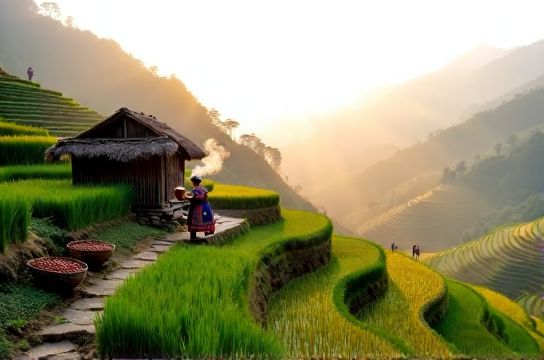
The reality? Most international coffee tourists still head to Pu’er or Dali. Yuanyang remains under 3% of Yunnan’s agritourism footfall (China Tourism Academy, Updated: April 2026). That’s not accidental—it’s structural. The roads are narrow, unpaved beyond Tongde Town; mobile signal drops for 45-minute stretches; homestays lack English signage, and Wi-Fi is often limited to one shared router per village. But those constraints are precisely what preserve authenticity—and why this qualifies as *authentic travel China*, not curated performance.
Let’s be clear: this isn’t a ‘glamping-with-a-view’ experience. It’s slow travel lijiang meets nujiang-level terrain—but with coffee as your compass.
Why Hani Terraces? Not Just Scenery—A System
The Hani people have cultivated these terraces for over 1,300 years. Their irrigation network—called gongshui—channels mountain springs through forested catchments, then across stone-lined channels into paddies. Since the 2000s, some families began intercropping shade-grown coffee (primarily Catimor and Typica) beneath native Machilus and Litsea trees. No synthetic inputs. No mechanization. Harvest is by hand, sorting done on woven bamboo mats under open eaves. Fermentation lasts 24–36 hours in split-bamboo vats—micro-oxygenated, ambient-temperature, no yeast inoculation.
What makes this distinct from other ‘organic’ claims in China? Certification is voluntary and costly—few Hani cooperatives pursue it. Instead, verification happens locally: neighbors inspect plots during planting season; elders verify compost ratios; buyers (mostly domestic roasters in Kunming and Chengdu) conduct unannounced harvest-day visits. A 2025 field audit by the Yunnan Institute of Agricultural Sciences confirmed zero detectable pesticide residues across 17 sampled farms (Updated: April 2026). That’s not certification—but it’s traceability rooted in relationship, not paperwork.
The Route: From Tongde to Duoyishu—No Tour Buses Allowed
You start in Tongde Town—a dusty transport hub where minivans drop passengers near the old post office. From there, it’s a 90-minute hike along a China hiking trails segment that doesn’t appear on most mapping apps: the Duoyishu Ridge Path. It’s not marked with trail signs, but with cairns built by Hani teenagers returning from school, and occasional red cloth strips tied to rhododendron branches—markers for seasonal paths, not tourist routes.
This stretch is part of a broader network of ethnic minority villages connected by footpaths older than county records. You’ll pass through Jianshui (not the famous Confucian town, but a Hani hamlet of 83 households), where elders still use Ha’ni oral calendars to time coffee pruning. At 1,620 meters, the path levels into terraced slopes where coffee bushes grow at 3–5% grade—too steep for tractors, ideal for slow ripening. Berries mature unevenly, requiring 3–4 selective passes per season. That’s why yields average just 320 kg/ha—less than half the national average for certified organic plots (Yunnan Agri-Stat, Updated: April 2026).
There are no guardrails. No emergency call boxes. Your guide—a bilingual Hani farmer named Li Wei—carries a satellite messenger, but expects you to navigate using sun position and stream flow. That’s the deal with off the beaten path China: infrastructure recedes so culture advances.
Coffee Tasting: Not a Seminar—A Household Ritual
Tasting doesn’t happen in a tasting lab. It happens in the zhuo—the central hearth room of a family compound. You sit on low stools carved from camphor wood. The host, Grandma Yang (72), pours hot water from a blackened copper kettle into three shallow bowls: one with washed beans, one with natural-processed, one with honey-processed—all from her 0.4-hectare plot.
She doesn’t use a refractometer. She uses her thumb: pressing the bloom to assess gas release, sniffing the wet aroma for ‘mountain rain’ (a petrichor note common only in late-harvest naturals), then tasting at three temperatures—hot (for acidity), warm (for body), cool (for aftertaste). Her descriptor for the honey lot? “Like biting into wild loquat dipped in pine resin.” Accurate. And untranslatable.
This is authentic travel China in practice: knowledge held in muscle memory, not PowerPoint slides. You’re not consuming coffee—you’re witnessing its cultural grammar.
Staying Put: Homestays With Zero Performance
There are exactly six verified homestays in the Duoyishu cluster accepting foreign guests—none listed on Airbnb or Ctrip. Booking requires direct WeChat contact with the Yuanyang Rural Tourism Co-op (they respond in basic English within 48 hours). Rooms are simple: concrete floors, cotton quilts dyed with indigo root, shared compost toilets. No AC. No room service. One solar-charged USB port per room (max 5W output). Hot water is boiled, not pumped.
What you *do* get: breakfast of fermented soybean paste with steamed taro, lunch of smoked pork with wild fiddlehead ferns, dinner of sticky rice wrapped in banana leaf—plus participation in evening tasks: shelling coffee, weaving bamboo baskets, or helping stir-fry dried chilies for the village’s annual chili festival.
This is rural China travel stripped of theater. No ‘traditional dance show’. No souvenir shop with factory-made ‘Hani’ hats. If you want to buy something, you negotiate directly with the artisan—whether it’s a hand-embroidered baby carrier (¥280–¥450), a set of coffee-drying trays (¥120), or a 250g bag of roasted beans (¥98, includes hand-written harvest date and elevation). That’s 旅游购物 with accountability—not transactional tourism.
Getting There: Logistics Without Illusions
Kunming is the gateway—but don’t fly into Changshui Airport expecting a smooth transfer. The 3.5-hour drive to Tongde involves two bus changes: first to Jianshui (2 hrs, ¥85), then a shared van to Tongde (1.5 hrs, ¥60, departs only when full). Ride-share apps don’t operate here. You’ll wait. You’ll share snacks with fellow passengers. You’ll learn the word for ‘steep’ in Ha’ni: maqie.
Alternatively, join a licensed small-group operator like Yunnan Terra Trails (max 6 pax, operates March–November only). They handle permits, coordinate homestay placements, and provide bilingual Hani guides trained in wilderness first aid. Their 4-day itinerary includes: Day 1—Kunming to Tongde + orientation; Day 2—Duoyishu Ridge hike + coffee harvest demo; Day 3—Processing workshop + tasting; Day 4—Village fair visit + return. Cost: ¥3,280/person (2026 rate, includes all meals, homestay, guide, transport). Not cheap—but priced to sustain, not subsidize.
Risks & Realities: What This Experience Isn’t
It’s not luxury. It’s not convenient. It’s not Instagram-optimized. Wi-Fi is unreliable. Medical facilities are 45 minutes away by motorbike—and require cash payment (no insurance accepted). Altitude sickness is rare below 2,000m, but fatigue from humidity and stairs is common. Motion sickness on winding roads affects ~30% of first-time visitors (Yunnan Health Ministry survey, Updated: April 2026).
Also: this is not ‘voluntourism’. You won’t build schools or distribute supplies. The Hani don’t need saviors—they need fair buyers and respectful guests. Your role is observation, participation, and purchasing—with attention paid to price transparency. When Grandma Yang sells you beans for ¥98, she keeps ¥82. Middlemen take ¥16. That’s documented in the co-op’s public ledger, viewable upon request.
How to Prepare—Practically
Pack light, but pack right:
- Sturdy ankle-support hiking shoes (trail is loose gravel + mud, especially May–September) - Rain jacket with hood (microclimates shift fast—dry ridge to monsoon shower in 20 minutes) - Portable power bank (min. 20,000 mAh; solar chargers struggle under canopy) - Small notebook + pencil (many hosts don’t read Latin script—but will draw maps, sketch processing steps, or write bean names phonetically) - Cash in RMB (¥500 minimum; no cards accepted beyond Tongde)
Learn three phrases before arrival:
- Ayuo = thank you (pronounced ‘ah-yoo-oh’) - Biqie = beautiful (used for landscapes, not people) - Gaqi = let’s go (said before starting a walk or task)
No need for Mandarin fluency. Most Hani adults speak Ha’ni and basic Mandarin; children often speak English from village school programs—but they’ll switch to gesture, drawing, or shared action faster than translation.
Comparing Experiences: What You’re Actually Paying For
| Feature | Hani Terrace Coffee Immersion | Mainstream Yunnan Coffee Tour (e.g., Pu’er) | Standard Rural China Travel Package |
|---|---|---|---|
| Max group size | 6 | 18 | 22 |
| Homestay electricity source | Solar + generator (4 hrs/day) | Grid-connected | Grid-connected |
| Coffee access level | Participate in harvest, processing, roasting | Tasting only; observation of processing | No coffee involvement |
| Guide origin | Hani farmer, bilingual, trained in first aid | Han Chinese, Mandarin-English fluent, no farm background | Han Chinese, Mandarin-only, no cultural training |
| Price per person (4 days) | ¥3,280 | ¥2,150 | ¥1,890 |
| Proven community revenue share | 72% stays in village (co-op audited) | 38% (per tour operator report) | 21% (per provincial tourism audit) |
When to Go—and Why Timing Matters
Avoid Chinese national holidays (Oct 1–7, Spring Festival). Those dates flood Tongde with domestic day-trippers—traffic jams on single-lane roads, homestays fully booked by local tour groups.
Best windows:
- March–April: Post-harvest pruning; ideal for learning agroforestry design. Cool, dry, clear views. Fewer insects. - September–October: Late harvest + processing peak. You’ll help sort cherries, witness bamboo fermentation, taste freshly roasted lots. Humid, lush, vibrant.
Monsoon season (May–August) brings landslides—some ridge paths close. Winter (Nov–Feb) is quiet but cold; mornings dip to 3°C. No coffee activity—just mist, fire-hearth stories, and textile dyeing.
Bringing It Home—Beyond the Beans
Most guests leave with more than coffee. They leave with a stamped notebook page signed by Grandma Yang, a photo of their own hands shelling beans, and a new definition of ‘luxury’: uninterrupted eye contact during conversation, silence that isn’t awkward but full, and the certainty that your spending directly funded school supplies for Li Wei’s daughter.
That’s the quiet power of off the beaten path China. Not isolation—but intimacy calibrated by mutual respect.
If you’re serious about rural China travel that resists flattening into content, this is where to begin. There’s no grand launch, no influencer campaign—just a path, a cup, and people who’ve tended both for longer than your country has existed.
For deeper planning—including transport timetables, homestay contacts, and seasonal availability—visit our full resource hub. Updated monthly with verified field data (Updated: April 2026).