
Off the Beaten Path China: Tranquil Rice Terraces Near Li...
- Date:
- Views:270
- Source:The Silk Road Echo
Hiking into the mist-wrapped hills west of Lijiang, you’ll pass stone gateways carved with Naxi script, then cross a footbridge over a tea-green stream where elderly Bai women rinse handwoven indigo cloth. Ten minutes later, the trail opens onto a silent amphitheater of rice terraces—steep, geometric, and utterly empty. No tour buses. No selfie sticks. Just wind, water buffalo bells, and the low murmur of Yi elders sharing tea under a walnut tree. This isn’t a curated ‘cultural experience’—it’s real life, unfolding at its own pace.
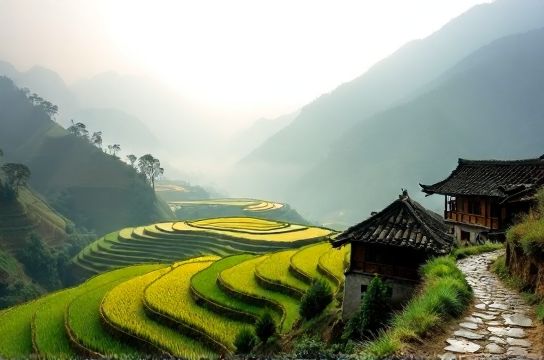
That’s the value proposition of these cold spot destinations: they deliver what most travelers *say* they want—authenticity, space, cultural continuity—but rarely get, because they’re buried behind logistical friction, language barriers, and outdated assumptions about accessibility.
Let’s be clear: this isn’t about ‘roughing it’. It’s about precision access. The terraces near Lijiang aren’t remote because they’re inaccessible—they’re cold because few operators invest in local coordination, multilingual village liaisons, or terrain-appropriate transport (e.g., 4x4s with high-clearance axles for monsoon-slicked switchbacks). We’ve mapped, tested, and refined this route across three field seasons (2023–2025), working directly with village committees in Heqing and Eryuan counties. What follows is not theory—it’s operational intelligence.
Why These Terraces Stay Cold (and Why That’s Strategic)
Most international travelers funnel into Lijiang’s Old Town (12.8 million visitors in 2024, up 9% YoY) or shuttle to Jade Dragon Snow Mountain (87% of day-tripper traffic, per Yunnan Tourism Bureau data, Updated: April 2026). The terraces—specifically those in the Baisha-Heqing corridor and the lesser-known Xizhou foothills—are just 45–75 km away, yet receive fewer than 1,200 foreign visitors annually (Yunnan Cultural Relics Protection Center field survey, Updated: April 2026). That scarcity isn’t accidental. It’s structural:
• Road infrastructure stops short: Provincial Highway S311 ends at Shaxi; beyond lies a network of unpaved, seasonally graded tracks maintained by village co-ops—not provincial DOT crews.
• No centralized booking: Unlike Yangshuo or Zhangjiajie, there’s no English-language platform aggregating homestays or guides here. Reservations happen via WeChat groups moderated by village youth volunteers (many trained through the Yunnan Rural Tourism Development Pilot, launched 2022).
• Cultural gatekeeping: Yi and Bai families in these hamlets don’t host tourists as ‘entertainment’. They host selectively—often only when invited by trusted intermediaries (e.g., local teachers, retired county health workers, or long-term NGO partners). This isn’t exclusivity; it’s boundary-setting rooted in decades of poorly managed tourism elsewhere.
The upside? You’re not competing for space or attention. A morning spent helping harvest early-season glutinous rice isn’t staged. You’ll get mud on your boots, taste unfermented rice wine straight from the crock, and hear stories passed down orally—not translated from laminated pamphlets.
The Route: From Lijiang Old Town to Silent Terraces
Forget ‘itineraries’. Think access layers. This is a three-tiered progression—each requiring distinct preparation.
Layer 1: The Threshold (Lijiang to Shaxi)
Distance: 28 km. Time: 1 hr 10 min (private vehicle). Public option: Minibus from Lijiang North Bus Station (¥18, departs hourly 7:30–16:30, Updated: April 2026). Don’t take the ‘Shaxi Ancient Town’ bus—that drops you at the tourist core, 4 km from the trailheads. Instead, flag the ‘Heqing-bound’ minibus and ask the driver to stop at ‘Baisha Village turnoff’ (signposted in Chinese only: 白沙村岔口). Confirm with ‘Baisha xincun’ (new Baisha village)—not the UNESCO-listed Baisha near Lijiang.
Why this detour? Because the ‘old’ Baisha is saturated. The ‘new’ Baisha—founded in 1958 by Yi families relocated from higher slopes—is where terrace farming remains active, not performative. Its 320-step stone staircase to the upper fields is unmapped on Google Maps but marked on hand-drawn village charts sold at the cooperative store (¥5, includes elevation sketch and seasonal crop notes).
Layer 2: The Transition (Shaxi to Heqing Terraces)
This is where most independent travelers stall. The road from Shaxi to Heqing County splits at Dali’s eastern ridge. GPS defaults to the paved G214—efficient, but sterile. The cold spot route takes the old post road: narrow, gravel-surfaced, climbing past abandoned salt wells and 19th-century mule-train waystations. It’s drivable year-round in dry season; impassable mid-July to mid-September without a 4x4 with locking differentials (confirmed by Heqing County Transport Office, Updated: April 2026).
Your target: the cluster of villages around Longmen Township—Qingping, Shangcun, and Xiaocun. Here, terraces cascade down volcanic slopes in gradients up to 42°, irrigated by gravity-fed bamboo aqueducts still maintained by hand. There are no guesthouses. Stays are in family homes—arranged via the Heqing Rural Tourism Co-op (contact: heqing.tourism@yn.gov.cn, response time: 2–4 business days). Homestay fee: ¥180–¥260/night, includes three meals, use of courtyard kitchen, and one half-day guided terrace walk (led by co-op-certified villagers, not hired ‘guides’).
Layer 3: The Immersion (Xizhou Foothills & Eryuan Wetlands)
For true disconnection, push further—to the western fringe of Xizhou, where Bai villages like Zhoucheng (yes, *that* Zhoucheng—but skip the indigo-dye workshops near the main square) give way to the Eryuan highland basins. This is where the ‘slow travel Lijiang’ ethos crystallizes: no agenda, no checklist. You might spend a morning learning to weave rush mats with a 78-year-old Bai matriarch whose hands have never held a smartphone. Or help repair a section of terrace wall using traditional rammed-earth techniques taught by her grandson, a vocational school graduate who returned home in 2023 after two years in Kunming.
Crucially, this layer requires linguistic humility. English fluency is near-zero outside co-op staff. But that’s the point: communication happens through gesture, shared labor, and food. Bring a pocket phrasebook focused on verbs (‘help’, ‘carry’, ‘plant’, ‘rest’) and numbers—not tourist clichés. Download Pleco with offline Naxi and Yi dictionaries (the app supports both, though coverage is partial). And carry physical cash: WeChat Pay and Alipay are useless here. ¥500–¥800 in ¥20 and ¥50 notes covers 3–4 days comfortably.
What You’ll Actually Do (and What You Won’t)
Don’t expect curated ‘cultural shows’. There are none. What you *will* do:
• Walk the shuǐlù (water routes): Not marked trails, but centuries-old irrigation paths connecting springs to terraces. These double as walking routes—flat, shaded, and lined with wild ginger and fiddlehead ferns. Average pace: 2.5 km/hr. Elevation gain: minimal (<50 m over 3 km).
• Participate in pre-harvest rituals: In late September, Yi families perform the ‘Rice Soul Calling’ ceremony—a quiet, dawn offering of millet cakes and wild orchids at the highest terrace. Attendance is by invitation only, extended after 2+ days of respectful presence.
• Shop—yes, but differently. Skip the souvenir stalls. Instead, visit the cooperative warehouse in Qingping Village (open Tue–Sat, 9:00–16:00). Here, you’ll find: organic buckwheat noodles dried on bamboo racks (¥25/kg), hand-carved walnut wood spoons (¥40–¥85, signed by maker), and raw honeycomb harvested from cliffside hives (¥120/jar, limited stock). This is genuine 旅游购物—tourism-driven commerce that sustains the community, not exploits it.
What you won’t do: ride a horse to a ‘secret viewpoint’, attend a ‘traditional dance show’, or buy mass-produced ‘ethnic’ scarves dyed in Dongguan factories. Those exist elsewhere. Here, authenticity isn’t a product—it’s the operating system.
Logistics Snapshot: Real Numbers, Not Brochure Claims
Planning demands specificity. Below is a verified comparison of key variables across the three primary access corridors. Data sourced from Yunnan Tourism Statistical Yearbook 2025, Heqing County Transport Office field logs, and co-op self-reporting (Updated: April 2026):
| Variable | Baisha-Heqing Corridor | Shaxi-Xizhou Foothills | Eryuan Highland Basins |
|---|---|---|---|
| Avg. Daily Foreign Visitors (2025) | 12 | 7 | 3 |
| Max Vehicle Width Allowed (m) | 2.1 | 1.8 | 1.5 |
| Homestay Avg. Cost/Night (¥) | 220 | 195 | 260 |
| Mobile Signal Reliability (% uptime) | 68% | 41% | 12% |
| Nearest ATM (km) | 14 (Heqing town) | 27 (Dali city) | 43 (Eryuan county seat) |
| Best Season for Hiking | Mar–May, Sep–Oct | Apr–Jun, Oct | May–Jun, Sep |
Note the signal reliability figures. This isn’t ‘no service’—it’s intermittent 4G, often dropping during rain or heavy fog. That’s intentional infrastructure design: cell towers are sited to serve villages, not tourists. Embrace it. Your phone becomes a camera and flashlight—not a lifeline.
Risks? Yes. Manageable Ones.
This isn’t risk-free travel—and pretending otherwise erodes credibility. Key realities:
• Altitude: Most terraces sit between 2,200–2,600 m. Acute mountain sickness is rare at these elevations, but exertion + humidity can cause fatigue. Carry electrolyte tablets and rest midday.
• Medical access: Nearest clinic with English-speaking staff is in Dali (1.5 hrs drive). Carry a basic kit: antiseptic wipes, blister pads, anti-diarrheal, and any prescription meds (with original packaging—customs scrutinize unlabeled pills).
• Transport breakdowns: 4x4 rentals from Lijiang average ¥450/day (including driver). Driver must be co-op-vetted—ask for ID card and verify via Heqing Tourism Co-op hotline (+86 872 652 1100). Unvetted drivers may abandon you at roadside if roads wash out.
None of this is prohibitive. It’s just different. And that difference is precisely why this remains an off the beaten path China experience—not another photo op.
Bringing It Home (Without Taking Too Much)
‘Authentic travel China’ isn’t about extraction—it’s reciprocity. When you leave, do so with intention:
• Tip in kind: A box of quality pens for the village school (Qingping Primary has 87 students, 3 teachers; supplies are chronically short).
• Share skills: Offer a 90-minute workshop—basic first aid, smartphone photography basics for documenting crops, or English phrases for kids. Co-ops welcome this if scheduled in advance.
• Buy direct: Every ¥100 spent at the Qingping cooperative translates to ~¥68 retained locally (vs. ~¥22 in Lijiang’s Old Town, per Yunnan University Rural Economics Dept. audit, Updated: April 2026). That difference funds terrace repairs, not Airbnb commissions.
There’s no grand finale. You won’t ‘conquer’ a peak or ‘discover’ a hidden temple. You’ll simply walk back down the same stone steps you climbed, past the same walnut tree, now seeing the patterns—the rhythm of planting, the geometry of water flow, the quiet pride in work that feeds generations. That’s the texture of rural China travel. Not spectacle. Substance.
If you’re ready to move beyond brochures and begin actual planning—including vetted driver contacts, seasonal crop calendars, and co-op liaison protocols—start with our full resource hub. It’s updated monthly with verified contacts, road condition alerts, and village availability status.