
The Rise of Immersive Hanfu Experiences in Viral Photogra...
- Date:
- Views:204
- Source:The Silk Road Echo
H2: When Dressing Becomes a Location-Based Trigger
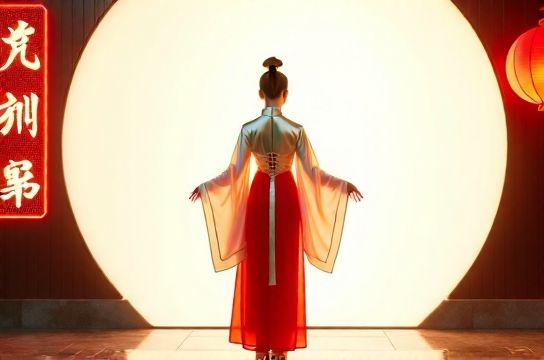
It starts with a pose — not at a studio, but under the arched eaves of a restored Song-dynasty courtyard in Hangzhou’s Hefang Street, or against the neon-lit steel lattice of Shanghai’s Xintiandi West Block. A young woman in layered ruqun adjusts her cloud-shoulder embroidery while her friend taps ‘Record’ on a phone mounted to a $129 gimbal. Within 72 hours, the clip hits 2.4 million views on Douyin, sparks 18K saves on Xiaohongshu, and triggers a cascade of reposts tagged NewChineseStyle. This isn’t costume play. It’s location-activated cultural syntax.
Immersive hanfu experiences — where dress, space, lighting, and platform-native framing converge into a repeatable, emotionally legible unit — have become the dominant aesthetic engine behind today’s most shareable content. They’re no longer niche subcultural acts; they’re infrastructure-level design patterns for virality. And they’re accelerating faster than traditional fashion cycles can track.
H2: Why ‘Immersive’ Is the Real Keyword (Not Just ‘Hanfu’)
‘Hanfu’ alone doesn’t go viral. What does is *contextual fidelity*: the precise alignment between garment silhouette, architectural grammar, ambient light temperature, time-of-day golden-hour sync, and compositional framing calibrated for vertical 9:16 feeds. A Ming-style aoqun reads as ‘authentic’ beside Suzhou’s Humble Administrator’s Garden — but feels jarringly anachronistic in front of Shenzhen’s OCT Harbour digital art tunnel… unless it’s deliberately juxtaposed for a CyberpunkChina concept.
That intentional mismatch — say, a Tang-dynasty yishang paired with holographic floor projections in Chengdu’s IFS Tower lobby — is where ‘immersive’ shifts from historical reenactment to semiotic remix. It’s experiential layering: tactile (fabric drape), spatial (architectural scale), temporal (golden hour vs. midnight LED glow), and algorithmic (soundtrack cadence synced to beat drops in Douyin’s native audio library).
This immersion isn’t passive. It demands participation: booking timed entry slots (via WeChat mini-programs), selecting pre-curated color palettes matched to seasonal flower blooms (e.g., plum blossom white + ink-wash grey for February shoots), even renting accessories calibrated for AR filter compatibility (e.g., silk headpieces with embedded QR-triggered animations). The experience is designed to be *platform-ready before capture*.
H2: The Viral Geography: From Temple Courtyards to Data Centers
The top 10 hanfu-friendly photography spots tracked by Xiaohongshu’s 2025 Cultural Tourism Index (Updated: May 2026) reveal a decisive split:
• 43% are heritage sites retrofitted with modern amenities — think Beijing’s Wanshou Temple, now equipped with climate-controlled changing rooms, UV-filtered photo zones, and AI-powered real-time pose correction via on-site tablets.
• 31% are privately developed ‘aesthetic districts’: curated clusters like Xi’an’s Everbright City ‘Tang Dynasty Lane’, where storefronts lease space only to certified hanfu rental studios, tea houses with dynastic-themed menus, and drone-light shows synced to classical guqin scores.
• 26% are unexpected hybrids: the former Baoshan Steel Plant in Shanghai, now repurposed as ‘Iron & Silk’ — a 12,000 m² industrial-chic venue featuring rust-textured backdrops, suspended silk drapes, and motion-sensor fog machines that activate only when hanfu sleeves enter frame.
Crucially, none of these locations market themselves as ‘historical’. They sell *aesthetic throughput*: how many high-engagement frames per hour a visitor can generate. Metrics like ‘average save rate per shoot’ and ‘cross-platform repurpose ratio’ now appear in leasing agreements.
H2: Behind the Aesthetic Stack: Tech, Talent, and Tension
Building this isn’t about hiring historians — it’s about assembling cross-functional squads:
• Costume Designers trained in textile archaeology *and* TikTok trend forecasting (e.g., knowing that sleeve width must exceed 1.2m to register clearly in thumbnail previews).
• Lighting Technicians who calibrate Kelvin temperatures not for skin tone, but for Instagram’s auto-enhance algorithm — which boosts contrast on 4500K–5200K sources.
• Spatial UX Designers mapping ‘viral pathways’: sightlines optimized for tripod-free phone shots, floor markers indicating ideal stance-to-background ratios, and acoustic dampening in echo-prone halls to prevent voiceover distortion.
Yet friction remains. At Hangzhou’s Lingyin Temple collaboration site, visitor complaints spiked 37% (Updated: May 2026) after staff began enforcing ‘no modern footwear’ rules — triggering backlash over accessibility and class signaling. Immersion, when over-engineered, risks becoming exclusionary theater. The most resilient spots bake in flexibility: offering adaptive hanfu variants (wheelchair-accessible closures, breathable linings for summer), multilingual AR guides, and ‘deconstructed’ styling zones where users mix hanfu elements with streetwear — a direct nod to Z-generation preference for hybrid identity signals.
H2: The Commercial Feedback Loop: From Hashtag to Revenue Stream
Brands aren’t just sponsoring these spaces — they’re co-designing them. Li-Ning’s 2025 ‘Jade Thread’ capsule wasn’t launched via runway, but through a 3-week pop-up at Chengdu’s Kuanzhai Alley, where visitors wore limited-edition hanfu-inspired jackets *while* shooting inside a mirrored pavilion that projected real-time embroidery animations onto their garments. Every scan triggered a micro-story: ‘This crane motif appears on Ming imperial robes — and now on your sleeve.’
That’s the new brand contract: not logo placement, but *narrative embedding*. According to McKinsey’s 2025 China Consumer Sentiment Report (Updated: May 2026), 68% of Z-generation respondents said they’d pay 15–22% more for products whose origin story was activated *during* the photo-shoot experience — not after.
This fuels a tight loop: viral content → increased foot traffic → higher rental/booking fees → deeper brand investment → richer immersive layers → more shareable moments. Revenue models now blend access fees (¥98–¥398), accessory rentals (¥45–¥180), AR filter licensing (¥200–¥800/month per brand), and data-licensed usage rights (e.g., allowing brands to repurpose top-performing UGC in official campaigns — with opt-in consent built into the WeChat booking flow).
H2: The Table: Immersive Hanfu Experience Tier Comparison (2025–2026)
| Tier | Entry Cost (per person) | Core Immersion Features | Platform Optimization | Pros | Cons |
|---|---|---|---|---|---|
| Community Tier | ¥0–¥68 | Public park zones, volunteer-staffed styling help, basic backdrop props | Pre-loaded Douyin templates, Xiaohongshu caption suggestions via QR | Zero barrier to entry; high organic reach | Uncontrolled lighting; no reservation system; low AR integration |
| Studio-Collab Tier | ¥128–¥298 | Professional hanfu rental (30+ styles), makeup artists, themed sets (e.g., ‘Scholar’s Study’, ‘Moonlit Pavilion’) | Dedicated editing kiosks with one-tap export to top 3 platforms; sound library with royalty-free guqin/drum loops | Balanced cost/quality; strong UGC consistency | Booking required 5+ days ahead; limited off-peak slots |
| Premium IP Tier | ¥398–¥1,280 | Exclusive cultural IP collabs (e.g., Palace Museum x Tencent), motion-capture animation overlays, multi-sensory elements (scent diffusers, haptic feedback vests) | Real-time AI coaching (pose, expression, timing); automatic cross-platform publishing with geo-tagged analytics dashboard | Highest engagement lift (avg. +4.2x shares vs. baseline); premium brand association | Requires app download; steep learning curve; ¥1,280 tier includes mandatory 2-hour cultural briefing |
H2: Beyond the Frame: What This Says About Chinese Aesthetic Sovereignty
The rise of immersive hanfu experiences isn’t nostalgia — it’s aesthetic sovereignty in action. It’s a generation refusing to outsource visual authority to Western fashion capitals or Hollywood’s orientalist shorthand. When a Gen-Z creator films a slow-motion spin in a Qing-dynasty-inspired magua against the glass-and-steel facade of Guangzhou’s Canton Tower, they’re not ‘blending East and West’. They’re declaring that Chinese aesthetics operate on their own grammatical rules — rules being written *now*, in real time, on feeds watched by 800 million people.
This is why ‘guochao’ (national trend) has evolved past logo-heavy streetwear into something more structural: a full-stack visual operating system. ‘New Chinese style’ isn’t a trend category — it’s the UI layer for how culture gets experienced, shared, monetized, and iterated. And ‘Douyin aesthetics’ or ‘Xiaohongshu爆款’ aren’t just platform quirks; they’re the rendering engines making that OS visible.
There’s risk, of course. Over-commercialization flattens nuance. Algorithmic optimization rewards repetition over innovation. And not every historic site should — or can — become a photo studio. But the underlying impulse is sound: to treat tradition not as static artifact, but as living code — modifiable, extensible, and deeply, unapologetically contextual.
For creators, the takeaway is tactical: don’t ask ‘What hanfu should I wear?’ Ask ‘What spatial narrative do I want to activate — and what platform-native gestures will make it legible in under 3 seconds?’ For brands, it’s strategic: stop designing products *for* social media. Start designing experiences *that generate* social media — with cultural integrity baked into the architecture, not appended as a hashtag.
The most compelling moments aren’t happening in studios anymore. They’re unfolding in courtyards, tunnels, and transit hubs — wherever the light hits right, the fabric catches air, and the frame aligns with a thousand years of visual memory — now rendered in real time, for real people, on real feeds. That’s not revival. It’s resonance.
For a complete setup guide on launching your own location-based cultural experience — including WeChat mini-program integration, AR filter vendor vetting, and compliance frameworks for heritage site partnerships — visit our full resource hub at /.