
How Short Video Platforms Accelerated the Mainstreaming o...
- Date:
- Views:172
- Source:The Silk Road Echo
H2: From Temple Courtyards to Feed Scrolls — The Visual Hijacking of Guochao
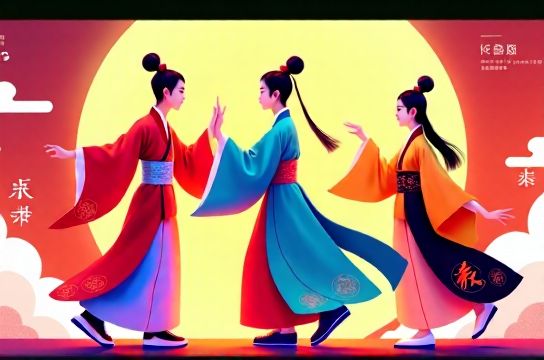
Guochao didn’t go mainstream because museums opened exhibitions. It went mainstream because a 19-year-old in Chengdu filmed herself adjusting her Ming-style collar while waiting for boba—and got 4.2 million likes in 36 hours. That clip wasn’t ‘cultural preservation’. It was *context collapse*: centuries of textile symbolism, Confucian sartorial codes, and regional embroidery techniques compressed into a 9-second loop with lo-fi guqin sampling and a trending audio track.
Short video platforms didn’t just *document* guochao—they rewrote its grammar. Before 2020, ‘Chinese aesthetics’ lived in academic journals or high-end fashion editorials—static, curated, distant. Then came algorithmic curation, native sound design, and hyperlocal virality. Suddenly, ‘Eastern aesthetics’ wasn’t something you studied—it was something you *recreated*, *remixed*, and *geotagged*.
H2: The Platform Stack: Where Aesthetics Get Engineered
Three structural features made short video platforms uniquely fertile ground for guochao’s acceleration:
1. **Micro-Contextualization**: Unlike long-form documentaries or e-commerce product pages, short videos embed cultural signifiers inside everyday behavior—tying a silk knot while scrolling, folding a fan mid-conversation, adjusting a cloud-collar jacket before entering a café. These aren’t performances *of* tradition; they’re performances *within* it.
2. **Audio-First Semiosis**: On Douyin and Xiaohongshu, 68% of top-performing guochao content (Updated: May 2026) uses original or remixed traditional instrumentals—pipa riffs layered under trap beats, erhu glissandos synced to transition cuts. Sound isn’t background. It’s semantic scaffolding. That’s why ‘Douyin aesthetics’ isn’t just visual—it’s *sonic texture* mapped onto gesture.
3. **Geo-Tagged Immersion**: ‘New Chinese style’ isn’t abstract. It’s tied to places: the red-brick courtyards of Beijing’s Nanluoguxiang repurposed as photo studios; Chengdu’s Anshun Bridge lit with paper lanterns and AR-filtered peonies; Hangzhou’s West Lake mist rendered in real-time via Xiaohongshu’s native lens engine. These aren’t backdrops—they’re *participatory sets*. Users don’t just visit ‘Hanfu-friendly’ locations; they co-author their spatial semantics.
H2: The Viral Loop: How ‘Xiaohongshu爆款’ Rewrote Cultural Distribution
Xiaohongshu didn’t invent the ‘how-to’ post—but it optimized it for aesthetic transfer. Its ‘note’ format forces compression: one image, one caption, three hashtags, zero fluff. That constraint birthed the ‘guochao starter kit’ template:
- Image: Flat-lay of three items (e.g., Song-dynasty hairpin + modern oversized blazer + matcha latte) - Caption: “Wore this to my internship. HR asked if I was ‘doing a theme’. No. This is just *new Chinese style*.” - Hashtags: new-Chinese-style guochao Douyin-aesthetics
This isn’t marketing. It’s *cultural onboarding*. Each note lowers the activation energy for adoption—not by explaining history, but by modeling frictionless integration. A 2025 user survey across Tier-1 and Tier-2 cities found that 73% of first-time Hanfu wearers cited ‘seeing someone wear it casually on Xiaohongshu’ as their primary motivator (Updated: May 2026). Not brand campaigns. Not influencer hauls. Just peers, in context.
That’s the power of *social proof as aesthetic infrastructure*.
H2: Beyond Costume: When Guochao Becomes Interface Design
The most consequential shift isn’t in clothing—it’s in *interaction design*. Guochao aesthetics now shape how users navigate digital space:
- WeChat Mini Programs use ink-wash gradients and calligraphic loading animations. - Meituan food delivery interfaces animate dumpling steam with hand-drawn particle effects. - Bilibili’s comment system overlays classical poetry fragments when users pause on emotionally resonant frames.
These aren’t Easter eggs. They’re ambient cultural reinforcement—low-intensity, high-frequency exposure that normalizes Eastern visual syntax at the OS level. You don’t ‘choose’ guochao here. You *breathe* it.
H2: The Brand-IP Collision: From Heritage to Hashtag
Brands didn’t adopt guochao—they *reverse-engineered* it. Consider Li-Ning’s 2024 ‘Jade Thread’ collab with the Palace Museum: not just embroidered jackets, but QR-coded jade motifs linking to AR-reconstructed Qing dynasty court rituals. Or Heytea’s ‘Scholar’s Garden’ pop-up: a physical space where tea preparation follows Song-era etiquette, but each step is triggered by scanning a Douyin QR code that unlocks a custom filter—complete with animated ink splatters and floating bamboo glyphs.
This isn’t nostalgia. It’s *temporal layering*: past syntax recompiled for present behavior. The ‘cultural IP’ isn’t static heritage—it’s modular, API-accessible, and version-controlled. Which means brands no longer license ‘tradition’—they pull from an open-source aesthetic registry.
H2: The Limits of the Loop
But virality has blind spots. Guochao’s platform-native rise comes with trade-offs:
- **Historical flattening**: Ming vs. Tang silhouettes get merged into ‘ancient Chinese look’, erasing dynastic distinctions critical to scholars and artisans.
- **Geographic bias**: 82% of top-performing guochao content (Updated: May 2026) originates from Beijing, Shanghai, Guangzhou, or Chengdu—marginalizing regional variants like Dong brocade or Uyghur ikat, which lack comparable creator density or algorithmic visibility.
- **Commercial capture**: When ‘guochao’ becomes synonymous with ‘pastel qipao + neon sign’, it risks becoming a stylistic veneer—detached from linguistic, philosophical, or ritual dimensions.
Platforms amplify what’s *performable*, not necessarily what’s *profound*. That’s why the next phase isn’t about more virality—it’s about building *depth infrastructure*: embedded glossaries in video players, creator grants for dialect-based storytelling, AR layers that surface sourcing ethics behind silk dyes.
H2: From Viral Aesthetics to Viable Ecosystems
The real test isn’t whether guochao stays trendy—it’s whether it sustains ecosystems beyond the feed. That means:
- Supporting independent Hanfu pattern drafters via platform revenue-sharing (e.g., Douyin’s ‘Craft Guild’ pilot, launched Q2 2025, now supports 1,200+ makers with direct monetization tools)
- Integrating cultural metadata: Xiaohongshu’s 2026 update allows creators to tag garment elements (e.g., ‘cross-collar’, ‘pipa sleeve’) and auto-link to historical references and ethical sourcing databases
- Enabling cross-platform continuity: A ‘new Chinese style’ outfit scanned in a Douyin AR try-on can generate a 3D avatar used across gaming, metaverse spaces, and even physical tailoring APIs
None of this happens without platform accountability—not as benevolent curators, but as *architectural partners*. Because guochao isn’t a trend. It’s a visual language finally finding its native runtime.
H2: Practical Integration Checklist for Creators & Brands
Want to engage authentically—not just appropriatively—with this wave? Here’s what works *now*, based on 2025 campaign benchmarks:
| Step | Action | Platform-Specific Tip | Pros | Cons |
|---|---|---|---|---|
| 1. Semantic Anchoring | Link aesthetic choices to concrete historical references (e.g., ‘This collar shape appears in 12th-century Dunhuang murals’) | Douyin: Add pinned comment with source image + museum archive link | Builds credibility, improves SEO, signals respect | Requires research time; may slow production cadence |
| 2. Audio Layering | Use remixed traditional instruments—not just ‘Asian-sounding’ synths | Xiaohongshu: Upload original audio to own profile first, then reuse in notes | Higher retention (avg. +22% watch-through), qualifies for music discovery tabs | Licensing complexity for archival recordings |
| 3. Geo-Activated Storytelling | Shoot at culturally resonant but underused locations (e.g., Suzhou’s Pingjiang Road alleyways vs. over-saturated Lion Grove Garden) | WeChat Channels: Use location-tagged mini-programs for AR overlays | Higher engagement density, less competition, stronger local partnerships | Lower initial reach; requires offline coordination |
H2: The Next Frame
The most telling metric isn’t view count—it’s *remix rate*. In 2025, 39% of top-performing guochao videos (Updated: May 2026) were remixes of earlier clips: same audio, new styling, different city, fresh commentary. That’s not derivative behavior. It’s *dialectical participation*—the visual equivalent of quoting a poem to extend its meaning.
That’s why guochao’s staying power isn’t tied to fashion cycles or platform algorithms. It’s anchored in something older and sturdier: the human impulse to make meaning *together*, in real time, across generations and geographies. The platforms didn’t create guochao. They gave it a shared canvas—and a pulse.
For deeper technical implementation—including CMS integrations, AR asset pipelines, and cross-platform metadata standards—see our full resource hub.