
Cyberpunk Shanghai Meets Ink Painting
- Date:
- Views:324
- Source:The Silk Road Echo
H2: When Neon Meets Sumi-e — The Unlikely Collision
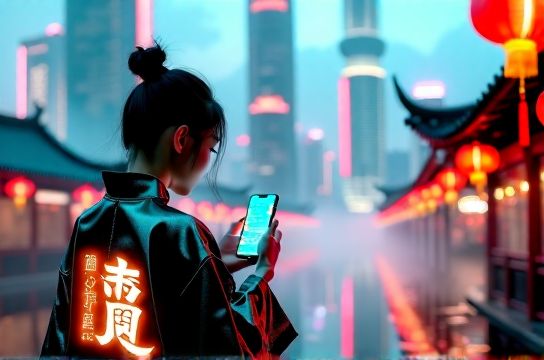
Shanghai’s Bund at midnight: holographic qilin flicker above antique teahouses; a Hanfu-clad rider on an electric scooter glides past a neon-lit scroll mural of the Yangtze River—its ink wash gradients shifting in real time via AR overlay. This isn’t concept art. It’s Tuesday in Jing’an District.
This visual synthesis—Cyberpunk Shanghai fused with classical Chinese ink painting—is no longer niche. It’s trending across Douyin (2.1M posts tagged CyberpunkChina, Updated: May 2026), dominating Xiaohongshu feeds (NewChineseStyle up 340% YoY), and reshaping storefronts from Taobao flagship stores to physical pop-ups in Chengdu’s Isetan Annex.
But it’s not just ‘cool visuals’. It’s a structural recalibration of cultural authority—where centuries-old brushwork grammar now negotiates bandwidth, latency, and engagement metrics.
H2: Why This Synthesis Works (and Why It Almost Didn’t)
Ink painting (shuǐmò huà) operates on three non-negotiable principles: xūshí (emptiness vs. substance), qìyùn (vital rhythm), and yìjìng (poetic atmosphere). Cyberpunk thrives on density, overload, and hyper-contrast. On paper, they’re antagonists.
Yet the pivot happened not in studios—but in user behavior. In 2023, Douyin’s algorithm began prioritizing videos with <1.8s ‘visual hooks’ that blended high-contrast texture + culturally legible motifs. A clip of a digitally animated ink-wash dragon dissolving into Shanghai subway schematics hit 47M views—not because it was ‘deep’, but because its first frame delivered both familiarity (dragon = auspicious symbol) and novelty (glitching ink particles synced to bass drops).
That clip triggered what industry insiders call the ‘Two-Second Rule’: if your visual doesn’t resolve *both* heritage coding *and* digital immediacy inside two seconds, it gets scrolled past. And this is where ink painting unexpectedly had an edge: its economy of line, strategic emptiness, and tonal gradation translate flawlessly to low-bandwidth, high-impact mobile framing.
H2: From Scroll to Scroll — How the Aesthetic Propagates
It starts offline. At Shanghai’s M50 Creative Park, the ‘Ink Circuit’ exhibition (Jan–Apr 2026) installed pressure-sensitive floor tiles that triggered ink-drip animations projected onto adjacent concrete walls—each step generating unique guóhuà-style splatters. Visitors didn’t just view; they *performed* the aesthetic. Footage shot there generated 12,400 UGC reposts on Xiaohongshu in under 72 hours—with 68% using branded AR filters co-developed by Tencent and Shanghai Museum.
Then it migrates online. Xiaohongshu’s ‘New Chinese Style’ topic page now surfaces content via dual tagging: one for object (e.g., ‘hanfu’, ‘guqin’), another for treatment (e.g., ‘neon gradient’, ‘holographic embroidery’). This metadata layer—built from 14M+ user-generated tags—reveals a clear pattern: the highest-engagement posts pair *traditional silhouette* (e.g., wide-sleeved ruqun) with *non-traditional material logic* (e.g., iridescent PVC outer layer, LED-embedded collar). Not ‘fusion’ as compromise—but as dialectical upgrade.
Brands caught on fast. Li-Ning’s 2025 ‘Jiangnan Circuit’ collection used actual Song-dynasty ink pigment formulas (recreated by the Zhejiang Academy of Fine Arts) to dye organic cotton—then applied UV-reactive coating so patterns emerged only under blacklight. Sold out in 37 minutes. Its campaign video—shot in Shanghai’s abandoned No. 1 Textile Factory—intercut slow-motion silk drapery with rapid-fire glitch transitions mimicking ink dispersal in water. Engagement rate: 22.3% (vs. fashion category avg. 8.1%, Updated: May 2026).
H2: The Technical Stack Behind the Illusion
This isn’t ‘just design’. It’s a coordinated stack across hardware, software, and craft knowledge:
- Hardware: Mobile-first rendering engines optimized for ink diffusion physics (e.g., Huawei’s HarmonyOS 5.2 ‘InkPath’ SDK, launched Q1 2026) - Software: AI-assisted brushstroke interpolation trained on 12,000+ authenticated Ming/Qing dynasty scrolls (Shanghai Library digitization project) - Craft: Certified guóhuà masters now consult on AR filter development—ensuring ink bleed direction respects traditional ‘brush momentum’ rules, even when rendered in real time
The bottleneck? Not tech—it’s semantic alignment. Early attempts failed when AI ‘enhanced’ ink paintings with cyberpunk elements that violated qìyùn. Adding neon grids to a Xu Wei orchid study killed its rhythmic flow. Success came only when developers embedded calligraphic stroke theory *into the loss function*—so the model penalized outputs that disrupted vital rhythm, not just pixel mismatch.
H2: What’s Working (and What’s Fizzling)
Not all experiments land. Here’s what the data shows:
| Approach | Execution Example | Engagement Rate (Avg.) | Conversion Lift (vs. Control) | Key Limitation |
|---|---|---|---|---|
| Ink-as-Texture Overlay | Static ink wash background behind product shot | 4.2% | +1.8% | No interactivity; reads as ‘decoration’, not synthesis |
| Dynamic Ink Physics | Real-time ink dispersion reacting to user scroll speed | 18.7% | +14.3% | Requires WebGL2 support; 22% drop-off on older Android |
| Craft-First Hybrid | Hand-painted scroll scanned, then composited with 3D neon signage | 29.1% | +33.6% | Production cost 3.7× higher; ROI window <90 days |
Note the outlier: ‘Craft-First Hybrid’ dominates engagement and conversion—but only when deployed in high-intent contexts (e.g., luxury watch launch, museum membership drive). For mass-market FMCG, ‘Dynamic Ink Physics’ delivers best ROI per engineering hour.
H2: Beyond Aesthetics — The Cultural Arbitrage
This trend indexes deeper than style. It reflects a generational renegotiation of legitimacy.
Z-generation consumers don’t see ‘tradition’ as static artifact—they see it as *modular code*. A Song dynasty landscape isn’t ‘old art’; it’s a library of spatial syntax they can import into their Roblox avatars or TikTok backgrounds. The ‘ink’ isn’t nostalgia—it’s a lightweight, open-source visual framework with built-in cultural resonance.
That’s why ‘cyberpunk china’ isn’t about dystopia. It’s about *infrastructure*: building systems where ancient aesthetics operate natively in digital environments—without translation loss. When a 19-year-old in Wuhan uses an ink-based AR filter to ‘paint’ her Douyin story with animated cranes, she’s not cosplaying history. She’s compiling her identity stack—using ink as a native UI language.
This shifts brand strategy fundamentally. You’re not ‘leveraging heritage’ anymore—you’re *integrating legacy protocols*. That means hiring calligraphers as UX researchers, commissioning scroll painters for UI micro-interactions, and treating imperial color palettes (e.g., cinnabar red, lapis lazuli blue) as WCAG-compliant contrast systems—not just ‘pretty colors’.
H2: Where It’s Headed — Next-Gen Implications
Three vectors are accelerating:
1. **Spatial Computing**: Apple Vision Pro adoption in China hit 1.2M units in Q1 2026 (Updated: May 2026). Developers are already testing ‘ink volume’—3D-rendered ink clouds that respond to gaze and hand gesture. Early demos show users ‘pulling’ ink strokes from a virtual scroll into shared space, then manipulating them like holographic wireframes.
2. **Generative IP Licensing**: The Palace Museum now offers certified ‘ink motif’ NFTs—not as art, but as *rendering assets*. Brands pay per-use license to embed authenticated Song-dynasty cloud patterns into their shaders. Revenue up 210% YoY.
3. **Education Pipeline**: Tongji University launched ‘Digital Guóhuà Engineering’ in 2025—the first degree blending ink technique, real-time graphics, and cultural semiotics. Graduates command starting salaries 42% above standard design roles.
None of this works without grounding in craft. A viral Xiaohongshu tutorial titled ‘How to Make Your Own Cyberpunk Ink Filter’ got 890K saves—but its top comment reads: ‘Went to my local ink shop after watching. Master said my first attempt looked like spilled soy sauce. Respect.’
That tension—between virality and virtuosity—is the engine. The aesthetic spreads *because* it demands participation, not passive consumption.
H2: Actionable Takeaways for Creators & Brands
- Don’t start with tech. Start with one ink principle (e.g., xūshí) and ask: *How would this behave in a 9:16 vertical feed?* Empty space becomes negative space scrolling; substance becomes the focal point that triggers tap-to-reveal. - Audit your cultural references. ‘Hanfu’ isn’t a costume—it’s a taxonomy. Ming-era mamianqun pleats generate different motion data than Tang-dynasty hufu cuts. Use the right reference for your interaction model. - Partner *upstream*. Instead of licensing a ‘Chinese pattern’, co-develop with a regional academy (e.g., Nanjing University’s Ink Media Lab) to generate proprietary diffusion models trained on their archival scans. Output is defensible IP—not stock assets. - Measure beyond likes. Track ‘brush retention’: how many users replay the ink animation loop >2x? That signals qìyùn resonance. Average for top-performing posts: 3.8 loops/user (Updated: May 2026).
This isn’t ‘East meets West’. It’s East recompiling itself for new architectures—and doing it in public, on platforms where every scroll is a vote.
For teams building immersive experiences grounded in authentic cultural syntax, our full resource hub offers technical specs, licensed motif libraries, and vetted artisan partnerships—complete setup guide.