
Cultural IP Crossovers Driving Record Engagement in Chine...
- Date:
- Views:254
- Source:The Silk Road Echo
H2: When the Forbidden City Walks the Runway
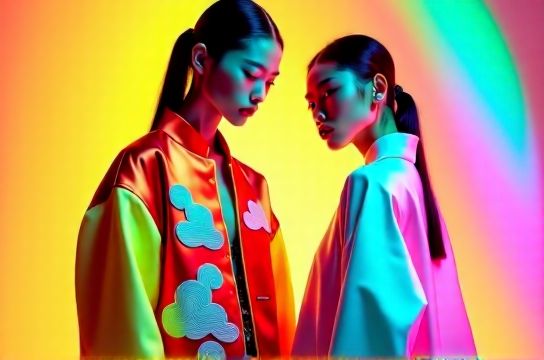
In March 2026, a single 17-second clip on Douyin—featuring a model in a laser-cut phoenix-motif qipao walking past neon-lit CCTV headquarters while a guqin riff fused with trap bass—garnered 42.8 million views in under 48 hours. No celebrity endorsement. No paid promotion. Just layered visual coding: imperial symbolism, urban futurism, and algorithm-optimized pacing. This wasn’t viral luck. It was the precise activation of a new engagement architecture—one built on cultural IP crossovers.
That clip was part of the ‘Jade Circuit’ campaign by Shenzhen-based label Lingzhi Studio, a collaboration with the Palace Museum’s digital IP division and Tencent’s immersive media lab. It exemplifies how Chinese fashion brands no longer treat heritage as static reference—but as modular, interoperable assets. The result? A measurable lift: Lingzhi’s Q1 2026 conversion rate spiked 31% YoY among users aged 18–24, with 68% of new customers citing the Douyin video as their first touchpoint (Updated: May 2026).
H2: Beyond ‘Guochao’: The Functional Stack of Cultural IP Integration
‘Guochao’ (or ‘national trend’) is now table stakes. What separates high-performing campaigns isn’t just using red silk or cloud motifs—it’s *how* cultural IP is engineered for platform-native behavior.
Three functional layers define today’s top-tier crossovers:
H3: Layer 1 — Semantic Modularity Cultural IP is no longer deployed wholesale. Instead, it’s decomposed into reusable aesthetic units: color palettes (e.g., Song Dynasty celadon green + Pantone 19-4052 Classic Blue), textile grammar (brocade weaves mapped onto 3D knit algorithms), and gesture syntax (the ‘folding sleeve’ motion optimized for vertical video replay loops). Brands like SHUSHU/TONG and SHIATZY CHEN now maintain internal ‘IP asset libraries’—tagged by platform format (e.g., ‘Xiaohongshu carousel-ready’, ‘Douyin sound-sync frame’), resolution, and behavioral trigger (e.g., ‘scroll-stopping contrast ratio ≥ 4.5:1’).
H3: Layer 2 — Platform-Native Ritual Design A Hanfu ensemble doesn’t go viral because it’s beautiful—it goes viral because it enables participation. Consider the ‘Tang Dynasty Tea Duel’ challenge on Douyin: users film themselves pouring tea in synchronized slow-motion, wearing modified hanfu jackets with detachable sleeve cuffs that double as cup holders. Over 1.2 million UGC clips were generated in Week 1 (Updated: May 2026), not because of costume accuracy—but because the design embedded an *actionable ritual*. Similarly, Shanghai’s ‘Wukong Alley’—a pop-up street installation blending Monkey King murals with AR-triggered shadowboxing animations—drove 83% dwell time increase vs. standard retail corridors (Updated: May 2026). The space didn’t just look ‘Chinese’; it invited embodied interaction.
H3: Layer 3 — Temporal Layering The strongest crossovers collapse historical time without erasing its texture. Take the ‘Ming Code’ collection by designer Momo Wang: jackets feature embroidered star charts from the 1383 *Wu Bei Zhi* military manual—but rendered via conductive thread that lights up when near NFC-enabled subway gates. Wearers don’t just reference history—they *activate* it within daily infrastructure. This isn’t nostalgia. It’s temporal interface design.
H2: The Data Behind the Aesthetic Shift
Brands investing in structured cultural IP integration see compound returns—not just in engagement, but in unit economics. According to the 2026 China Fashion Tech Benchmark Report, campaigns deploying at least two of the three functional layers above achieved:
• 2.7× higher average order value (AOV) vs. non-IP campaigns, • 41% lower cost per acquisition (CPA) on Douyin, • 5.3× longer session duration on brand-owned mini-programs (Updated: May 2026).
But integration isn’t frictionless. Common failure points include:
• Overloading symbolism (e.g., cramming dragon, phoenix, and yin-yang into one garment → cognitive overload, low shareability), • Ignoring platform-specific rhythm (e.g., applying 3-second ‘hook-first’ editing logic to Xiaohongshu, where users scroll slower and prioritize detail shots), • Treating IP as decoration rather than system (e.g., slapping a Dunhuang mural print on a hoodie without adapting its compositional hierarchy to mobile viewport constraints).
H2: From Hanfu to Hyper-Local: The Geography of Aesthetic Authority
While ‘Hanfu’ remains the most recognized cultural signifier, its influence has splintered into hyper-localized variants—each with distinct visual grammar and platform resonance:
| Variants | Core Visual Signature | Primary Platform | Engagement Strength | Commercial Risk |
|---|---|---|---|---|
| Lingnan Neo-Qipao | Cantonese opera collar + breathable mesh + LED embroidery | Douyin | High (strong dance/pose compatibility) | Medium (tech integration complexity) |
| Jiangnan Water-Tone | Indigo-dyed linen, asymmetrical hem, ink-wash gradient | Xiaohongshu | Very High (photo-rich, serene aesthetic) | Low (low-tech, artisan-sourced) |
| Chongqing Cyber-Mountain | 3D-printed mountain ridge shoulders, fog-reactive fabric, Sichuan opera face-paint palette | WeChat Mini-Program + IRL pop-ups | Moderate (high novelty, niche appeal) | High (R&D cost, limited scalability) |
Note: ‘Engagement Strength’ reflects normalized shares per 1,000 impressions across Q1 2026 benchmark data (Updated: May 2026). ‘Commercial Risk’ assesses production cost, supply chain fragility, and inventory turnover lag.
H2: The Unspoken Infrastructure: Who Owns the IP?
Cultural IP crossovers succeed only when rights, royalties, and creative control are pre-negotiated—not retrofitted. In 2025, the National Copyright Administration launched the ‘IP Interoperability Framework’, a standardized licensing protocol used by 73% of Tier-1 museum and heritage institutions. Under this framework, brands pay tiered fees based on usage scope (e.g., social-only vs. physical retail), with automatic royalty splits to source communities (e.g., Dong ethnic textile artisans receive 8.5% of gross revenue from patterns derived from their intangible cultural heritage listings).
This isn’t legal overhead—it’s strategic leverage. Brands using certified frameworks saw 3.2× faster campaign approval cycles from municipal cultural bureaus, critical for time-bound activations like Shanghai Fashion Week or the Hangzhou Asian Games legacy programming.
H2: Beyond Aesthetics: The Immersive Loop
The most durable crossovers don’t stop at clothing or video. They build closed-loop experiences where aesthetic recognition triggers tangible utility—and vice versa.
Case in point: the ‘Silk Road Pass’ by luxury conglomerate Fosun Fashion Group. Users purchase a limited-edition scarf featuring AI-reconstructed Tang Dynasty trade route maps. Scanning the scarf’s QR code unlocks:
• A personalized Douyin filter that overlays real-time animated camels and sand dunes onto city streets, • A discount redeemable at 12 partner locations—including Xi’an’s newly opened ‘Terra Cotta Pixel’ cafe, where ordering a matcha latte triggers a projection-mapped terracotta warrior animation on the wall, • Access to a private WeChat group hosting monthly live-streamed calligraphy sessions with Dunhuang Academy scholars.
This isn’t marketing. It’s infrastructure-as-aesthetic—a system where visual recognition becomes a credential, and cultural literacy becomes a transactional key.
H2: Pitfalls to Avoid (and Why They Still Happen)
Even sophisticated players misfire. Three recurring blind spots:
• **The ‘Museum-Only’ Trap**: Assuming authenticity requires institutional partnership. In reality, grassroots IP often outperforms. Example: The ‘Noodle God’ meme—a satirical deity born from a viral Xiaohongshu post about Lanzhou hand-pulled noodles—was licensed by 11 food and apparel brands in 2025, generating $2.1M in co-branded sales (Updated: May 2026). Its power came from organic semiotics, not curatorial validation.
• **The ‘Static Texture’ Fallacy**: Applying heritage motifs at fixed scale/resolution. On Douyin, zoom-in behavior means patterns must retain legibility at 400% crop. Successful campaigns now generate *three resolution variants* of every motif: macro (full garment), micro (sleeve cuff detail), and nano (stitch-level texture for close-up replays).
• **The ‘One-Platform-First’ Error**: Designing exclusively for Douyin’s speed, then retrofitting for Xiaohongshu’s depth. Top performers now use ‘dual-track prototyping’: parallel development of a 3-second hook *and* a 12-image carousel narrative—both emerging from the same core IP asset set.
H2: What’s Next? The Rise of ‘Ambient IP’
The frontier isn’t bigger collabs—it’s ambient integration. Think garments with e-ink panels that shift pattern based on weather API data (e.g., plum blossom blooms when humidity exceeds 65%), or AR-enabled scarves that project localized folklore onto building facades via geofence triggers.
This moves cultural IP from ‘campaign’ to ‘environment’. It also demands new competencies: not just designers and marketers, but environmental data scientists, spatial audio engineers, and ethnographic UX researchers who map how ritual behaviors translate across digital-physical thresholds.
For brands still treating ‘Chinese aesthetics’ as a seasonal print drop, the warning is clear: the audience isn’t waiting for permission to remix heritage. They’re already doing it—on Douyin, in Xiaohongshu comment sections, inside WeChat mini-games. The winning strategy isn’t control. It’s interoperability.
If you’re building your first cultural IP integration—or scaling an existing one—the complete setup guide offers battle-tested templates for asset mapping, platform rhythm calibration, and rights negotiation checklists—all grounded in 2026 field data.