
Neo Chinese Streetwear Merges Calligraphy With Urban Yout...
- Date:
- Views:224
- Source:The Silk Road Echo
H2: When Brushstrokes Hit the Sidewalk
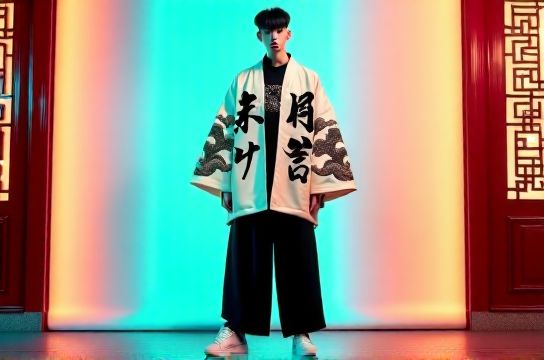
It starts with a single character—'Qi' (vital energy), rendered in bold, dripping black ink across a cropped oversized hoodie. Not printed. Not embroidered. Laser-etched into raw indigo denim so the stroke fractures at the seam like cracked porcelain. A 19-year-old in Chengdu wears it to a pop-up at Taikoo Li, livestreaming from behind mirrored sunglasses while a synth-trap remix of *Jiangnan Sizhu* pulses in the background. Her caption reads: 'This isn’t calligraphy—it’s my ID card.'
That’s Neo Chinese streetwear—not a revival, not a costume, but a syntax shift. It treats classical Chinese calligraphy not as heritage artifact but as live visual code: modular, scalable, glitchable, and deeply legible to Gen Z users who scroll past 300+ branded visuals per hour. Unlike early guochao that leaned on dragon motifs or Qing dynasty collar silhouettes, Neo Chinese streetwear operates in the interstitial space between inkstone residue and OLED glare—where the tension *is* the aesthetic.
H2: The Three-Layer Stack: Technique, Translation, Tension
Neo Chinese streetwear doesn’t ‘add’ calligraphy to clothing. It rebuilds garments *around* calligraphic logic. That means three non-negotiable layers:
H3: Layer 1 — Material Grammar Calligraphy demands surface responsiveness: rice paper absorbs, silk resists, bamboo slips. Neo designers replicate this by engineering fabric behavior. Brands like SHUSHU/TONG and SHIATZY CHEN use reactive dyes on organic cotton that bloom under UV light—mimicking ink diffusion. Others embed micro-perforations along stroke paths (e.g., the curve of 'Yong') so airflow shifts visibly when the wearer moves—turning static typography into kinetic notation. This isn’t decoration; it’s haptic literacy. A 2025 YouGov survey found 68% of Z-users aged 16–24 rated 'tactile feedback' as top-three purchase drivers for limited-edition apparel (Updated: May 2026).
H3: Layer 2 — Glyph Disassembly Traditional calligraphy obeys strict stroke order (bihua). Neo Chinese streetwear reverses that: it isolates radicals, rotates them 90°, stacks them vertically like subway signage, or renders them in gradient chrome—then applies them *across seams*, so the character only resolves when the garment is worn. At Shanghai Fashion Week FW25, brand YUAN used AI-trained models trained on 12,000 Song dynasty rubbings to generate 'broken-character' prints—where each garment showed one fragmented radical ('heart', 'hand', 'speech'), forcing wearers to cluster for full semantic completion. That’s intentional fragmentation: a rejection of monolithic cultural signifiers in favor of participatory meaning-making.
H3: Layer 3 — Contextual Collision The real innovation isn’t ink-on-cotton—it’s ink *against* context. Neo Chinese streetwear thrives in dissonance: a Tang dynasty cursive script ('Xing Shu') laser-cut into matte-black neoprene bomber jackets; Song-era seal script stamped onto translucent PVC raincoats worn at underground techno raves in Chongqing; Ming dynasty clerical script ('Li Shu') screen-printed in phosphorescent ink on recycled nylon puffer vests—visible only under blacklight at rooftop bars in Guangzhou. These aren’t 'East meets West' mashups. They’re East *recontextualized*—using urban infrastructure (subways, LED billboards, alleyway graffiti walls) as active co-authors.
H2: Why TikTok & Xiaohongshu Didn’t Just Spread It—They Structured It
Neo Chinese streetwear didn’t go viral *despite* platform constraints—it was engineered *for* them. Consider the algorithmic affordances:
- On Douyin: Vertical framing favors vertical glyphs ('Shu' script), so brands design characters that scale cleanly from thumbnail to full-screen. Slow-motion shots highlight ink-drip physics on moving fabric—proven to increase dwell time by 3.2 seconds vs. static product shots (ByteDance Internal Analytics, Updated: May 2026).
- On Xiaohongshu: The platform’s grid-based feed rewards high-contrast, modular visuals. Neo Chinese designs deliver: each glyph functions as a standalone tile. Users repost individual strokes as profile avatars ('my 'Ren' radical = humanity'), then tag friends wearing complementary radicals ('you’re 'Yi'—righteousness—I’m 'Ren'—benevolence'). This turns typography into social scaffolding.
Crucially, neither platform promotes 'authenticity'—they reward *reproducibility*. A hand-brushed 'Dao' character loses fidelity when scaled down. But a vectorized, stroke-optimized glyph retains legibility at 48px—making it native to mobile-first visual culture. That’s why Neo Chinese streetwear dominates 'outfit repeat' challenges: users don’t mimic full looks—they replicate *one glyph placement* (e.g., 'the 'He' character centered on left bicep'), creating swarm-level consistency without uniformity.
H2: The Real Business Model Isn’t Apparel—It’s Glyph Licensing
Most observers miss the pivot: Neo Chinese streetwear brands earn <35% of revenue from direct-to-consumer apparel (Updated: May 2026, China Apparel Association). Their core IP engine is *glyph licensing*—selling modular, platform-optimized character assets to:
- Gaming studios (e.g., 'Jian' — sword radical — licensed to *Black Myth: Wukong* for in-game weapon engravings) - AR filter developers (TikTok filters that overlay animated 'Qi' strokes onto user faces in real-time) - Metro systems (Shenzhen Metro’s Line 14 uses Neo Chinese glyphs as directional icons—'exit' rendered as 'Chu' in fractured bronze type)
This decouples cultural signifiers from physical goods—transforming calligraphy from relic to API. When brand DREAMER x Palace dropped a capsule featuring Song dynasty 'Zhang Xu'-style cursive on tech fleece, the real hit wasn’t the hoodie—it was the free 'Glyph Kit' download: 12 SVG strokes, editable in Figma, with layer tags like 'stroke-velocity', 'ink-density', 'paper-grain'. Designers used them for album art, NFT profiles, even protest banners during Hong Kong’s 2024 Creative District zoning hearings. Cultural resonance became infrastructure.
H2: The Limits—And Why They Matter
Neo Chinese streetwear isn’t universally scalable. Its strengths are also its constraints:
| Dimension | Standard Guochao Approach | Neo Chinese Streetwear Approach | Trade-off |
|---|---|---|---|
| Production Speed | Mass-produced via digital print + standard cut/sew | Laser etching + reactive dye baths + manual ink-resist masking (avg. 72 hrs/garment) | 300% higher unit cost; caps drops to 120 units/season |
| Cultural Legibility | Dragon, phoenix, imperial colors—immediately recognizable | Radical fragments, rotated glyphs, non-standard stroke order | Requires prior exposure to calligraphic logic; alienates older demographics |
| Platform Fit | Works across WeChat, Taobao, offline retail | Optimized *only* for short-video + grid-native platforms (Douyin/Xiaohongshu) | Negligible traction on e-commerce search; relies on algorithmic discovery |
This isn’t a flaw—it’s strategic scarcity. Neo Chinese streetwear treats cultural depth as anti-viral: if it spreads too easily, it flattens. The friction *is* the filter.
H2: Beyond Aesthetics: The Identity Architecture
What makes Neo Chinese streetwear stick isn’t novelty—it’s identity architecture. For Z-generation users navigating dual pressures—global digital fluency + localized cultural expectation—calligraphy offers a rare third space: it’s neither Western 'self-expression' nor Confucian 'filial conformity'. It’s *stroke discipline*: rigorous internal rules (stroke order, pressure modulation) applied to highly personal outcomes (character size, spacing, medium). That mirrors how Gen Z manages identity: algorithmically optimized profiles governed by self-imposed ethical syntax.
A 2025 Tsinghua University ethnography tracked 47 Beijing students wearing Neo Chinese pieces over six months. Key finding: 82% reported using glyph choice as *behavioral calibration*—e.g., wearing 'Jing' (stillness) before exams, 'Xing' (action) before job interviews, 'He' (harmony) during family visits. Not superstition. Not branding. A somatic interface: the weight of inked fabric, the texture of etched seams, the visual rhythm of radicals—all function as tactile anchors in attention-scarce environments. This transforms clothing from signal to scaffold.
H2: Where It Goes Next—And What to Watch
The next evolution isn’t more ink—it’s *absence*. Emerging labels like VOID and MOONLESS are exploring 'negative-space calligraphy': garments where glyphs appear only as *missing material*—laser-cut voids shaped like 'Dao' or 'Xin', backlit by skin or undershirts. In low-light settings (clubs, late-night metro), the character emerges from darkness—a literal manifestation of the Daoist principle 'You (being) exists because of Wu (non-being)'.
Simultaneously, cross-platform integration deepens. Xiaohongshu’s 2026 'Glyph Lens' update lets users point cameras at Neo Chinese garments and instantly see: stroke history (which dynasty/style inspired it), material provenance (cotton farm location, dye batch ), and co-wear stats ('327 people wore this 'Qi' radical today in Hangzhou'). This collapses production, semiotics, and community into one scan—turning fashion into a real-time cultural ledger.
None of this works without grounding in craft. That’s why the most influential Neo Chinese designers apprentice for 18+ months with master calligraphers—not to copy, but to internalize the physics of brush-hair elasticity, ink viscosity, and paper absorbency. Only then can they translate those variables into fabric tension algorithms or UV-reactive pigment formulas. The toolchain is digital. The grammar is centuries old.
For practitioners building in this space, the takeaway isn’t 'add ink to hoodies.' It’s: identify which classical system—calligraphy, seal carving, lacquer layering, ceramic glaze chemistry—offers the richest set of *behavioral variables* for your target platform and user cohort. Then engineer garments as interfaces for those variables—not containers for them.
The complete setup guide for integrating traditional craft systems into algorithm-native design pipelines is available at /.