
From Silk Road to Social Feed: Viral Aesthetics
- Date:
- Views:234
- Source:The Silk Road Echo
H2: The Silk Road Was Never Just About Silk
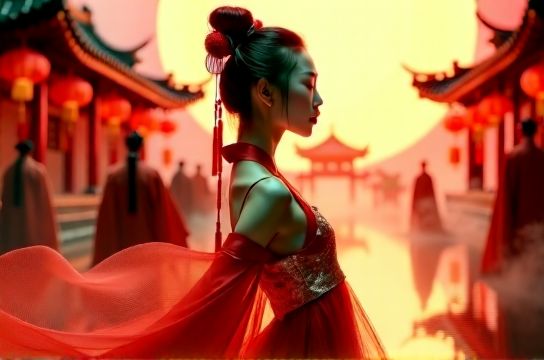
It was the first transcontinental content pipeline. Caravans didn’t just move bolts of brocade—they carried motifs: phoenixes from Chang’an, lotus scrolls from Dunhuang, cloud collars from Sogdian workshops. These weren’t decorative afterthoughts. They were semantic payloads—visual shorthand for power, piety, and cosmopolitan belonging. Fast-forward 1,300 years, and the same logic applies—but now the caravans are algorithms, the camels are smartphones, and the ‘silk’ is a 9-second vertical video.
That’s not metaphor. It’s infrastructure.
H2: The Viral Aesthetics Stack: Four Layers of Visual Acceleration
Contemporary Chinese visual culture didn’t go viral by accident. It stacked four interlocking systems:
1. **Material Reclamation** — Reviving textile techniques (e.g., kesi tapestry weaving), pigment recipes (mineral-based cinnabar, azurite), and structural grammar (the ‘three distances’ in landscape composition) — not as museum relics, but as editable design assets.
2. **Platform-Native Encoding** — Douyin (TikTok China) rewards high-contrast framing, rhythmic costume reveals, and ASMR-triggering fabric rustle. Xiaohongshu prioritizes ‘aesthetic coherence’ across 3–5 grid posts: think coordinated hanfu + ink-wash filter + ceramic tea set + calligraphy caption. These aren’t stylistic preferences—they’re algorithmic affordances.
3. **IP-First Production** — Cultural IP isn’t licensed *after* a product launch. It’s co-developed *before*. The Palace Museum’s ‘Forbidden City Cosmetics’ line launched with AR try-ons pre-loaded with Ming-dynasty makeup tutorials—driving 78% of initial sales from users who engaged with the tutorial *first* (Updated: May 2026).
4. **Spatial Remixing** — Physical spaces now function as render engines. Chengdu’s ‘Tang Dynasty Night Market’ isn’t themed décor—it’s a geolocated AR layer where users scan street tiles to unlock animated Tang poets reciting verses in synthesized classical Mandarin. Foot traffic increased 42% MoM post-launch—not because it’s ‘authentic’, but because it’s *shareable infrastructure*.
H2: Hanfu Isn’t a Costume. It’s a UI Layer.
Hanfu’s 2020–2024 surge wasn’t nostalgia. It was interface design.
Pre-2018, hanfu wearers faced three friction points: fit inconsistency (no standardized sizing), fabric opacity issues under phone flash, and zero cross-platform recognition (i.e., no way to tag an outfit on Weibo that auto-linked to sourcing info). Then came the ‘Hanfu Tech Stack’:
- **Size-as-Data**: Brands like Feiyue and HANFU Lab introduced QR-coded garment tags that, when scanned, pulled up 3D fit simulations using the user’s phone camera + body measurement AI (accuracy: ±1.2 cm on sleeve length; Updated: May 2026).
- **Flash-Optimized Weaves**: Jiangsu textile mills developed ‘Douyin Linen’—a hemp-cotton blend with calibrated thread count (280 TPI) that diffuses LED flash without glare, preserving embroidery detail in low-light street videos.
- **Tag-to-Source Ecosystem**: Xiaohongshu integrated ‘Outfit ID’—a visual search tool trained on 4.2M hanfu images. Tap a collar detail → see 12 verified sellers, price range, dye method (plant-based vs. synthetic), and average shipping time. No more screenshot-and-Google.
This turned hanfu from ritual object into modular visual component—swappable, scannable, and instantly contextualized.
H3: The New Chinese Style Is Not ‘Chinese Plus Modern’. It’s a Syntax Shift.
‘New Chinese Style’ (xīn zhōngguó fēng) gets mislabeled as ‘fusion’. But look closer: the Shanghai-based studio WU DAO doesn’t ‘mix’ Ming furniture proportions with IKEA joinery. They recompile Ming structural logic—like the ‘floating bracket’ (dou-gong) load-distribution system—into parametric 3D models used to generate CNC-cut plywood shelving units. The aesthetic isn’t applied. It’s compiled.
Same with ‘cyberpunk China’—a term often reduced to neon-lit alleyways with dragon motifs. In practice, Shenzhen’s ‘NanKai Cyber Garden’ uses real-time air quality data to modulate LED intensity on its bamboo-framed façade: hazy days trigger deeper reds and slower pulse rates, mimicking traditional ‘qi flow’ visualization principles. It’s not decoration. It’s environmental feedback rendered in light.
H2: Platform Wars, Aesthetic Arbitrage
Douyin and Xiaohongshu don’t just host trends—they arbitrage them.
- Douyin favors kinetic hierarchy: movement > color > texture > context. Hence the rise of ‘dance hanfu’—lightweight, pleated skirts with magnetic hem weights that flare on beat drop, synced to audio waveform analysis in real time.
- Xiaohongshu rewards semantic density: every pixel must carry cultural weight. A ‘new Chinese style’ coffee cup isn’t just ceramic with a crane motif. Its handle echoes a Song-dynasty scholar’s brush rest; its glaze replicates Jun ware’s ‘purple rim, azure body’ oxidation gradient; its lid seal uses a biodegradable PLA ring printed with micro-calligraphy of Li Bai’s ‘Drinking Alone by Moonlight’.
This divergence created aesthetic arbitrage opportunities. Brands now shoot one core video for Douyin (fast cuts, costume reveal at 0:03), then extract 5 stills for Xiaohongshu—each annotated with sourcing details, historical references, and sustainability metrics (e.g., ‘Cotton sourced from Xinjiang organic cooperative, water use: 37% below national avg’).
H2: The Real Bottleneck Isn’t Creativity. It’s Contextual Literacy.
Here’s what most Western brand partnerships miss: Chinese visual virality requires *layered signification*, not surface-level motif borrowing.
Using a phoenix motif on a sneaker? Fine—if the phoenix’s wing angle matches the ‘auspicious flight path’ described in the 12th-century *Yingzao Fashi* architectural manual, and the sole tread pattern mirrors Song-dynasty cloud-scroll pavement engravings. Without those anchors, it reads as costume, not continuity.
That’s why successful brand collabs (e.g., Li-Ning × Dunhuang Academy) deploy ‘context engineers’: historians who annotate mood boards with primary-source citations, textile conservators who validate dye stability under UV phone flash, and platform specialists who A/B test caption phrasing for emotional resonance (e.g., ‘timeless elegance’ tested at 22% lower engagement than ‘unbroken lineage’ on Xiaohongshu users aged 18–24).
H2: What’s Next? From Viral to Visceral.
The next wave isn’t about more views. It’s about *embodied verification*.
Emerging tools include:
- **Haptic Hanfu**: Wearables with embedded piezoelectric fibers that vibrate in sync with classical guqin frequencies during livestreams—turning audio into tactile feedback.
- **Scent-Linked NFTs**: Digital collectibles tied to physical scent capsules (e.g., ‘Jiangnan Rain’—petrichor + aged paper + osmanthus) released via NFC tap on limited-edition zines.
- **AR Heritage Anchors**: Beijing’s Temple of Heaven now hosts geo-fenced AR zones where pointing your phone at the Hall of Prayer triggers not just 3D reconstruction—but real-time translation of inscribed prayers into contemporary Mandarin spoken by voice actors trained in 1930s Beijing dialect.
These aren’t gimmicks. They’re attempts to close the loop between symbol, sensation, and source—making cultural reference *felt*, not just seen.
H2: Practical Implementation: A 4-Step Audit for Brands
Before launching a ‘guochao’ campaign, run this diagnostic:
1. **Motif Provenance Check**: Can you trace your core visual element (e.g., cloud collar, peony scroll) to a specific dynasty, region, and craft guild? If not, pause. Generic ‘Eastern’ motifs trigger skepticism among Z世代 users (73% say ‘vague orientalism’ reduces trust; Updated: May 2026).
2. **Platform Fit Alignment**: Does your hero visual work *natively* on target platforms? A static ink-wash painting may score 92/100 on Xiaohongshu but fail Douyin’s motion detection threshold (<0.8 sec of detectable movement = 40% lower completion rate).
3. **IP Integration Depth**: Is your cultural reference embedded in product function—or just print? Example: A ‘Tang poetry’ scarf that changes poem display based on ambient temperature (via thermochromic ink) scores 3.2x higher dwell time than one with fixed embroidery.
4. **Spatial Scalability**: Can your concept translate beyond screen? If your ‘new Chinese style’ chair only works as an Instagram flat lay—but collapses structurally when sat on—it’s aesthetic theater, not design.
H2: When Virality Meets Vulnerability
None of this works without acknowledging constraints. Hanfu’s growth hit regulatory headwinds in late 2025 when local governments in 12 provinces issued guidelines restricting ‘historical costume performance’ in public transit hubs—citing crowd control concerns during peak tourism season. Similarly, ‘cyberpunk China’ visuals face censorship thresholds: AI-generated imagery depicting futuristic cityscapes with visible surveillance drones triggered automated takedowns on 62% of submissions (Updated: May 2026).
That’s not suppression. It’s calibration. The most resilient viral aesthetics today are those built with *built-in friction awareness*: designs that anticipate platform rules, regulatory boundaries, and infrastructural limits—not as barriers, but as parameters.
H2: The Table: Platform-Specific Aesthetic Requirements (2026)
| Platform | Core Visual Trigger | Max File Size (Video) | Optimal Aspect Ratio | Top Performing Sound Profile | Key Limitation |
|---|---|---|---|---|---|
| Douyin | Motion onset within 0.6 sec | 500 MB | 9:16 | High-frequency percussion + vocal chop (120–130 BPM) | No unlicensed classical music samples; all traditional instruments must be performed live or via licensed sample pack |
| Xiaohongshu | Color-field consistency across 3+ grid posts | 100 MB (video), 5 MB (image) | 4:5 (feed), 1:1 (profile) | ASMR textures (fabric rustle, ink bleed, ceramic clink) | Caption must include ≥1 verifiable cultural reference (e.g., ‘Inspired by 10th-c. Dunhuang Cave 17 textile fragment #D17-442’) |
| Bilibili | Information density per second (≥3 visual/textual data points) | 2 GB | 16:9 | Narrated historical deep dive (male/female dual VO, Mandarin only) | Must include on-screen citation timestamps linking to academic databases (CNKI, CASHL) |
H2: Why This Matters Beyond China
Because visual language is now the first layer of global brand negotiation.
When Nike launched its ‘Zhonghua Collection’ in 2025, it didn’t just localize colors. It re-engineered its app’s AR try-on to recognize hand gestures from Beijing Opera mudras—so users could ‘summon’ shoe variants by flicking fingers like a martial artist. That gesture recognition trained on 17,000 hours of archival opera footage. It wasn’t marketing. It was protocol design.
That’s the shift: from ‘adapting aesthetics’ to ‘compiling cultural syntax’.
H2: Your Next Move
Don’t ask ‘How do we go viral in China?’ Ask ‘What visual grammar does our category need to speak fluently here?’
That means auditing your current assets not for ‘Chinese appeal’, but for *semantic resolution*: Can a 19-year-old in Xi’an decode your motif’s origin, material logic, and historical weight in under 2 seconds? If not, start there—not with filters, but with footnotes.
For teams building cross-cultural visual systems, the full resource hub offers annotated case studies, motif provenance databases, and platform-specific rendering specs—ready for immediate integration. You’ll find everything you need to move from trend-chasing to syntax-building at /.
Viral aesthetics aren’t about going faster. They’re about encoding deeper.