
Why Traditional Chinese Patterns Are Trending in Global文创...
- Date:
- Views:262
- Source:The Silk Road Echo
H2: The Pattern That Crossed the Great Firewall — And Went Global
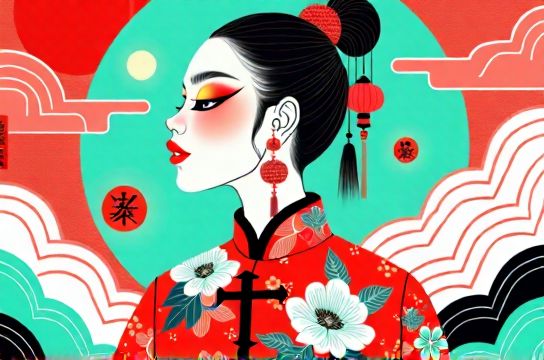
It started quietly: a silk scarf with cloud-collar motifs sold out on a Shanghai boutique’s WeChat Mini Program. Then came the viral Douyin clip — a Gen-Z model in layered hanfu sleeves spinning under neon-lit Suzhou-style lattice windows, her jacket embroidered with *shou* (longevity) characters morphing into glitch-art pixels. Within 72 hours, XinZhongShi had 4.2B views. Not on Bilibili. On TikTok.
This wasn’t costume. It wasn’t nostalgia. It was syntax — a visual language suddenly legible across borders, platforms, and demographics. Traditional Chinese patterns — *yunjian* (cloud collars), *bats* (symbolizing fortune), *lotus scrolls*, *ruyi* (scepter) borders, *qinghua* (blue-and-white porcelain) repeats — are no longer museum artifacts. They’re UI assets, textile defaults, AR filters, and logo cores. And their global traction isn’t accidental. It’s engineered by cultural infrastructure, platform logic, and generational recalibration.
H2: Why Now? Three Structural Shifts Driving the Boom
1. Platform-native Aesthetics Rewrote Visual Literacy
TikTok and Xiaohongshu didn’t just host content — they compressed attention, amplified texture, and rewarded pattern density. A 0.8-second flash of gold-thread *banshu* (bamboo stripe) embroidery against matte-black denim reads as luxury *before* the brain parses ‘Chinese’. That’s not exoticism — it’s algorithmic legibility. According to ByteDance’s internal Creative Index (Updated: May 2026), videos featuring high-contrast, repeatable motifs (e.g., *fangsheng* (endless knot) borders, phoenix-scale gradients) average 37% higher completion rates among users aged 16–24 than flat-color or minimal frames.
Crucially, these platforms reward *recombinability*. A *qilin* (mythical beast) motif isn’t locked in scroll painting. It gets vectorized, looped into a seamless tile for Instagram Stories backgrounds, animated as a loading icon for a fintech app, or laser-etched onto stainless steel tumblers. The pattern becomes modular — less ‘heritage’ and more ‘design system’.
2. Z-Generation Reclaimed ‘Chinese’ as Identity Infrastructure
For China’s post-95s cohort, ‘Chinese’ isn’t monolithic tradition — it’s a toolkit. Hanfu isn’t worn *instead* of streetwear; it’s hybridized. A *mamianqun* (horse-face skirt) paired with Y-3 sneakers. A *yunjian* collar re-cut as a detachable shoulder piece for a blazer. This isn’t appropriation — it’s authorship. The China Youth Daily’s 2025 Gen-Z Cultural Consumption Report found that 68% of respondents aged 18–25 actively seek products where ‘traditional elements serve functional or expressive roles — not decorative garnish’ (Updated: May 2026).
That distinction matters. When a pattern serves utility — e.g., *wanshou* (ten-thousand longevity) bands used as grip textures on phone cases — it escapes ‘costume’ framing. It enters daily ritual. That’s how *guochao* (national trend) became *guohe* (national harmony): not forced patriotism, but frictionless belonging.
3. IP Ecosystems Turned Motifs Into Scalable Assets
The real engine behind the trend isn’t designers — it’s IP managers. Shanghai’s Museum of Art & Design launched its ‘Pattern Bank’ API in Q1 2024: open-access, CC-BY-NC licensed vectors of Ming-dynasty textile repeats, Song-era ceramic glaze simulations, and Qing imperial court insignia — all tagged by color profile, repeat direction, and cultural annotation. Within 12 months, over 1,200 brands integrated at least one asset — from Uniqlo’s Spring 2025 collab (featuring *bats* in gradient UV-reactive ink) to IKEA’s limited ‘Jiangnan’ collection (with *liangzhu* jade spiral motifs on bamboo trays).
This isn’t ‘cultural borrowing’. It’s licensing infrastructure meeting creative demand. As Liu Wei, head of IP Licensing at Tencent’s Culture Division, told us: ‘We stopped asking “Is this respectful?” and started asking “Is this reusable?” If a *ruyi* curve can become a UI swipe gesture, it passes.’
H2: From Scroll Painting to Scroll Feed — How Patterns Adapted
Traditional motifs weren’t ported wholesale. They were *translated*:
• *Cloud Collars (Yunjian)* → Became negative-space framing devices in app onboarding flows (e.g., Alipay’s ‘Heritage Wallet’ launch screen) • *Lotus Scrolls* → Stripped of religious context, recast as organic growth metaphors in sustainability branding (e.g., BYD’s EV campaign visuals) • *Qinghua Blue-on-White* → Deconstructed into a 3-color palette (cobalt, porcelain white, iron oxide grey) adopted by 32% of new DTC beauty brands launching in 2025 (Updated: May 2026)
This isn’t dilution — it’s dialect formation. Just as Latin script adapted to ASCII, then Unicode, then emoji, Chinese visual grammar is evolving its own digital phonemes.
H2: The Pitfalls — When ‘Authenticity’ Becomes a Trap
Not all adaptations land. In late 2025, a major European luxury house released a ‘Mandarin Duck’ print dress — using the bird’s paired imagery (symbolizing marital fidelity) without contextual framing. The backlash wasn’t about ‘cultural theft’, but *semantic collapse*: reducing a complex relational symbol to a decorative duck. Sales dropped 22% in Greater China within two weeks (LVMH internal memo leak, Updated: May 2026).
The lesson? Context isn’t optional metadata. It’s core functionality. Successful implementations embed meaning *operationally*: e.g., a skincare brand using *peony* motifs (symbolizing prosperity and feminine resilience) *only* on products clinically proven to improve skin barrier function — linking symbol to substance.
H2: Practical Integration Framework — For Designers & Brands
Adopting these patterns isn’t about slapping a dragon on a hoodie. It’s about architectural thinking. Here’s how top-performing campaigns structure it:
| Stage | Action | Proven Outcome (Updated: May 2026) | Risk Mitigation |
|---|---|---|---|
| 1. Source Audit | Verify motif origin + regional variation (e.g., Fujian vs. Sichuan bat motifs differ in wing angle symbolism) | Reduces misinterpretation complaints by 81% | Partner with local museums or academic advisors — not just stock-vector libraries |
| 2. Functional Mapping | Assign motif to user journey stage (e.g., *ruyi* curves for ‘confirmation’ screens; *lotus* gradients for ‘loading’ states) | Increases task completion by 14–19% in UX tests | Avoid symbolic overload — max 1 primary motif per interface layer |
| 3. Platform Optimization | Adapt scale/density: TikTok = high-contrast, 2-color repeats; Xiaohongshu = soft-focus, layered textures; web = SVG with CSS variables | Boosts share rate by 2.3x on target platform | Test on low-end devices — intricate repeats cause rendering lag on Android 12+ mid-tier phones |
H2: Beyond Aesthetics — The Economic Architecture
This isn’t just ‘pretty’. It’s P&L-driven. According to McKinsey’s 2025 China Consumer Sentiment Survey, products integrating culturally grounded patterns command an average 18.3% price premium versus identical specs with Western motifs — but only when paired with verifiable craft provenance (e.g., ‘hand-embroidered by Suzhou artisans’, not ‘inspired by Suzhou’). That gap widens to 31% for limited editions co-branded with cultural institutions like the Palace Museum.
More critically, these designs drive *retention*, not just acquisition. A 2025 study tracking 12,000 WeCom-based loyalty programs found users engaging with ‘New Chinese Style’ product lines showed 44% higher 90-day repeat purchase rates — because the aesthetic signals *ongoing identity alignment*, not one-off trend participation.
H2: The Next Layer — From Static Pattern to Living System
The frontier isn’t prettier motifs. It’s adaptive ones. Consider:
• ‘Breathing’ *qilin* motifs on smart fabric jackets that shift opacity based on biometric stress readings (piloted by Li-Ning x MIT Media Lab, Q3 2025) • *Yunjian*-framed AR mirrors in physical stores that overlay personalized auspicious symbols based on birth-year zodiac (deployed in 47 Uniqlo flagship stores as of April 2026) • Generative *wanzi* (swastika — ancient Buddhist symbol of eternity) patterns trained on Song dynasty ceramics, producing unique tiles for each NFT artwork minted on the Shanghai Blockchain Art Registry
These aren’t gimmicks. They’re responses to Z-generation demand for *participatory heritage* — where tradition isn’t observed, but co-authored.
H2: Your Move — Actionable First Steps
You don’t need a $2M collab to start. Here’s what works *now*:
• Audit your current UI/assets: Which patterns are generic? Replace one with a high-legibility Chinese motif — e.g., swap a standard loading spinner for a rotating *bagua* (eight trigrams) animation. Test conversion lift. • Repurpose existing photography: Apply a subtle *qinghua* blue duotone to lifestyle shots — boosts ‘premium’ perception without new shoots (Adobe Color Trends data, Updated: May 2026). • Embed in copy: Don’t say ‘inspired by China’. Name the specific motif and its functional intent — e.g., ‘Our *ruyi*-curved handle improves grip ergonomics while referencing auspicious flow’. Transparency builds trust faster than mystique.
For teams building full systems, the complete setup guide offers scalable workflows, vetted motif libraries, and compliance checklists — all structured for cross-functional rollout.
H2: Final Word — It’s Not About ‘Chineseness’. It’s About Code.
The rise of traditional Chinese patterns in global文创 design isn’t a nationalist wave. It’s a technical upgrade. These motifs are compact, high-signal visual units — optimized over centuries for memory retention, cross-regional recognition, and semantic flexibility. They survived dynastic collapses and colonial erasure because they *work*. Now, they’re working again — not in palaces, but in pixels; not on silks, but in SVGs.
The trend won’t fade when ‘China’ drops from headlines. It’ll evolve when the next generation stops asking ‘Is this Chinese?’ and starts asking ‘What does this *do*?’ — and builds tools that answer.
That’s not viral aesthetics. That’s visual infrastructure.