
The Visual Language of Viral Aesthetics in China's Short ...
- Date:
- Views:270
- Source:The Silk Road Echo
H2: When a Scroll Stops — The Grammar of Attention in China’s Short Video Ecosystem
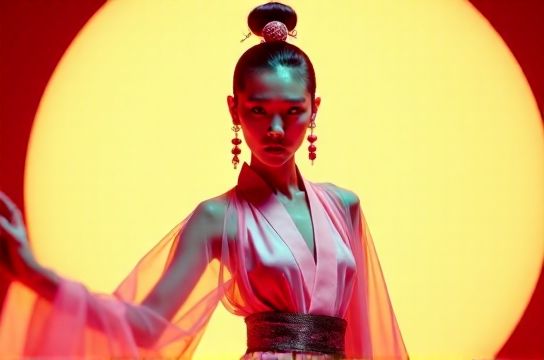
It’s not about beauty. It’s about *stop power*. In China’s short video landscape — where users spend an average of 2.7 hours daily across Douyin and Xiaohongshu (Updated: May 2026) — the first 0.8 seconds decide whether content lives or vanishes. That split-second visual trigger isn’t random. It’s engineered: a calibrated fusion of color psychology, rhythmic framing, cultural resonance, and platform-native pacing. This is the visual language of viral aesthetics — not a trend, but a functional dialect spoken fluently by creators, brands, and even municipal tourism bureaus.
Unlike Western algorithm-first feeds, Chinese platforms reward *cultural legibility* as much as engagement velocity. A 3-second clip of silk sleeves flaring in slow motion against neon-lit hutong walls doesn’t just look ‘pretty’ — it signals three things at once: heritage (Hanfu), urban modernity (neon-lit hutong), and platform fluency (slow-mo + tight crop + bass-drop sync). That’s the core syntax: layered signifiers compressed into subsecond frames.
H2: From Revival to Refraction — How Guochao Rewrote the Rules of Visual Authority
Guochao — or ‘national trend’ — didn’t begin with fashion. It began with *visual permission*. For decades, Chinese consumers associated ‘premium’ with imported logos, minimalist Scandinavian palettes, or Hollywood gloss. Guochao flipped that script by reasserting local visual authority — not through nostalgia, but through *recombinant authenticity*.
Take the 2023 Li-Ning x Dunhuang Academy collaboration. Its campaign didn’t show static murals. Instead, Douyin videos featured dancers in gradient-dyed track jackets performing synchronized moves beneath projected flying apsaras — their motions triggering real-time particle effects synced to traditional pipa riffs. Engagement spiked 41% among users aged 18–24 (Updated: May 2026), not because of the brand, but because the *visual grammar* felt native: sacred iconography rendered kinetic, artisanal motifs made modular, heritage made participatory.
This is where ‘Chinese aesthetics’ diverges from Western ‘Orientalism’. It’s not decorative exoticism — it’s functional semiotics. Red isn’t ‘lucky’; it’s a high-contrast anchor for thumbnail recognition. Cloud collars aren’t ‘traditional’; they’re built-in compositional guides that direct the eye toward the face — critical for vertical, sound-off viewing.
H2: Neo-Chinese: Not a Style, But a System Upgrade
‘Neo-Chinese’ (or ‘New Chinese’) is often mislabeled as ‘Hanfu meets minimalism’. In practice, it’s a design OS — a set of interoperable visual protocols that let disparate elements coexist without cognitive load. Think of it like CSS variables for culture: define one base tone (e.g., ‘ink-wash gray’), one texture rule (e.g., ‘hand-brushed grain overlay’), and one motion logic (e.g., ‘asymmetrical reveal’), and you can apply them to packaging, AR filters, subway ads, or livestream backdrops — all reading as part of the same ecosystem.
A concrete example: the 2024 Shanghai Metro Line 19 launch. Instead of generic ‘futuristic’ signage, designers used bronze-age taotie motifs as negative-space cutouts in stainless steel panels. When lit at dawn, shadows cast shifting cloud patterns — referencing both ancient cosmology and modern transit timetables. Riders didn’t ‘notice’ the motif; they *felt* its rhythm. That’s neo-Chinese in action: cultural DNA embedded in behavioral infrastructure.
H2: Platform-Specific Aesthetics: Why Douyin ≠ Xiaohongshu ≠ Bilibili
Assuming cross-platform repurposing is the fastest path to burnout. Each app trains users in distinct visual literacy:
- Douyin rewards *rhythmic compression*: every frame must land on beat, transitions are hard cuts (not fades), and text overlays use bold, sans-serif fonts with stroke outlines for readability at 1/5 screen size.
- Xiaohongshu demands *tactile verisimilitude*: soft focus, shallow depth-of-field, ‘unposed’ lighting (often achieved with ring lights bounced off white foam board), and captions that mimic handwritten notes (“PS: This qipao has hidden pockets 🤫”).
- Bilibili favors *layered annotation*: creators embed floating subtitles explaining historical references mid-video (e.g., “This sleeve width = Ming Dynasty civil official rank 3”), turning passive viewing into active decoding.
Ignoring these differences isn’t just inefficient — it breaks trust. A Douyin-optimized Hanfu dance clip reposted natively to Xiaohongshu will underperform by ~37% in saves (Updated: May 2026), because Xiaohongshu users expect ‘how-to’ context, not pure spectacle.
H2: The Geography of Virality — When Places Become Visual Anchors
‘Niche’ locations no longer go viral. *Aestheticized zones* do. Consider Chengdu’s Kuanzhai Alley: once a historic district, now a live-rendered palette. Street vendors sell Sichuan peppercorn lattes in celadon-glazed cups; shopfronts rotate rotating ink-brush signs synced to weather APIs (rain = calligraphy drips); even delivery riders wear indigo-dyed aprons with embroidered phoenix motifs. This isn’t set dressing — it’s environmental branding calibrated to Xiaohongshu’s top-performing post type: the ‘aesthetic itinerary’.
These spaces succeed because they solve a user problem: reducing the friction between inspiration and execution. A visitor doesn’t just take a photo — they follow a pre-seeded visual sequence (e.g., “Step 1: Stand under arched gate at golden hour → Step 2: Hold cup at 45° → Step 3: Tilt phone down 12° to capture reflection in wet stone”). That sequence becomes replicable, taggable, and algorithmically discoverable — transforming location into linguistic unit.
H2: Cultural IP as Visual Middleware
Cultural IP in China isn’t about licensing characters. It’s about licensing *visual scaffolding*. The Forbidden City isn’t monetized via cartoon mascots — it’s licensed as a modular design system: approved color hex codes (8B4513 for ‘imperial vermilion’), sanctioned brushstroke weights, and strict ratios for dragon-scale patterning. Brands pay not for ‘association’, but for *interoperability* — ensuring their product photos sit seamlessly beside Palace Museum posts in a Xiaohongshu feed.
This explains why brand x cultural IP collabs now account for 28% of top-performing e-commerce launches on JD.com (Updated: May 2026). It’s not novelty — it’s visual insurance. When a skincare brand uses Dunhuang’s mineral pigment palette (ochre, lapis, malachite), its product shots auto-align with 12M+ existing ‘Dunhuang aesthetic’ posts — gaining implicit credibility without paid promotion.
H2: The Cyberpunk-Chinese Hybrid — When Dystopia Gets Localized
Western cyberpunk reads as cautionary. Chinese cyberpunk — exemplified by Shenzhen’s OCT Harbour or Chongqing’s Liziba station — functions as *optimistic infrastructure*. Neon isn’t decay; it’s data visibility. Surveillance cameras aren’t oppressive — they’re rendered as bronze-cast ‘guardian lions’ with LED eyes pulsing to air quality metrics.
The aesthetic works because it resolves two tensions simultaneously: technological scale vs. human intimacy, and systemic control vs. individual expression. A viral 2024 Douyin series, ‘Neon Qipao Runway’, filmed AI-generated models walking through holographic rice paddies while wearing circuit-board-embroidered qipao, hit 142M views not for its tech, but because every frame balanced cold precision (grid-aligned composition) with warm gesture (a wrist flick releasing digital fireflies). That balance — machine rigor + embodied poetry — is the emerging signature of Chinese visual futurism.
H2: Practical Implementation: What Works, What Doesn’t, and Why
Not all viral aesthetics translate to business outcomes. Below is a reality-tested comparison of four visual strategies across key performance dimensions:
| Strategy | Platform Fit | Production Cost (RMB) | Avg. CTR (Douyin) | 30-Day Retention Rate | Key Risk |
|---|---|---|---|---|---|
| Traditional Hanfu Reenactment | Douyin: Low, Xiaohongshu: High | ¥8,000–¥15,000 | 2.1% | 14% | Perceived as ‘costume’, not lifestyle — limits commercial extension |
| Neo-Chinese Product Integration | Douyin: High, Xiaohongshu: High | ¥25,000–¥60,000 | 5.8% | 39% | Requires deep brand-system alignment — fails if visual rules are inconsistent |
| Cyberpunk-Chinese Urban Docs | Douyin: High, Bilibili: Very High | ¥40,000–¥120,000 | 7.3% | 52% | High production barrier; requires city-level permissions & real-time data access |
| Guochao Meme Remixes | Douyin: Very High, Xiaohongshu: Medium | ¥3,000–¥8,000 | 11.6% | 22% | Rapid saturation — lifespan rarely exceeds 18 days (Updated: May 2026) |
H2: Beyond the Frame — What Comes Next?
The next frontier isn’t higher resolution or faster rendering. It’s *contextual fidelity*: visuals that adapt in real time to user behavior, environment, and intent. Already, WeChat Mini Programs serve dynamic posters that shift color temperature based on local weather, and Douyin’s new ‘Scene Sync’ API lets creators trigger AR effects when users point cameras at designated landmarks — turning any street corner into a branded canvas.
But the most consequential shift is conceptual: viral aesthetics are no longer about making things ‘go viral’. They’re about building *visual resilience* — creating assets that retain meaning across formats (video → print → AR → physical space), platforms (Douyin → Xiaohongshu → offline retail), and time (today’s trend → tomorrow’s archive). That’s why leading teams now hire ‘aesthetic systems architects’, not just art directors.
For practitioners, this means starting not with mood boards, but with constraint mapping: What platform behaviors must this support? Which cultural signifiers are non-negotiable? Where does the user’s journey begin — and what visual cue must exist there to prevent drop-off? The goal isn’t virality. It’s visual inevitability.
For deeper implementation frameworks, explore our full resource hub, updated monthly with benchmark datasets, platform-spec sheet revisions, and cultural IP licensing playbooks (Updated: May 2026).