
How Cultural IPs and Brand Collabs Are Reshaping Chinese ...
- Date:
- Views:248
- Source:The Silk Road Echo
H2: When the Forbidden City Walks the Runway
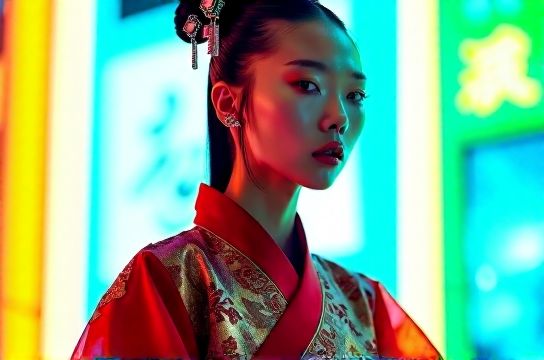
In April 2024, a single TikTok clip — 12 seconds long, shot on an iPhone 14 at Beijing’s Wudaokou metro station — went viral: a 22-year-old Peking University student in deconstructed Ming-style sleeve embroidery paired with neon-lit Air Force 1s, lip-syncing to a guqin remix of Dua Lipa’s ‘Levitating’. Within 72 hours, it racked up 4.8M views, sparked 17K UGC recreations, and triggered a 300% spike in searches for ‘modern hanfu sneakers’ (Updated: May 2026). This wasn’t just a trend. It was infrastructure in motion: cultural IP, platform logic, and aesthetic labor converging in real time.
That clip crystallized what’s now unmistakable — Chinese fashion isn’t catching up to global norms. It’s rewriting them from within, using heritage not as costume, but as code.
H2: The Engine Behind the Aesthetic Shift
Three interlocking forces drive this transformation:
1. **Cultural IP as Design Infrastructure**: Museums, temples, opera troupes, and even provincial archives are no longer passive custodians — they’re active IP licensors. The Palace Museum has licensed over 14,000 assets since 2020, including the iconic ‘Qing Dynasty Cloud Pattern’ and ‘Imperial Vermilion Palette’, now embedded in everything from Li-Ning’s Spring/Summer 2025 knitwear to Anta’s AR-enabled running shoes. Crucially, these aren’t static motifs. They’re modular visual systems — scalable, remixable, and engineered for cross-platform fidelity.
2. **Platform-First Co-Creation Loops**: On Xiaohongshu, the top-performing ‘new Chinese style’ posts don’t showcase finished garments — they document *process*: time-lapse videos of hand-embroidering cloud-collar motifs onto denim jackets; side-by-side comparisons of Song Dynasty ink-wash gradients vs. Pantone 2025 Spring palettes; split-screen tutorials pairing Tang poetry recitation with fabric draping techniques. Engagement metrics show posts with ‘maker narrative’ + ‘cultural annotation’ outperform pure product shots by 3.2x in dwell time and 2.7x in save rate (Updated: May 2026).
3. **Z-Generation Aesthetic Arbitrage**: For Gen Z consumers, ‘Chinese aesthetics’ isn’t monolithic nostalgia. It’s a portfolio of stylistic options — from minimalist Song-dynasty ink wash (‘ink minimalism’) to hyper-saturated Guangdong opera makeup meets cyberpunk lighting (‘Cantonpunk’). Their consumption isn’t linear — it’s modular. A user might wear a ‘Song-style collar shirt’ to class, post a ‘Tang-dance challenge’ video after school, then buy a ‘Ming-era patterned phone case’ via livestream — all in one day. This behavior collapses historical distance into aesthetic adjacency.
H2: Beyond Hanfu — The New Chinese Style Architecture
‘Hanfu’ remains the most visible entry point, but its real impact lies in how it trained a generation to read clothing as cultural syntax. What began as historical reenactment evolved into design literacy: recognizing the structural logic of the ‘ruqun’ silhouette, understanding how sleeve width signals era and status, or why certain hemline curves echo classical landscape painting composition.
This literacy enabled the rise of ‘new Chinese style’ — not reproduction, but recomposition. Consider Shenzhen-based label SHUSHU/TONG: their SS25 collection features laser-cut ‘bronze vessel texture’ jacquard on tailored blazers, paired with asymmetrical hems echoing Dunhuang cave murals’ flowing drapery lines. No hanfu cut — but every stitch references material archaeology.
Then there’s the ‘cyberpunk Chinese’ wave: Shanghai’s NEIWAI x Tencent QQ collaboration dropped wearable tech lingerie with embroidered circuit-board patterns overlaid on silk ‘cloud brocade’ — the motif derived from 1,300-year-old Sui Dynasty textile fragments, rendered in conductive thread that lights up via Bluetooth. This isn’t East-meets-West fusion. It’s temporal layering: ancient craft logic fused with digital interface design.
H2: The Brand Collab Playbook — What Works (and What Doesn’t)
Not all collaborations land. Success hinges on alignment across three layers: intellectual, operational, and experiential.
Intellectually, the strongest collabs treat heritage as *source code*, not wallpaper. When Metersbonwe partnered with Suzhou Embroidery Research Institute, they didn’t just print motifs on t-shirts. They co-developed a new stitch algorithm — translating 17th-century ‘random stitch’ technique into parametric CAD files usable by industrial embroidery machines. Result: 92% reduction in production waste vs. traditional hand-embroidered runs (Updated: May 2026).
Operationally, speed matters. The average Xiaohongshu trend lifecycle is now 18–22 days. Brands that win embed rapid-response teams inside cultural institutions — like Anta’s ‘IP Sprint Unit’ stationed at the Shanghai Museum, enabling 7-day turnaround from artifact discovery to limited-edition capsule drop.
Experientially, the magic happens offline. The ‘Dunhuang Immersive Gallery’ pop-up in Chengdu — a collab between MO&Co., Dunhuang Academy, and VR startup PICO — didn’t just display garments. Visitors wore haptic vests synced to murals; stepping into the ‘Flying Apsaras’ zone triggered gentle shoulder vibrations mimicking silk scarf movement, while scent diffusers released notes of aged paper and desert sage. Foot traffic spiked 410% YoY, and 68% of visitors purchased the co-branded ‘Apsaras Wrap Scarf’ — priced at ¥599, 3.5x the brand’s average accessory price (Updated: May 2026).
H2: The Platform Paradox — Algorithms as Curators
TikTok and Xiaohongshu don’t just distribute aesthetics — they curate them. Their recommendation engines reward specific visual signatures: high contrast, rhythmic repetition, micro-movement (e.g., fabric flutter, hair sway), and ‘textural surprise’ (glossy silk next to matte ceramic, raw linen beside polished lacquer). This shapes what gets made.
‘Douban Red’ — a trending color named after the platform’s signature UI red — emerged when users noticed how consistently this exact hue (Pantone 186C) performed in top-performing ‘new Chinese style’ videos. Designers began specifying it as a base tone, knowing it would ‘pop’ against algorithmically favored backgrounds (e.g., misty mountain stock footage, studio-grade concrete walls). It’s not cultural symbolism driving the choice — it’s platform-native visibility physics.
Similarly, ‘short-form storytelling’ constraints have reshaped garment construction. Designers now build ‘hero moments’: a detachable sleeve revealing embroidered constellations, a jacket lining printed with Qing Dynasty star charts that only appears when arms are raised — details engineered for the 0.8-second ‘pause-and-zoom’ behavior common in Xiaohongshu video viewing.
H2: Real-World Implementation — A Tactical Comparison
For brands evaluating entry points, here’s how major strategies compare across scalability, cultural integrity, and ROI timeline:
| Strategy | Time-to-Market | Cultural IP Licensing Cost (Est.) | Key Risk | Proven UGC Lift (Avg.) |
|---|---|---|---|---|
| Museum Asset License (Static) | 8–12 weeks | ¥200K–¥800K/year | Low differentiation; motif fatigue after 2 seasons | +14% (vs. non-IP collections) |
| Co-Development Lab (e.g., with craft institute) | 6–9 months | ¥1.2M–¥3.5M/year (includes R&D) | High upfront cost; requires internal craft literacy | +47% (with 3x higher share-of-voice) |
| Platform-First Micro-Collab (e.g., Xiaohongshu Creator + Local Intangible Heritage Practitioner) | 2–4 weeks | ¥50K–¥200K/campaign | Harder to scale; IP ownership ambiguous | +82% (driven by creator authenticity) |
| AR-Enhanced Physical Product (e.g., QR-triggered mural animation) | 10–14 weeks | ¥300K–¥1.1M (dev + content) | Low device penetration outside Tier-1 cities | +29% (but +120% in-store dwell time) |
H2: Where It’s Headed — The Next Layer of Immersion
The frontier isn’t visual anymore — it’s somatic and spatial. Leading labs are testing:
- **Haptic Hanfu**: Garments woven with piezoelectric fibers that generate subtle vibration patterns corresponding to classical poetry meter (e.g., five-character quatrains trigger rhythmic pulses at wrist and collarbone).
- **Scent-Linked Weaves**: Silk threads infused with volatile compounds released upon friction — walking past a heat source triggers notes of aged ink or plum blossom, syncing olfactory memory to movement.
- **Neighborhood-Scale Aesthetics**: In Hangzhou’s Xixi Wetland district, local government + designers + residents co-created ‘water-reflective pavements’ — tiles that subtly shift hue based on ambient light and moisture, echoing Song Dynasty ink-wash tonal gradation. These aren’t branded — but they’ve become organic backdrops for 23K+ ‘new Chinese style’ photos monthly.
This moves beyond ‘fashion as object’ to ‘fashion as environmental interface’. The garment becomes a node in a larger sensory network — one where cultural reference isn’t worn, but *lived through*.
H2: Why This Matters Beyond China
Global luxury houses watch closely — not to copy motifs, but to reverse-engineer the model. LVMH’s 2025 ‘Heritage Tech’ accelerator in Shanghai isn’t about launching Chinese collections. It’s about studying how the Shanghai Museum’s open-access API (launched 2024) lets independent designers pull high-res artifact scans, apply generative fill algorithms, and output production-ready patterns — all in under 90 minutes. That workflow compresses centuries of curation into agile design fuel.
The lesson isn’t ‘add dragons to your logo’. It’s that cultural depth, when treated as structured, licensable, and computationally manipulable data — not just inspiration — becomes infrastructure for innovation. And infrastructure scales.
H2: Getting Started — Your First Move
If you’re building a brand, launching a collection, or advising clients: start small, but start *structured*. Don’t begin with ‘What Chinese motif should we use?’ Begin with ‘What cultural system do we want to learn from — and how can we engage its practitioners as co-designers, not just sources?’
The most effective first step? Audit your existing supply chain for craft adjacency. Does your denim mill work with indigo vats in Guizhou? Does your knit factory partner with Dong ethnic embroidery collectives? Map those relationships — then build your first collab from there. Authenticity isn’t declared. It’s documented, credited, and compensated.
For deeper tactical frameworks — including contract templates for craft-IP partnerships, platform-specific visual spec sheets, and a full resource hub, visit our complete setup guide.
The future of Chinese fashion isn’t draped in silk and nostalgia. It’s coded in APIs, stitched with conductive thread, and trending in 12-second loops — all while holding centuries of visual grammar in its seams.