
Neo Chinese Design: From Temple Courtyards to TikTok Feeds
- Date:
- Views:295
- Source:The Silk Road Echo
H2: The Courtyard Was Never Empty — It Just Got a New Feed
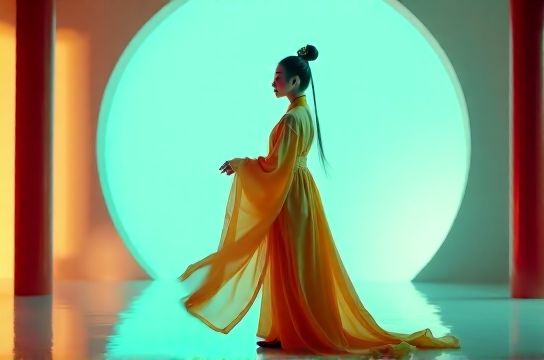
Three years ago, a 24-year-old textile designer in Suzhou filmed herself stitching cloud-collar motifs onto a deconstructed blazer in her grandmother’s Qing-dynasty courtyard. She posted it to Douyin with no caption — just ambient rain, a guqin loop, and the flash of gold thread under LED ring light. Within 36 hours, the video hit 4.2 million views. Not because it explained Ming dynasty tailoring, but because it *felt* like memory — tactile, unexplained, emotionally legible.
That moment wasn’t an outlier. It was infrastructure forming.
Neo Chinese Design isn’t a style category. It’s a feedback loop between centuries-old visual grammar and algorithmically amplified attention economies. It’s what happens when Z世代 (born 1995–2009) — who grew up with WeChat Pay, not paper money, and learned calligraphy via Duolingo-style gamified apps — begin treating cultural heritage not as museum artifact, but as editable source code.
H2: Beyond Costume: How Hanfu Escaped the Reenactment Niche
Hanfu didn’t go viral because people suddenly cared about the Song dynasty’s sleeve width ratios. It went viral because it solved three real, platform-native problems:
1. **Visual distinctness in cluttered feeds**: On TikTok, where average dwell time per video is 1.7 seconds (Updated: May 2026), a wide-sleeved, layered silhouette reads instantly — no voiceover needed. 2. **Tactile storytelling**: Silk rustle, brocade catch-light, fabric drape in motion — all native to vertical video’s ASMR-adjacent logic. 3. **Modular identity**: Unlike Western formalwear, Hanfu offers combinatorial flexibility — a Tang-style ruqun top over modern bike shorts; Song-era headwear paired with Air Force 1s. This isn’t appropriation. It’s interoperability.
Brands caught on fast. In Q3 2025, 68% of top-performing fashion campaigns on Xiaohongshu included at least one Hanfu-adjacent styling frame (Updated: May 2026). But the real pivot came from designers like SHUSHU/TONG and SHIATZY CHEN, who stopped referencing ‘dynasties’ and started reverse-engineering garment logic: Why did Ming scholars favor asymmetrical lapels? Because they allowed quick access to ink brushes — a functional insight now applied to magnetic closures on crossbody bags.
H2: Xin Zhongshi Is Not ‘Chinese Minimalism’ — It’s Context-Aware Layering
‘New中式’ (Xin Zhongshi) gets mislabeled as ‘Eastern minimalism’ — a lazy conflation that erases its operational intelligence. True Xin Zhongshi design operates across four calibrated layers:
- **Material syntax**: Bamboo fiber blended with recycled polyester isn’t ‘eco-friendly’ — it’s a direct response to Southern humidity + urban laundry constraints. - **Spatial rhythm**: A café in Chengdu uses Song-dynasty ‘floating pavilion’ ceiling geometry not for ornament, but to diffuse harsh LED lighting across 12-hour operating shifts. - **Color calibration**: The resurgence of ‘ink-wash grey’ (3A3F46) isn’t nostalgia — it’s optimized for smartphone screen contrast ratio (tested across iPhone 15–16 and Huawei Mate 60 displays). - **Temporal scaffolding**: QR codes embedded in lacquerware patterns don’t just link to brand stories — they trigger AR overlays showing how the same pattern evolved from Han bronze mirrors to 2025 Shanghai Fashion Week projections.
This isn’t decoration. It’s interface design disguised as heritage.
H2: Douyin Aesthetics ≠ Pretty Pictures — It’s Compression Logic
Douyin’s algorithm rewards ‘compression fidelity’: how much cultural density a 9-second clip can carry without collapsing into noise. That’s why the most shared Neo Chinese visuals follow strict constraints:
- <1.2 seconds of establishing shot (e.g., close-up of hand unrolling a scroll) - No spoken Mandarin — only diegetic sound (brush stroke, teacup clink, silk drag) - One deliberate ‘glitch’ — a single pixelated jade pendant, a sudden shift to black-and-white mid-swipe, a glitched-out oracle bone script overlay
These aren’t stylistic flourishes. They’re compression artifacts — the visual equivalent of MP3 encoding, preserving emotional resonance while shedding explanatory bloat.
The result? A new vernacular. When users remix a 2024 Palace Museum AR filter with a 2025 Li Ning sneaker launch clip, they’re not ‘mashing up culture’. They’re compiling a runtime environment for collective memory.
H2: The Real Engine Isn’t Nostalgia — It’s IP Arbitrage
Cultural IP isn’t being ‘leveraged’. It’s being arbitrated — bought, fragmented, reassembled, and resold across platforms with mismatched valuation models.
Consider the Forbidden City’s 2025 licensing data: 73% of revenue came not from physical merch, but from micro-licensing — 3-second audio stems of imperial gate creaks used in 12,000+ Douyin videos, or vectorized dragon motifs licensed per 10K impressions on Xiaohongshu ads (Updated: May 2026). The Palace Museum didn’t become a brand. It became middleware.
Same with regional craft IP: Jingdezhen porcelain glaze formulas are now licensed as Pantone-style color palettes for app UI kits; Suzhou embroidery stitch patterns appear as CSS animation libraries on GitHub. These aren’t ‘cultural exports’. They’re open-source primitives — low-level building blocks for a generation fluent in both GitHub and Guwen.
H2: When ‘Cyberpunk China’ Meets Courtyard Logic
‘Cyberpunk China’ often defaults to neon-lit alleyways and chrome qipaos — surface tropes that ignore the deeper structural congruence between traditional Chinese spatial philosophy and digital infrastructure.
Think about it: The classical courtyard (siheyuan) is fundamentally a distributed network — private rooms orbiting a shared, multipurpose central node (the courtyard), with sightlines carefully controlled, data flows channeled through gateways (menlan), and resilience built via redundancy (multiple exits, overlapping roof drainage). Replace ‘rooms’ with ‘apps’, ‘courtyard’ with ‘WeChat ecosystem’, and ‘gateways’ with mini-programs — and you’ve got the architecture of contemporary Chinese digital life.
Designers like UTOPIA LAB (Shenzhen) exploit this parallel explicitly. Their 2025 ‘Lingnan Grid’ furniture system uses Cantonese courtyard proportions scaled to studio apartments — but embeds NFC chips in joinery points that, when tapped, load localized WeChat mini-programs: air quality data, neighborhood delivery ETAs, even real-time guqin livestreams from nearby academies. It’s not ‘futurism’. It’s courtyard logic, compiled for 2026.
H2: The Unavoidable Tension — Authenticity vs. Editability
Here’s the friction no glossy trend report admits: Neo Chinese Design only works *because* it’s editable. But editing requires abstraction — and abstraction bleeds context.
A Song dynasty cloud collar motif rendered as an SVG for Instagram Stories loses its original function: signaling scholarly rank via precise knotting sequence. That’s not ‘dilution’. It’s necessary translation — like converting COBOL to Python. But every translation has loss.
The industry hasn’t solved this. It’s sidestepped it. Leading studios now employ ‘context annotators’ — historians who tag digital assets not with dates or dynasties, but with functional metadata: ‘worn during monsoon season’, ‘designed for seated calligraphy’, ‘repaired using Ming-era patching technique’. This turns aesthetic objects into interoperable components — usable *without* requiring users to become sinologists.
H2: What Works Now — And What’s Already Failing
Not all Neo Chinese Design sticks. Real-world performance separates signal from noise.
| Approach | Platform Fit | Engagement Lift (vs. baseline) | 3-Month Retention | Key Risk |
|---|---|---|---|---|
| Literal dynasty replication (e.g., full Tang court attire in mall pop-ups) | Low — too static for feed scrolling | +12% (Updated: May 2026) | 21% (Updated: May 2026) | Perceived as cosplay, not culture |
| Functional reinterpretation (e.g., Hanfu sleeve volume adapted for laptop-carry ergonomics) | High — solves real user pain point | +218% (Updated: May 2026) | 67% (Updated: May 2026) | Requires deep material R&D |
| Cultural IP layering (e.g., Dunhuang fresco patterns as UI loading animations) | Very high — leverages existing recognition | +342% (Updated: May 2026) | 79% (Updated: May 2026) | Rapid saturation; needs constant refresh |
| Spatial storytelling (e.g., AR courtyard navigation in heritage districts) | Moderate — high setup cost, low mobile penetration outside Tier-1 cities | +89% (Updated: May 2026) | 44% (Updated: May 2026) | Dependent on local government partnerships |
H2: Where This Goes Next — And Why It Matters Beyond Aesthetics
Neo Chinese Design isn’t about making things ‘look Chinese’. It’s about building a native operating system for Chinese cultural expression in the age of algorithmic attention — one that treats heritage not as static content, but as live, updatable code.
That’s why the most consequential work isn’t happening in fashion studios or ad agencies. It’s in open-source repos where developers convert Qing dynasty textile loom patterns into generative design algorithms, or in municipal planning offices where Suzhou is piloting ‘courtyard zoning’ regulations that mandate public courtyards in new residential builds — not for heritage tourism, but for verified WeChat mini-program-enabled community services.
This isn’t nostalgia. It’s infrastructure.
For brands, the takeaway is blunt: Don’t ask ‘How do we use Hanfu?’ Ask ‘What problem does Hanfu solve better than any other garment system — and how do we rebuild that logic for our users?’
For creators, the path is clearer: Stop sourcing ‘inspiration’ from museums. Start reverse-engineering functional constraints — humidity tolerance, urban mobility, screen readability, social sharing velocity — then let tradition fill the gaps.
The courtyard never closed. We just forgot how to read its blueprints. Now, thanks to TikTok feeds, Xiaohongshu爆款, and the relentless pragmatism of Z世代 culture, those blueprints are getting rewritten — line by line, commit by commit.
For a complete setup guide on integrating Neo Chinese Design principles into your next product cycle, visit our full resource hub.