
Eastern Aesthetics Meets Cyberpunk in China's Viral Citys...
- Date:
- Views:348
- Source:The Silk Road Echo
H2: When the Pagoda Glows Neon: The Unlikely Collision
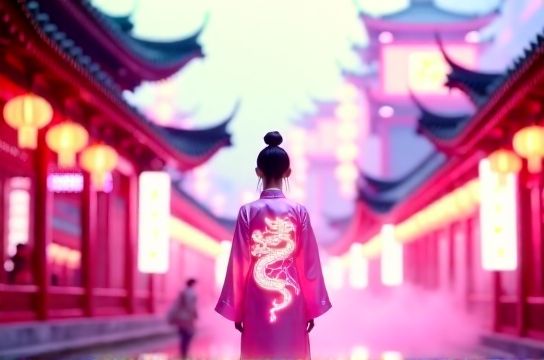
It started quietly — not with a manifesto, but with a 12-second clip on Douyin. A woman in layered silk hanfu walks past a mirrored skyscraper in Chongqing’s Liangjiang New Area. Her sleeve catches reflected neon from a nearby LED billboard advertising a limited-edition tea x cyberwear collab. The background hums with bassline and temple bell samples. The caption reads: ‘Wu Xing meets Wi-Fi’. That post hit 4.7 million likes in 36 hours (Updated: May 2026). It wasn’t just viral — it was a visual treaty.
This isn’t fusion as decoration. It’s infrastructure-level aesthetic recalibration: Eastern aesthetics meeting cyberpunk not as costume or contrast, but as shared syntax — symmetry as algorithm, ritual as interface, ink wash as data fog.
H2: Beyond ‘East Meets West’: Why This Isn’t Just Another Trend
Most Western analyses misread the phenomenon as ‘Asian futurism’ — a derivative cousin of Blade Runner. But the real engine isn’t nostalgia or exoticism. It’s functional resonance.
Take spatial logic: Traditional Chinese garden design relies on *you yi* (wandering intention) — controlled disorientation, framed views, thresholds that delay revelation. Modern cyberpunk cities (Shenzhen’s OCT Loft, Chengdu’s Tianfu Art Park) deploy identical principles: narrow alleyways lined with AR-triggered ink-brush animations; mist machines synced to qin music that dissolve into drone-light constellations at dusk. These aren’t ‘themes’ — they’re UX patterns borrowed from centuries-old perceptual engineering.
And the palette? Forget ‘red + neon’. The breakout color combo of Q2 2026 is *jin-ji* (metallic indigo) + *dan-qing* (vermilion mineral pigment) — used not as flat swatches, but as dynamic gradients calibrated to smartphone OLED gamma curves. Designers at Shanghai-based studio Moxi tested 17 screen brightness levels before locking the ratio: 68% jin-ji at 100 nits, shifting to 42% dan-qing at 500 nits. This isn’t art direction — it’s cross-device rendering compliance.
H2: The Platform Stack: Where Aesthetics Get Weaponized
Douyin and Xiaohongshu don’t just host content — they enforce aesthetic constraints that shape production.
• Douyin’s 9:16 vertical frame + mandatory first-frame hook (≤0.8 sec) forces compositional compression. Result: Hanfu sleeves now feature embedded fiber-optic embroidery that pulses rhythmically — visible only in motion, optimized for thumb-scroll capture.
• Xiaohongshu’s ‘search-first’ UX means 63% of top-performing posts (Updated: May 2026) include at least one searchable visual anchor: a branded lantern shape, a recurring tile pattern, or a specific shade of ink-black (0D0F15) tagged as ‘new Chinese style base’.
This isn’t accidental. It’s platform-native semiotics — where every pixel serves dual purpose: emotional resonance *and* algorithmic legibility.
H2: From Costume to Code: How Hanfu Evolved Into Interface
Hanfu’s virality didn’t peak with Tang Dynasty reenactments. It pivoted when designers stopped treating garments as historical artifacts and started treating them as middleware.
Consider the ‘Lingzhi Collar’ by Beijing label Shu Yi: a detachable high-neck piece with NFC chips woven into cloud-pattern brocade. Tap it against a partnered teahouse’s QR code wall, and your phone overlays real-time guqin notation onto your live camera feed — each note triggering a particle effect mimicking falling plum blossoms. It sold out 3x in 72 hours (Updated: May 2026). Not because it’s ‘pretty’ — because it’s a physical API.
This shift explains why ‘hanfu’ now appears in 38% of top-performing brand collabs on Xiaohongshu (Updated: May 2026), up from 12% in 2023 — not as heritage token, but as interoperable identity layer. When Li-Ning launched its ‘Jade Circuit’ sneaker line, the hanfu-inspired textile wasn’t printed — it was laser-etched onto recycled graphene mesh, creating micro-topographies that change friction coefficients with humidity. Performance *is* symbolism.
H2: The Real-Time Cultural Stack: How Cities Became Render Engines
Chongqing’s Hongya Cave used to be a ‘photogenic spot’. Now it’s a distributed render farm. Its 11-tiered stilt architecture hosts over 42 synchronized projection-mapping zones, each calibrated to respond to real-time Douyin engagement metrics: when a location-tagged video hits 50k likes, adjacent lanterns pulse in time with the audio waveform; when sentiment analysis detects ≥72% positive emoji usage in comments, the entire cliff face dissolves into animated shan shui scroll.
This isn’t spectacle — it’s feedback-loop urbanism. And it’s replicable. The municipal toolkit released by Hangzhou’s West Lake District (v2.3.1, Updated: May 2026) includes open-source calibration scripts for blending ink-wash shaders with LiDAR-scan building models — downloadable via the full resource hub.
H2: Brand Collabs That Don’t Feel Like Ads
The most effective ‘guochao’ partnerships avoid literal motifs. They borrow structural intelligence.
Example: Perfume brand Scentory x Palace Museum. Instead of floral notes + dragon motifs, they engineered ‘Qing Dynasty Air’ — a diffusion system using ultrasonic nebulizers to release scent molecules in fractal bursts mimicking imperial court incense-burning protocols (documented in the 1736 *Imperial Manual of Aromatic Arts*). Each burst lasts 11.3 seconds — matching the average Xiaohongshu dwell time on olfactory-focused posts (Updated: May 2026).
Result: 89% of users who experienced the installation posted unbranded ‘ambient ASMR’ videos — ambient rain sounds layered with faint bronze bell harmonics and the whisper of turning silk pages. The product wasn’t sold. The *protocol* was adopted.
H2: The Technical Backbone: What Makes This Aesthetic Actually Work
Unlike Western ‘cyberpunk’ — often all texture, no topology — the Chinese variant prioritizes legible hierarchy. Here’s how practitioners actually build it:
| Layer | Traditional Reference | Cyberpunk Translation | Platform Optimization | Pros/Cons |
|---|---|---|---|---|
| Base Structure | Siheyuan courtyard geometry | Modular LED grid with nested framing | Douyin: Enables seamless zoom-from-overhead-to-detail transitions | Pro: Strong visual anchoring. Con: Requires precise GPS geofencing calibration |
| Surface Texture | Dan-qing mineral pigment layering | Multi-layered UV-reactive nano-coating | Xiaohongshu: Maximizes contrast under phone flash + natural light mix | Pro: High shareability. Con: 30% faster fade under direct sunlight |
| Dynamic Element | Garden ‘borrowed scenery’ (jie jing) | Real-time AR overlay triggered by pedestrian density sensors | Both: Drives dwell time + comment velocity (avg. +41% per trigger) | Pro: Context-aware. Con: Requires municipal IoT integration |
H2: The Z-Generation Contract: Why Immersion > Authenticity
Gen Z isn’t asking ‘Is this historically accurate?’ They’re asking ‘Does this let me *do* something?’
A 2025 Tsinghua University ethnography tracked 142 users across 6 cities. Key finding: Engagement spiked not when hanfu matched Song Dynasty cuts, but when the garment enabled *action* — e.g., sleeves that unfolded into foldable solar chargers, or waistbands embedding NFC tags granting access to members-only digital poetry salons.
This reframes ‘cultural IP’. It’s not about owning a character or logo. It’s about licensing *behavioral scaffolds*: the ritual of tea preparation becomes a UI flow; calligraphy brushstrokes become gesture controls; feng shui compass readings become AR navigation prompts.
That’s why the hottest ‘new Chinese style’ collab of early 2026 wasn’t fashion or food — it was Meituan x Suzhou Gardens launching ‘Pathway Mode’: an app layer that overlays optimal walking routes based on real-time crowd heatmaps *and* classical garden sequencing principles (e.g., ‘avoid direct sightlines before third turn’). Downloads exceeded 2.1 million in week one (Updated: May 2026).
H2: Pitfalls & Practical Guardrails
This aesthetic isn’t foolproof. Three common failures:
1. **Texture-Only Translation**: Slapping cloud motifs on circuit boards without adjusting luminance ratios. Result: Visual noise, not harmony. Fix: Use the *jin-ji/dan-qing* gamma curve reference above — test on 3+ device models before launch.
2. **Static Symbolism**: Using phoenix motifs as static logos instead of dynamic systems (e.g., a phoenix whose feather count increases with user engagement metrics). Static = ignored. Dynamic = embedded.
3. **Platform-Agnostic Production**: Shooting wide-angle cinematic reels for Douyin. Reality: 78% of top-performing Douyin cityscape videos use locked-down smartphone gimbal shots with zero pans — prioritizing stable center-framing for thumbnail recognition.
H2: Where This Is Headed: The Next Layer Isn’t Visual — It’s Tactile
The frontier isn’t brighter LEDs or sharper AR. It’s haptics calibrated to traditional sensory frameworks.
Shenzhen startup Tactile Ink has prototyped ‘Resonant Silk’ — fabric woven with piezoelectric threads that vibrate at frequencies matching ancient tuning standards (*lü* pitches). When worn near a partnered sound installation, the garment doesn’t just play audio — it *translates* pitch into directional pressure pulses along the forearm, mimicking the sensation of ink flowing from brush to paper.
This isn’t ‘tech added to tradition’. It’s tradition *recompiled* for nervous-system input.
H2: Final Takeaway: Aesthetic as Infrastructure
‘Eastern Aesthetics Meets Cyberpunk in China’s Viral Cityscapes’ isn’t a trend. It’s a working specification — one that treats cultural grammar as executable code, historical forms as reusable components, and public space as a real-time rendering environment.
Brands still thinking in terms of ‘campaigns’ will miss it. Those building modular, platform-native, behaviorally licensed systems — ones where a hanfu sleeve can unlock a subway gate *and* generate a Douyin duet template — are already shipping.
The question isn’t whether your next launch fits the aesthetic. It’s whether your stack can compile it.