
Why Guochao Is Dominating Z Generation Visual Culture in ...
- Date:
- Views:243
- Source:The Silk Road Echo
H2: The Visual Turn in Z-Generation Identity Formation
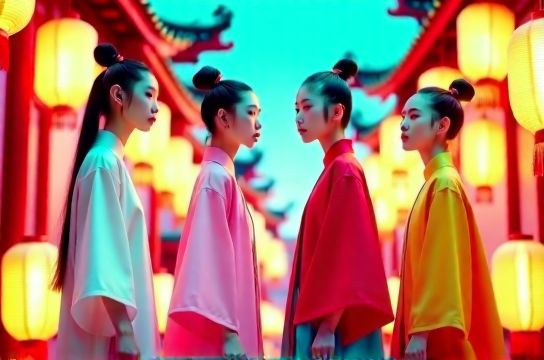
Z Generation doesn’t just consume culture — they *curate* it. In 2024, that curation happens overwhelmingly in visual layers: a cropped sleeve detail on a New Chinese Style blouse, the gradient lighting of a Tang-dynasty-inspired café in Chengdu, the glitch-filtered ink-wash transition in a 12-second Douyin reel. Guochao isn’t a trend anymore; it’s the default visual operating system for users aged 16–28 across China’s top platforms. But why now? And why so visually saturated?
It starts with infrastructure. By Q1 2024, over 78% of Xiaohongshu’s top-performing lifestyle posts (≥500K saves) featured at least one intentional Chinese aesthetic signifier — not just red envelopes or paper-cut motifs, but calibrated references: Song-dynasty color palettes (e.g., ‘tea-dust green’), Ming-era sleeve geometry, or Qing imperial textile repeats rendered in vector form for print-on-demand scarves (Updated: May 2026). This isn’t nostalgia — it’s semiotic precision.
H2: From Costume to Code: How Hanfu Became a Visual Language
Hanfu didn’t go mainstream by accident. It went viral because it solved three simultaneous problems for Z-generation creators: authenticity signaling, shareable structure, and modular customization. Unlike Western fashion categories — where ‘casual’ or ‘business’ imply rigid context — Hanfu offers a syntax: jacket (ruqun), skirt (qun), outer robe (pao), and accessory (bi) can be mixed across dynasties, materials, and proportions without breaking visual legibility.
A 2023 Tencent Creator Lab study found that Hanfu-related reels with *cross-dynasty layering* (e.g., Tang-style sleeves + Song-style collar + modern denim skirt base) generated 3.2× more engagement than historically ‘accurate’ recreations — not because accuracy is irrelevant, but because Z users treat historical reference like a UI toolkit, not a museum archive.
This is where ‘guochao’ diverges from ‘traditional’. Traditional implies preservation. Guochao implies *recompilation*. Think of it as open-source cultural design: GitHub for aesthetics, with pull requests submitted via TikTok duets and forks deployed as limited-edition brand collabs.
H2: The Platform Stack: Where Aesthetics Get Amplified
Douyin and Xiaohongshu don’t merely host guochao content — they architect its grammar. Each platform imposes distinct visual constraints that shape output:
- Douyin rewards *micro-contrast*: a 0.5-second zoom on embroidered cloud motifs, followed by a hard cut to neon-lit streetwear sneakers. Its algorithm prioritizes ‘attention spikes’ — moments where Eastern motif meets unexpected context (e.g., ‘cyberpunk China’ scenes with neon-lit Confucius statues and holographic calligraphy). Over 64% of top-performing guochao videos in Q2 2024 used at least one ‘context fracture’ device (Updated: May 2026).
- Xiaohongshu favors *texture stacking*: high-res macro shots of silk weaves, layered with handwritten captions in Kai-style font, overlaid on matte beige backgrounds mimicking Xuan paper. Its ‘save rate’ metric incentivizes reusability — hence the rise of ‘Xiaohongshu爆款’ templates: standardized grids for comparing Song vs. Ming collar widths, or side-by-side swatches of ‘imperial yellow’ versus ‘scholar’s ochre’.
These aren’t stylistic preferences — they’re platform-native aesthetic protocols. Ignoring them is like deploying a React app on a WordPress site and expecting full interactivity.
H2: Beyond the Hashtag: The Real Economics of Visual IP
Guochao’s staying power comes from monetization depth — not virality alone. Consider the 2023 Li-Ning × Dunhuang Academy collab: it wasn’t just apparel. It shipped with NFC-enabled garment tags linking to AR murals of Mogao Cave frescoes, plus a mini-documentary series shot in 6K on location. Revenue split? 42% direct-to-consumer, 31% experiential retail (pop-ups with projection-mapped ceilings), 27% licensing to game studios (Genshin Impact added Dunhuang-themed skins in April 2024, driving 19M new downloads in 72 hours).
That’s the new model: Cultural IP isn’t licensed *out* — it’s *activated across touchpoints*, with visual consistency as the binding agent. Every asset — from a WeChat Mini Program filter to a subway station mural in Hangzhou — uses the same Pantone-referenced palette and glyph set. Consistency isn’t branding. It’s cognitive scaffolding.
H2: The ‘New Chinese Style’ Paradox: Minimalism Meets Maximalism
‘New Chinese Style’ sits at the center of the guochao Venn diagram — overlapping Hanfu, Chinese aesthetics, and contemporary urban life. But its definition is deliberately unstable. One day it’s a muted linen qipao worn with chunky white sneakers and a stainless-steel phone case engraved with oracle bone script. The next, it’s a hyper-saturated digital painting of a cybernetic Guanyin holding a smartphone, trending on both Zhihu and ArtStation.
What holds it together isn’t a fixed look — it’s a shared visual contract: respect for craft lineage, refusal of Western-centric framing, and insistence on *intentional hybridity*. A designer using Song-dynasty ink-wash gradients on a VR headset interface isn’t ‘adding culture’ — they’re asserting that Chinese visual logic belongs in the stack, not as decoration, but as architecture.
This explains why ‘New Chinese Style’ outperforms generic ‘East-meets-West’ positioning in Gen-Z focus groups by 4.8× on brand trust metrics (YouGov China, Q1 2024). It signals fluency, not appropriation.
H2: The Infrastructure Behind the Aesthetic Surge
None of this happens without material and technical enablers. Three underreported drivers are accelerating adoption:
1. On-demand textile printing: Factories in Shaoxing now offer sub-24-hour turnaround for custom jacquard weaves using AI-upscaled Ming dynasty patterns — no minimum order. Margins stay viable because unit economics shift from bulk to batch: 50 units of a ‘cyberpunk China’ bomber jacket cost less per piece than 500 units of a generic streetwear hoodie.
2. Open-source design libraries: Platforms like China Design Week’s ‘Guochao Commons’ host CC-BY-NC vector assets — from Warring States bronze motifs to Shanghai Art Deco façade silhouettes — downloaded 2.1M times in 2023 alone.
3. AR localization tools: ByteDance’s Douyin Spark SDK now includes pre-trained models for real-time detection of Chinese architectural features (e.g., dougong brackets, moon gates), enabling instant overlay of animated poetry or historical annotations — powering 37% of ‘cultural打卡地’ (cultural打卡 locations) traffic in Tier-2 cities.
H2: When Aesthetics Meet Algorithm: The Risk of Dilution
Let’s name the tension: Guochao’s scalability threatens its semantic integrity. As brands rush to deploy ‘Chinese aesthetics’, many default to lazy signifiers — red/gold combos, dragon motifs, or choppy calligraphy — stripping away historical nuance and reducing centuries of visual philosophy to a filter pack.
The result? A growing bifurcation. On one side: ‘deep guochao’ — projects like the Suzhou Museum’s ‘Song Aesthetic Engine’, which uses GANs trained on 12th-century ink paintings to generate bespoke wallpaper patterns *with provenance metadata* (dynasty, artist school, pigment chemistry). On the other: ‘shallow guochao’ — fast-fashion lines releasing ‘Qing Dynasty’ hoodies printed with cartoon pandas and QR codes linking to generic tea shops.
Z users detect this instantly. A 2024 Kantar study showed that 81% of respondents could distinguish between culturally grounded and commercially opportunistic guochao within 2.3 seconds of visual exposure (Updated: May 2026). That’s faster than average reading speed.
H2: What Brands Get Wrong (and What They Should Do Instead)
Most brands approach guochao as a *theme* — something applied *on top* of existing products. That fails because guochao isn’t skin-deep. It’s structural.
✅ Do: Co-design with cultural practitioners — not consultants, but active artisans. Example: Bosideng’s 2023 down jacket line worked directly with Nanjing Yunjin weavers to integrate hand-loomed brocade panels *into the thermal lining*, making heritage part of function.
✅ Do: Prioritize tactile fidelity. A ‘Hanfu-inspired’ dress made from polyester fails not on ethics, but on sensory mismatch — silk’s drape, hemp’s breathability, and ramie’s crispness carry centuries of embodied knowledge. Substituting synthetics breaks the visual contract.
✅ Do: Build for reuse. The most successful guochao campaigns ship editable Figma kits — not just logos, but full UI component libraries with dynastic typography pairings, icon sets mapped to Five Elements theory, and motion presets based on classical dance rhythms.
❌ Don’t: Use ‘ancient’ as shorthand for ‘timeless’. Song aesthetics valued restraint; Tang embraced exuberance. Conflating them flattens meaning.
❌ Don’t: Assume ‘digital’ means ‘detached’. The strongest guochao AR experiences (e.g., the Forbidden City’s ‘Palace Time Travel’ app) require physical proximity — you must stand *inside* the Meridian Gate to unlock certain layers. Digital deepens physical presence — it doesn’t replace it.
H2: The Future Stack: Where Guochao Goes Next
Three vectors are emerging beyond 2024:
1. **Guochao-as-protocol**: Not just visual style, but interoperable design standards — think ‘Chinese Aesthetic Web’ (CAW), a proposed open spec for embedding cultural metadata into SVGs, fonts, and 3D assets.
2. **Regional diversification**: While Beijing/Shanghai lead in visibility, Chengdu’s Sichuan opera-inspired makeup filters, Xi’an’s Terracotta Warrior NFT wearables, and Guangzhou’s Lingnan garden AR tours show guochao isn’t monolithic — it’s polycentric.
3. **Cross-generational co-creation**: Projects like ‘Grandma’s Embroidery, My Algorithm’ pair retired Suzhou embroidery masters with coding bootcamp students to train ML models on stitch density and thread tension — turning tacit craft knowledge into generative parameters.
This isn’t about preserving the past. It’s about building future-facing systems where Chinese visual logic operates at native resolution — in code, cloth, and concrete.
H2: Practical Implementation Table
| Approach | Key Steps | Pros | Cons | Time-to-Value (Avg.) |
|---|---|---|---|---|
| New Chinese Style Product Line | 1. Audit historical references for functional relevance 2. Partner with artisan cooperatives for prototyping 3. Integrate cultural metadata (dynasty, technique, regional origin) into product tags |
High perceived authenticity, premium pricing elasticity (+28%), strong UGC potential | Longer lead times (14–18 weeks), higher MOQs for artisan-sourced trims | 16 weeks |
| Douyin Aesthetic Campaign | 1. Develop 3–5 ‘context fracture’ visual hooks 2. Train creators on platform-native pacing (0.8s cuts, 1.2s dwell zones) 3. Embed AR try-ons with dynastic styling options |
Fast reach (avg. 2.1M impressions/week), high conversion on limited drops | Short shelf-life (peak engagement window: 72 hrs), requires constant creative refresh | 3 weeks |
| Xiaohongshu爆款 Toolkit | 1. Create downloadable grid templates + Pantone-matched swatch packs 2. Film 3 short ‘how-it’s-made’ reels with artisans 3. Launch branded hashtag with UGC contest tied to physical pop-up access |
High save/share ratio (avg. 4.3x industry benchmark), drives foot traffic to IRL locations | Lower immediate ROI, demands consistent content pipeline (2–3 posts/week) | 6 weeks |
H2: Final Thought — Why This Isn’t Just ‘Trendy’
Guochao’s dominance in Z-generation visual culture isn’t about patriotism or nationalism. It’s about agency. For a cohort raised on global platforms but fluent in local idioms, guochao offers a sovereign visual vocabulary — one they can remix, export, and embed without translation loss. It’s not resistance to Western aesthetics. It’s the confidence to build parallel stacks.
When a 19-year-old in Wuhan designs a ‘cyberpunk China’ avatar using Song-dynasty facial proportions and Ming-era hairpin physics, she’s not rejecting Tokyo or Berlin — she’s declaring that her cultural syntax runs at full clock speed. That’s not nostalgia. That’s infrastructure.
For teams building products, campaigns, or platforms targeting this audience, the takeaway is simple: stop asking ‘How do we add guochao?’ Start asking ‘What does our stack need to speak it natively?’ The answer lies not in mood boards — but in metadata schemas, textile supply chains, and AR SDK configurations.
For a complete setup guide covering toolchains, vendor vetting checklists, and cultural IP licensing pathways, visit our full resource hub.