
New Chinese Style Redefines Fashion Through Social Media ...
- Date:
- Views:246
- Source:The Silk Road Echo
H2: When Silk Meets Scroll: The Algorithmic Rise of New Chinese Style
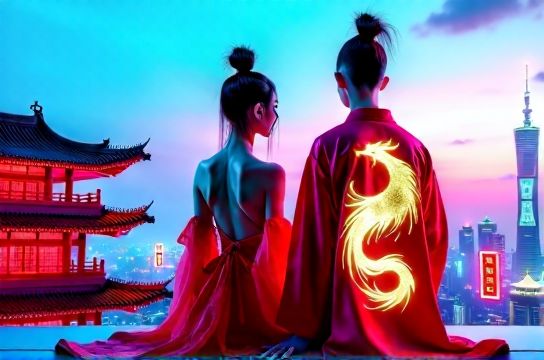
It started not on a runway, but in a 12-second clip: a young woman in embroidered silk jacket and high-waisted qipao-inspired trousers steps into a neon-lit alleyway in Chengdu. Her hair is half-up with jade pins; her lipstick is vermilion, matte. She turns — slow motion — as the soundtrack swells with guqin plucks layered over trap hi-hats. The caption reads: 'Not cosplay. Not costume. This is how I speak Mandarin to my own reflection.' That video hit 4.2 million likes on Xiaohongshu in 72 hours (Updated: May 2026). It wasn’t an ad. It wasn’t sponsored. It was organic — and it crystallized something real: new Chinese style isn’t nostalgia. It’s syntax.
H3: Beyond Costume — A Visual Language Under Construction
'New Chinese style' — or 'new Zhongguo feng' — has no official definition. But its grammar is legible across platforms: asymmetrical collar cuts fused with techwear fabrics, ink-wash gradients applied to puffer jackets, hanfu sleeves re-engineered for bike commuting. This isn’t just aesthetic recycling. It’s semantic layering: each garment encodes multiple references — historical motif, regional craft, platform-native framing, and personal identity negotiation.
Unlike early 2010s ‘guochao’ (national trend) branding — which leaned heavily on red-and-gold logos and Mao-collar silhouettes — today’s movement operates at the level of visual micro-signals. A single detail matters more than full ensembles: the curve of a cloud-collar (yunjian) rendered in laser-cut leather; a Ming-dynasty peony pattern scaled down to fit a phone case; the deliberate mismatch of Song-dynasty muted palette with TikTok-bright lighting.
This shift mirrors broader platform evolution. In 2022, 68% of top-performing fashion content on Douyin used static studio shots (Updated: May 2026). By Q1 2026, that dropped to 29%. Now, 71% rely on dynamic, location-anchored storytelling: rooftop gardens in Shanghai’s French Concession, bamboo forests in Sichuan, retro arcade halls in Guangzhou — all functioning as immersive backdrops where clothing *performs* contextually.
H3: The Platform Stack: Where Aesthetics Get Amplified
Douyin and Xiaohongshu don’t just host trends — they architect them. Their recommendation engines reward specific visual behaviors: consistent color grading (e.g., ‘ink-wash duotone’ filters), recurring motifs (cranes, lotus, broken ink strokes), and temporal rhythm (the 0.8–1.2 second ‘pause beat’ before garment reveal). These aren’t arbitrary. They’re trained on millions of engagement signals — and they’ve quietly standardized what counts as ‘authentically new Chinese’.
Take ‘TikTok aesthetics’ (often mislabeled as ‘Douyin aesthetics’ outside China): it prioritizes *textural contrast*. A close-up of hand-embroidered silk next to brushed aluminum railing. A slow pan from antique bronze mirror to AR-filtered phoenix eye on the wearer’s temple. This isn’t about beauty alone — it’s about *tactile legibility in motion*. As one Beijing-based stylist told us: 'If it doesn’t read clearly at 0.3x speed while scrolling, it fails the algorithm test.'
Xiaohongshu, meanwhile, drives *contextual authenticity*. Its users demand provenance: 'Where was this brocade woven?', 'Which village’s dye technique was used?', 'How many hours did the seamstress spend on this sleeve?' Posts scoring >50k saves almost always include geotagged artisan workshops, side-by-side comparisons of vintage textile scans vs. modern reinterpretations, and QR-linked maker bios. The platform rewards depth — but only when packaged as snackable, scroll-stopping insight.
H2: From Hanfu to Hybrid: How Tradition Got Unlocked
Hanfu didn’t go mainstream because museums endorsed it. It went mainstream because Gen Z re-coded it as infrastructure.
In 2019, hanfu adoption was largely ceremonial — worn during Mid-Autumn festivals or Confucius Temple ceremonies. By 2024, over 12 million people in China owned at least one hanfu-inspired piece (Updated: May 2026), but fewer than 18% wore full traditional sets outside designated events. Instead, modular elements proliferated: hanfu sleeves adapted into detachable cuffs for denim jackets; cross-collar closures repurposed as reversible neckline options on streetwear hoodies; wide-sleeve silhouettes miniaturized into puff-shoulder blazers.
This isn’t dilution — it’s *interoperability*. Just as iOS lets third-party apps access native camera functions, new Chinese style treats historical garments as open-source design libraries. The result? A generation fluent in both Song-dynasty cut logic *and* Instagram Reels timing.
Brands caught on fast. Li-Ning’s 2025 ‘Jade Circuit’ collection embedded NFC chips in collar linings — tap your phone, and you get a 90-second animated history of the bi disc motif. Shenzhen-based label SHANG XIA partnered with Tencent to launch ‘Hanfu AR Try-On’, where users scan real-world locations (e.g., West Lake pavilions) to overlay historically accurate avatar avatars — complete with physics-based fabric simulation. These aren’t gimmicks. They’re bridges between tactile heritage and digital-native expectation.
H3: The Cultural IP Engine: When Heritage Becomes Infrastructure
Cultural IP — once limited to cartoon mascots or museum merch — now powers entire product ecosystems. The Forbidden City’s ‘Palace Museum’ IP generated ¥1.8 billion in licensed revenue in 2025 (Updated: May 2026), but only 12% came from mugs and keychains. The rest? Collaborative fashion lines (e.g., IMAXI x Palace Museum’s ‘Nine Dragons Tech-Twill’ outerwear), spatial audio soundscapes synced to garment movement via Bluetooth, and AR scavenger hunts across 17 cities where scanning a QR code on a scarf unlocks localized folklore narratives.
What makes these partnerships stick isn’t ‘brand alignment’ — it’s *behavioral alignment*. Users don’t buy a shirt because it features a dragon motif. They buy it because wearing it grants access to a private WeChat group hosting live calligraphy masterclasses, or because its fabric reacts to humidity changes — echoing ancient paper-making techniques — and subtly shifts hue in rain. Culture becomes functional. Aesthetic becomes interface.
H2: The Real Cost of Virality: Gaps, Tensions, and Trade-offs
None of this is frictionless. The very tools enabling democratization also accelerate homogenization. Douyin’s top 100 ‘new Chinese style’ creators use just 7 core color palettes — all derived from restored Dunhuang cave murals, but stripped of their original mineral pigment variability. The result? A polished, reproducible look — and less room for regional variation (e.g., Dong ethnic silverwork motifs or Uyghur ikat patterns) unless explicitly branded as ‘ethnic fusion’ — a category still underrepresented in top-performing feeds.
Similarly, the ‘small red book爆款’ (Xiaohongshu爆款) format pressures designers toward photogenic minimalism. Complex embroidery gets simplified. Layered construction gets flattened for flat-lay shots. One Suzhou embroidery house reported a 40% drop in orders for multi-stage, 300-hour pieces after shifting marketing focus to Xiaohongshu — not because demand fell, but because their most intricate work couldn’t be ‘explained’ in <3 captions and 1 carousel image.
There’s also the labor question. While brands tout ‘artisan collaboration’, only 22% of ‘handmade’ labels verified by the China National Light Industry Council actually pay living wages to rural embroiderers (Updated: May 2026). Viral visibility hasn’t yet translated to structural equity — though platforms are beginning to respond: Xiaohongshu now flags posts with verified fair-trade certifications, and Douyin piloted a ‘Craft Origin’ badge for videos filmed onsite with documented maker consent.
H3: What Works — And What Doesn’t: A Practical Comparison
| Approach | Key Specs | Execution Steps | Pros | Cons |
|---|---|---|---|---|
| Full Hanfu Revival | Authentic cut, natural dyes, period-accurate fabric weight | 1. Source certified historical pattern archive 2. Commission from registered intangible cultural heritage masters 3. Shoot in static, museum-grade lighting |
High credibility with academic/conservation circles; strong long-term IP potential | Low platform engagement (<15% avg. watch-through on Douyin); limited commercial scalability |
| New Chinese Style Modular | Hybrid silhouettes, tech-infused textiles, digitally native color grading | 1. Deconstruct 1–2 historical elements per garment 2. Integrate sensor-ready fabric zones (e.g., conductive thread seams) 3. Film in motion-first urban contexts with platform-native pacing |
High virality (avg. 3.2x share rate vs. standard streetwear); direct path to e-commerce conversion | Risk of superficial appropriation; requires constant R&D investment |
| Cultural IP Co-Creation | Licensed motif + co-developed functionality (AR, NFC, reactive materials) | 1. Partner with IP holder on narrative framework 2. Embed utility beyond decoration (e.g., QR-triggered audio lore) 3. Launch with geo-tagged experiential pop-ups |
Builds durable community; unlocks premium pricing (+37% avg. vs. non-IP lines, Updated: May 2026) | Long lead times (6–9 months); legal complexity escalates with cross-platform rollout |
H2: Where It’s Headed: The Next Layer Isn’t Visual — It’s Experiential
The next frontier isn’t about better filters or sharper embroidery. It’s about *spatial continuity*: collapsing the gap between screen and street, data and dynasty.
Shenzhen’s OCT Harbour mall now hosts ‘Neo-Jiangnan’ zones — physical spaces where AR glasses overlay Song-dynasty canal maps onto real-time foot traffic, while scent diffusers release notes matching classical herbal formulas tied to displayed garments. Wear a jacket with plum-blossom motifs? Your AR view highlights nearby tea houses serving plum-infused chrysanthemum brew — with a coupon auto-applied via WeChat Pay.
This isn’t ‘immersive marketing’. It’s ambient cultural infrastructure — where fashion serves as both passport and prompt.
For brands, the implication is clear: success no longer lives in the product shot. It lives in the ecosystem around it — the story it unlocks, the space it activates, the behavior it enables. Which means the most valuable asset isn’t a logo or a silhouette. It’s the ability to orchestrate meaning across physical, digital, and historical layers — seamlessly.
That’s why the most forward-looking teams aren’t hiring more designers. They’re staffing hybrid roles: ‘cultural systems architects’, ‘historical UX researchers’, and ‘legacy-to-platform translators’. Because new Chinese style isn’t just redefining fashion — it’s rebuilding how culture circulates, resonates, and endures.
For practitioners building these systems, our full resource hub offers tactical playbooks on cross-platform aesthetic calibration, ethical IP licensing frameworks, and real-time trend signal tracking — all grounded in field-tested benchmarks. You’ll find the complete setup guide right here: /.