
Off the Beaten Path China: Bamboo Craft Workshops in Yi V...
- Date:
- Views:338
- Source:The Silk Road Echo
Hiking down a narrow stone path slick with morning mist, you pass terraced fields carved into steep mountainsides—corn stalks swaying, roosters crowing from thatched eaves, smoke curling from clay chimneys. No tour buses. No English signage. Just a woman weaving split bamboo strips into a fish trap while humming an ancient Yi melody. This isn’t a staged cultural performance. It’s Tuesday in Laojunshan Village, Liangshan Prefecture—a place where bamboo isn’t just material; it’s memory, livelihood, and language.
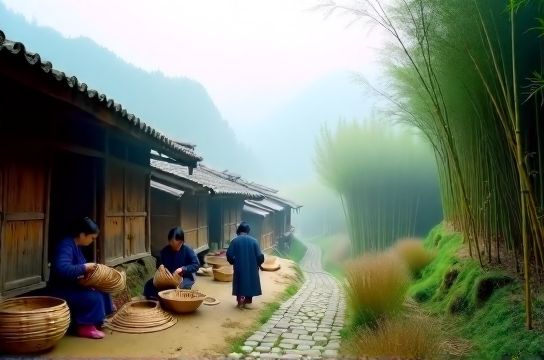
This is rural China travel at its most grounded—not curated, not commodified, but quietly persistent. And it’s one of the few remaining pockets where traditional Yi bamboo craftsmanship remains interwoven with daily life, not museum display.
Liangshan Yi Autonomous Prefecture (Sichuan Province) hosts over 2.8 million Yi people—the largest concentration in China—and more than 70% live in mountainous rural hamlets like those strung along the southern slopes of the Daliang Mountains. Unlike the polished heritage zones of Lijiang or Xitang Ancient Town, these villages lack UNESCO branding, multilingual apps, or even consistent mobile signal. That’s precisely why they’re among the most compelling destinations for travelers seeking authentic travel China—especially those willing to trade convenience for continuity.
But ‘authentic’ doesn’t mean static. Yi bamboo craft is evolving—not vanishing. In fact, since 2021, six village cooperatives across Mianning, Yuexi, and Zhaojue counties have launched bamboo craft workshops open to small-group visitors (3–8 people), combining skill transfer, ethical tourism income, and intergenerational knowledge preservation. These aren’t drop-in souvenir stalls. They’re invitation-led, seasonally scheduled, and rooted in local rhythms: harvest timing, festival calendars, and family availability.
Here’s what actually works on the ground—and what doesn’t.
Why Bamboo? Why Now?
Bamboo has been central to Yi material culture for centuries: woven into baskets for grain storage, split into slats for roof thatching, carved into ritual combs, and bent into children’s toys. Unlike lacquerware or silver filigree—crafts increasingly outsourced to urban workshops—bamboo processing remains largely domestic and decentralized. The raw material grows wild within 2 km of most hamlets; tools are hand-forged locally; drying and splitting happen in courtyards, not factories.What changed recently is access—not infrastructure, but intention. Starting in 2022, the Sichuan Provincial Department of Culture and Tourism began funding ‘Rural Cultural Vitalization Grants’, prioritizing projects where tourism directly supports intangible cultural heritage (ICH) bearers—not intermediaries. By Q3 2025, 14 Yi bamboo master artisans (all aged 58–79) had received formal recognition as ICH inheritors, enabling them to host structured workshops with stipends tied to visitor participation (Updated: April 2026).
Crucially, these workshops avoid the ‘craft-as-entertainment’ trap. You won’t sit through a 20-minute demo followed by mass-produced kits. Instead, you’ll spend half a day learning how to select culms by bark sheen and node spacing, then split, soak, and temper strips under guidance—not demonstration. Mistakes are expected. Your first coiled basket will likely unravel. That’s part of the pedagogy.
Finding the Right Hamlet (and Avoiding the Wrong One)
Not all Yi villages offer workshops—and some that do aren’t ready for guests. Liangshan is vast (60,423 km²) and topographically fractured. A ‘village’ may be 12 households scattered across three ridges. Logistics matter more than brochures.The most accessible and consistently reliable cluster lies near Mianning County, specifically the Baishui River corridor—easily reached via the G5京昆 Expressway exit at Mianning, then 45 minutes on county road S307. Here, three hamlets operate rotating workshop schedules: Laojunshan (population ~180), Shuizhong (population ~90), and Yingshan (population ~130). All are reachable by private vehicle or pre-arranged minibus (no public bus service beyond Mianning town). Ride-share apps like Didi don’t function reliably past the county seat—so booking transport through a local Liangshan-based operator like Yi Trails Collective (est. 2020) is non-negotiable.
Avoid villages promoted on generic ‘ethnic minority tours’ out of Chengdu. Many route through ‘model villages’ like Xide County’s Huaxi Village—renovated in 2023 with standardized guesthouses, rehearsed dance troupes, and bamboo souvenirs sourced from Fujian province. It’s clean, safe, and culturally hollow. Real bamboo craft happens where electricity flickers and Wi-Fi is a shared hotspot in the village head’s home.
The Workshop Experience: Structure, Limits, and Realities
Workshops run March–November only. Bamboo must be harvested in late winter/early spring (January–February) when starch content is lowest—preventing insect infestation during drying. Workshops outside that window use stored stock, but fresh harvesting is part of the immersion.A typical full-day session includes:
- 07:30–08:30: Walk with artisan to nearby grove; identify Phyllostachys heterocycla (the preferred species), assess maturity by bark color and internode length
- 09:00–10:30: Harvesting (using sickles, not chainsaws), transport to courtyard
- 10:45–12:15: Splitting culms with iron wedges and mallets; separating outer, middle, and inner layers for different uses
- 13:00–14:30: Soaking and gentle steaming (in wood-fired clay pots) to increase pliability
- 14:45–16:30: Weaving a small utility basket (approx. 18 cm diameter)—starting with warp foundation, then weft insertion, edge finishing
- 16:45–17:30: Shared meal—boiled yams, smoked pork, buckwheat cakes—served on hand-carved bamboo trays
No English translation is provided mid-session. Artisans speak Nuosu (the Yi language) and basic Mandarin. You’ll learn terms like shy mo (outer skin, used for fine weaving) and hxie bbur (inner pith, discarded) through repetition and gesture. Translation support is available upon request—but only if booked 14+ days in advance with Yi Trails Collective, and only for groups of 4+. Solo travelers typically rely on bilingual local coordinators trained through the Liangshan Vocational College’s Rural Tourism Program (graduates placed since 2022).
Note: These are working villages, not living museums. If a funeral occurs, the workshop pauses. If rain floods the river crossing, the schedule shifts. Flexibility isn’t optional—it’s protocol.
Hiking Trails That Connect, Not Just Cross
The bamboo workshops gain depth when paired with the surrounding terrain. Unlike the well-trodden Tiger Leaping Gorge or sections of the Nujiang (Salween) River trails, the Baishui River corridor offers low-altitude (<2,200m), low-traffic hiking routes that double as cultural corridors.Two trails stand out:
1. Baishui Ridge Traverse (12 km, 5–6 hrs, moderate)
Connects Laojunshan to Shuizhong via old salt-trade paths. Elevation gain: 420m. Marked intermittently with cairns and Yi-language trail signs carved into stone (not painted). Passes two active bamboo groves, a 17th-century stone shrine to the Mountain God, and a seasonal waterfall visible April–July. No facilities—carry water and snacks. Best done with a local guide ($40/day, includes lunch); self-guided navigation is possible but requires downloading offline maps via Gaia GPS (China version supports Nuosu place names).2. Yingshan Loop (6.8 km, 3 hrs, easy)
Circles the upper village, passing cornfields, apiaries, and a restored 1930s Yi script schoolhouse now housing a community library. Interpretive panels (in Nuosu and Mandarin only) explain historical literacy efforts. No English—yet. This is intentional: the loop is designed for reflection, not consumption.Neither trail appears on mainstream platforms like Komoot or AllTrails. They’re documented in the full resource hub maintained by the Liangshan Cultural Heritage Office—updated quarterly with GPS waypoints, seasonal access notes, and emergency contact protocols.
Shopping Without Extraction
‘Tourism shopping’ here means supporting household economies—not buying ‘ethnic chic’. Most artisans sell finished pieces directly: baskets ($12–$45), woven lampshades ($65–$110), and ceremonial combs ($28–$75). Prices reflect labor time (e.g., a medium basket takes 14–18 hours across 3 days), not market demand. There’s no haggling culture; fixed pricing is posted beside each item, often handwritten on bamboo tags.What you won’t find: mass-printed ‘Yi pattern’ scarves, plastic ‘handmade’ keychains, or bamboo charcoal toothbrushes marketed as ‘wellness’. Those originate from industrial clusters in Anji County (Zhejiang)—not Liangshan.
If you want to buy meaningfully, ask artisans what’s hardest to sell locally. Often it’s larger items: woven baby cradles ($190–$320) or rice-storage chests ($420–$680). These require weeks of work and rarely move without external buyers. Purchasing one funds not just the maker, but their apprentice—a teenager learning full-time since age 15.
Practical Logistics: What You Actually Need to Know
Getting there isn’t simple—but it’s doable with preparation. Flights to Xichang Qingshan Airport (XIC) land 90 minutes from Mianning. From XIC, pre-booked transport is essential: the airport taxi queue has no English speakers, and ride-hailing fails beyond the terminal perimeter. Yi Trails Collective offers door-to-airport transfers ($85 flat, includes 2-hour wait buffer for flight delays).Accommodation options are limited but purpose-built:
- Laojunshan Homestay: 4 rooms, shared bathroom, solar-heated water, no AC. $32/night. Book 3+ months ahead.
- Shuizhong Guest Pavilion: 6 rooms, compost toilet, wood stove heating. $45/night. Requires 5-night minimum stay (to align with workshop + hike scheduling).
- Yingshan Eco-Lodge: 3 cabins, rainwater catchment, no electricity after 22:00. $58/night. Open only April–October.
All include breakfast (buckwheat porridge, pickled vegetables, boiled eggs) and dinner (rotating village menu). No room service. No minibars. No Wi-Fi passwords handed out—just one shared hotspot in the common area, throttled to 2 Mbps to preserve bandwidth for village video calls.
When to Go—and When Not To
Peak season is May–June and September–October: mild temps (14–24°C), low rainfall, and active bamboo growth cycles. July–August brings monsoon-level downpours—roads wash out, trails become slick with mud, and outdoor weaving halts. December–February is cold (often below freezing at night) and workshops pause for Lunar New Year preparations. March is marginal: bamboo harvesting begins, but many artisans are still recovering from winter illness surges (respiratory infections remain prevalent in high-altitude hamlets; Updated: April 2026).Also avoid major Yi festivals unless you’ve built prior relationships. The Torch Festival (late June/early July) draws thousands of outsiders—many arriving via charter buses. While culturally rich, it overwhelms village infrastructure and dilutes workshop intimacy. Smaller, localized observances—like the Buckwheat Flowering Ceremony in mid-May—are better entry points, but attendance requires personal invitation.
| Village | Workshop Focus | Max Group Size | Duration | Price Per Person (USD) | Key Pros | Key Cons |
|---|---|---|---|---|---|---|
| Laojunshan | Basket weaving & structural forms | 6 | Full day (7:30–17:30) | $128 | Most established; bilingual coordinator on-site; easiest transport access | Limited accommodation; books out 4+ months ahead |
| Shuizhong | Finer weaving (lampshades, mats) | 4 | Full day + optional overnight | $142 | Smallest group size; strongest emphasis on design nuance; river access for bamboo soaking | 5-night minimum stay required; no ATM within 30 km |
| Yingshan | Ritual objects & carving integration | 3 | 2-day intensive (includes overnight) | $215 | Rarest specialization; includes carving basics; access to ancestral forest groves | Strict capacity limits; no solo bookings; requires health waiver |
Final Notes: Traveling Responsibly Isn’t Abstract Here
In Liangshan, ‘responsible travel’ isn’t about carbon offsets or plastic-free pledges. It’s concrete: paying the agreed workshop fee in full at the start (not after), declining to photograph elders without verbal consent, carrying out all waste (including fruit peels—compost systems are household-scale and overloaded), and never offering unsolicited medical advice (local clinics are staffed, but under-resourced; defer to village health workers).It also means accepting friction. That 45-minute drive on S307 includes three river crossings with no bridges—just stones laid by villagers last monsoon season. Your phone dies. Your notebook gets damp. You mispronounce shy mo for three days straight.
That’s not failure. It’s alignment.
These hamlets aren’t waiting for tourism to ‘save’ them. They’re adapting—with caution, clarity, and craft. Your role isn’t to witness authenticity. It’s to show up, listen closely, make something imperfect with your hands, and leave knowing exactly which ridge held the workshop—and why the bamboo there bends just so.
Because off the beaten path China isn’t about distance traveled. It’s about attention paid.