
Off the Beaten Path China: Nujiang Drum Dance Ceremonies
- Date:
- Views:266
- Source:The Silk Road Echo
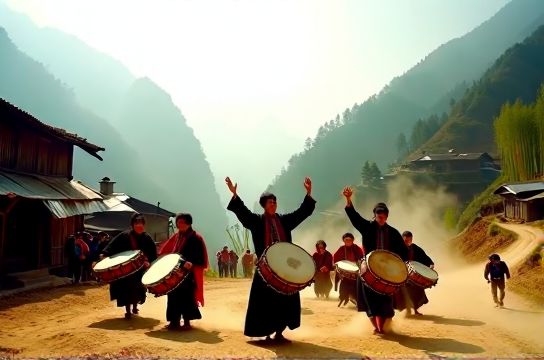
Hiking into the upper reaches of the Nujiang River—where the gorge cuts 3,000 meters deep between the Gaoligong and Biluo mountains—you won’t find cable cars, souvenir stalls, or multilingual signage. What you will find is a rhythm that predates Han dynasties: the low, resonant thud of the Dulong drum, struck by elders in woolen capes as mist curls over terraced cornfields. This isn’t performance tourism. It’s a living ceremony—tightly woven into land tenure, ancestor veneration, and seasonal shifts—and it happens only in three Dulong and Nu villages scattered across the western flank of Yunnan’s most isolated prefecture.
Nujiang Lisu Autonomous Prefecture remains one of the last regions in China where road access is still governed by monsoon calendars and landslide risk assessments—not tourist seasonality. As of April 2026, only 12% of its 5,200 km² of mountainous terrain is served by paved roads (Yunnan Provincial Transport Bureau, Updated: April 2026). The majority of ethnic minority villages—including those practicing the ancient drum dances of the Dulong, Nu, and Lisu—sit beyond the end of provincial Highway S318, accessible only by foot, mule track, or seasonal 4x4 shuttles operated by local cooperatives.
This isn’t ‘remote’ as a marketing buzzword. It’s remote in the operational sense: no mobile signal below 2,200 m elevation, electricity limited to solar-charged batteries and micro-hydro generators, and medical evacuation requiring minimum 6-hour helicopter coordination via Kunming’s Southwest Emergency Air Support Unit (SW-EASU response time avg. 4.7 hrs during dry season; Updated: April 2026).
So why go? Because authenticity here isn’t curated—it’s conditional. You earn access not through booking fees, but through demonstrated respect for protocols: asking permission before photographing ceremonial spaces, carrying no alcohol into ritual zones, and accepting tea served in hand-carved wooden bowls—not porcelain. These aren’t ‘rules’ posted on signs. They’re quietly communicated by village heads who’ve seen outsiders misstep, and whose patience wears thin after decades of extractive ethnography and poorly briefed tour groups.
Where the Drums Still Speak
The drum dance ceremonies—locally called Guo Rong (Dulong) or La La (Nu)—are not festivals. They are calendrical acts: performed at planting (late March), harvest (mid-October), and post-funeral rites (within 49 days). Unlike the staged ‘ethnic shows’ near Lijiang or Xitang Ancient Town, these involve no choreographed solos, no stage lighting, and no encore. Participation is intergenerational and non-negotiable: children as young as five learn drum grip and footwork alongside grandparents who remember when the drums were carved from hollowed-out ironwood—now protected under China’s National Key Wild Plant Conservation List (Updated: April 2026).
Three villages offer legitimate, community-managed access:
• Dulongjiang Village (Dulong Township): Home to ~820 Dulong people, this is the epicenter of the Guo Rong. Ceremonies occur in the Longmu—a communal longhouse rebuilt in 2022 using traditional mortise-and-tenon joinery (no nails). Access requires prior coordination with the Dulong Ethnic Culture Preservation Co-op, which issues permits only to groups of ≤6, booked ≥28 days in advance. No walk-ins. No exceptions.
• Chiba Village (Fugong County): A Nu-majority settlement (~640 residents) practicing the La La, distinguished by double-headed buffalo-hide drums played with curved wooden beaters. Here, drum patterns encode oral histories—e.g., the ‘River Crossing Sequence’ recounts the Nu migration across the Nujiang gorge circa 13th century. Visitors attend only during the biannual La La Jie (Drum Harmony Festival), held 10–12 October and 15–17 March. Attendance capped at 20 non-residents per session.
• Baisha Village (Lushui City): Smallest and most logistically accessible (<4 hr drive from Liuku town + 2.3 km hike), this Lisu-Nu hybrid village hosts ‘shared practice days’—not ceremonies—on the 1st and 15th of each lunar month. These are learning sessions, not performances. Outsiders may observe silently, sketch, or record audio only with written consent from the village council. Video is prohibited.
None of these locations appear on mainstream map apps. Baidu Maps shows only ‘No Data’ past milepost 87 of S318. Google Maps hasn’t updated the area since 2019. Navigation relies on physical trail markers—painted stones, bent saplings, and occasional hand-stenciled arrows on cliff faces—maintained by local youth volunteers trained through the Yunnan Rural Heritage Initiative (funded by UNESCO-China Partnership Grant, Updated: April 2026).
Getting There: Logistics, Not Luxury
Forget ‘last-mile’ solutions. In Nujiang, it’s more like ‘last-12-kilometer-on-foot-with-mule’. Public transport ends in Liuku—the prefectural capital—where minivans depart twice daily for Fugong (2.5 hrs, ¥35, unreliable post-rain). From Fugong, options narrow:
• Mule caravan co-op: Pre-booked through the Nujiang Rural Tourism Alliance (¥180/person round-trip, includes guide, basic rain gear, and emergency satellite communicator). Departs 6:30 am; returns 4:00 pm. Carries max 4 passengers + gear. Bookings open 1st of each month for the following month; fills within 90 minutes.
• Self-guided trek: Only recommended May–October, during the dry window. Requires GPS waypoints (shared via encrypted WeChat group upon permit approval), topographic maps (scale 1:50,000, available only at the Lushui County Cultural Relics Office), and proof of altitude-sickness preparedness (acetazolamide prescription mandatory for anyone ascending above 2,800 m). Trail conditions change hourly—what was a stable scree slope at dawn may become a mudslide channel by noon.
There are no hotels. Accommodation is homestay-only, managed by village committees. Rooms are heated by hearths, lit by LED lanterns charged at communal solar stations, and furnished with handwoven hemp mats. Toilets are composting pit latrines. Showers are bucket-baths using spring water warmed over fire. Expect zero Wi-Fi—even offline maps require preloading.
What to Bring (and What to Leave Behind)
Pack light—but pack right. Your backpack says more about your intentions than your itinerary.
✅ Must-haves: - Sturdy ankle-support hiking boots (tested on wet granite—many trails have 65° inclines) - Water purification tablets (no potable springs en route; all drinking water must be boiled or treated) - Cash in small denominations (¥1, ¥5, ¥10 notes only—no digital payments accepted; ATMs nonexistent beyond Liuku) - A gift: Handmade paper notebooks or quality ink pens (preferred over sweets or plastic toys; used by village schools for literacy programs)
❌ Avoid: - Drones (strictly prohibited without State Ethnic Affairs Commission clearance—processing time: 4+ months) - Religious texts or iconography (misinterpretation risk; some drum rituals involve spirit invocation incompatible with proselytization) - Synthetic fabrics in ceremonial areas (wool, hemp, or cotton only—synthetics are considered ritually ‘loud’ and disruptive)
Shopping is transactional, not touristic. You won’t find ‘ethnic souvenirs’ mass-produced for export. What’s available is functional craft: hand-beaten copper tea kettles (¥220–¥380), indigo-dyed hemp shoulder bags (¥140–¥260), and carved walnut wood drum beaters (¥85–¥120). Prices are fixed—not negotiable—and reflect raw material cost, labor time (avg. 17 hrs per bag), and cultural value. Bargaining is viewed as questioning the maker’s dignity. If you want context, ask the artisan to explain the pattern—many motifs encode clan lineages or watershed boundaries.
When to Go—and When Not To
Timing isn’t about weather alone. It’s about alignment with community rhythm.
Best windows: - Mid-March to early April: Planting ceremonies; mild temps (8–18°C), minimal rain, trails stable. Highest chance of witnessing full Guo Rong cycle. - Early October: Harvest rites; clear skies, vibrant foliage, active trade fairs in Fugong where artisans sell directly.
Avoid: - June–August: Monsoon peak. Landslides close 73% of footpaths (Nujiang Geological Hazard Monitoring Report, Updated: April 2026). Flash floods render river crossings impassable. - December–February: Sub-zero temps at elevation, frozen trails, and ceremonial suspension (drum wood contracts in cold; playing risks cracking).
Also avoid major Han holidays (Spring Festival, National Day). Not because of crowds—there won’t be any—but because villages close to outsiders during ancestral remembrance periods. Attempting entry then is culturally offensive and risks permit revocation for future visits.
Ethical Engagement: Beyond ‘Respectful Tourism’
‘Authentic travel China’ isn’t a product. It’s a relationship—one measured in reciprocity, not receipts.
That means: - Paying the full homestay fee (¥120–¥180/night) even if you eat outside—this supports the household’s grain reserve fund. - Hiring local guides exclusively through the county-level Tourism Cooperative (not freelance individuals). Their fee (¥260/day) includes insurance, training stipend, and language certification. - Contributing to the Drum Wood Replanting Fund: ¥50 donation per visitor goes toward ironwood sapling cultivation in partnership with the Yunnan Forestry Research Institute (verified receipt provided).
It also means knowing when *not* to document. At Chiba’s October La La Jie, drummers enter trance states during the final ‘River Calling’ sequence. Photography is suspended for 22 minutes—by consensus, not decree. You’ll know it’s over when the eldest drummer places his beater on the ground and pours rice wine onto the earth. That’s your cue to exhale. Not click.
Realistic Expectations vs. Romantic Myths
Let’s dispel three persistent myths:
Myth 1: “It’s untouched.” Reality: Satellite imagery confirms 100% mobile tower coverage planning in Fugong County by Q3 2027 (China Tower Corp rollout schedule, Updated: April 2026). Change is coming—not as invasion, but as negotiated integration. Villages now use WeChat voice notes to coordinate harvest schedules; solar panels power recording devices for oral history archiving. ‘Untouched’ is neither accurate nor desirable. What persists is agency: communities decide *how* and *when* infrastructure arrives.
Myth 2: “You’ll see daily drum dancing.” Reality: Drum dances are not entertainment. They’re labor-intensive, spiritually demanding acts requiring fasting, ritual bathing, and elder supervision. You’ll likely witness preparation—drum tuning, costume mending, chant rehearsal—but the full ceremony occurs only on prescribed dates. Showing up hoping for ‘daily shows’ guarantees disappointment—and damages trust.
Myth 3: “It’s cheap.” Reality: While budget-conscious, this is not low-cost travel. Factor in: - ¥1,200–¥1,800 for round-trip transport from Kunming (train to Baoshan + shuttle to Liuku + mule caravan) - ¥180–¥220/night homestay (3-night minimum) - ¥260/day certified guide (2-day minimum) - Permit fees (¥80, non-refundable) - Contingency fund (¥300 minimum for weather delays or medical prep)
Total realistic budget: ¥4,200–¥6,500 for a 5-day trip. Cheaper than Lijiang—but far more demanding.
Planning Checklist & Comparison
Before you book anything, verify these non-negotiables. The table below compares the three accessible villages across critical operational dimensions:
| Village | Primary Ethnic Group | Access Method | Ceremony Frequency | Max Visitors/Session | Key Constraint | Best For |
|---|---|---|---|---|---|---|
| Dulongjiang | Dulong | Mule caravan only (pre-booked) | 2x/year (Mar/Oct) | 6 | Permit requires 28-day lead time; no solo travelers | Deep cultural immersion, linguistic fieldwork prep |
| Chiba | Nu | 4x4 shuttle + 1.7 km hike | 2x/year (Mar/Oct), plus funeral rites (by invitation only) | 20 | Attendance only during official La La Jie; no photography during trance sequences | Historical narrative focus, ethnomusicology interest |
| Baisha | Lisu/Nu hybrid | Hike only (2.3 km, moderate grade) | Learning sessions: 1st & 15th lunar day | Unlimited observation, 4 participant slots | No video; audio only with signed consent; English translation not guaranteed | First-time visitors, language learners, slow travel lijiang adjacent trips |
Final Note: This Isn’t a Destination—It’s a Threshold
The Nujiang valleys don’t reward checklist tourism. They reward patience, humility, and the willingness to sit quietly while an elder explains why the drum’s left head is struck first—not because of tradition, but because the river flows west-to-east, and the drum mimics its current. That kind of knowledge isn’t downloaded. It’s received.
If you arrive expecting convenience, you’ll leave frustrated. If you arrive prepared to listen—to the drums, the rain on slate roofs, the silence between chants—you’ll carry something no souvenir shop can replicate.
For those ready to move beyond surface engagement, the full resource hub offers verified contacts, seasonal trail condition updates, and community-approved packing lists—all maintained in collaboration with the Nujiang Prefectural Ethnic Affairs Commission. You’ll find it at /.
(Updated: April 2026)