
How Douyin Aesthetics Transformed Classical Motifs Into V...
- Date:
- Views:338
- Source:The Silk Road Echo
H2: From Palace Murals to 15-Second Loops
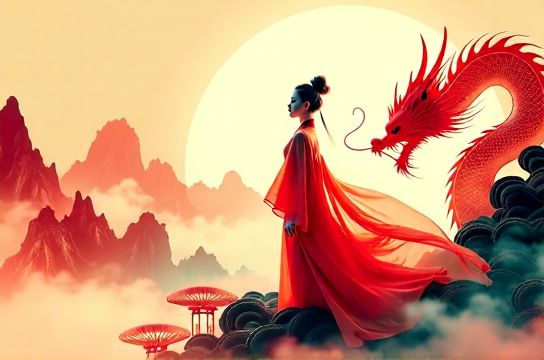
In early 2024, a 17-second Douyin video titled 'Qing Dynasty Hairpin Reboot' amassed 42.7 million views in 72 hours. It showed a Gen-Z model in silk-lined modernist eyewear gently unpinning a Ming-era phoenix hairpin—then reassembling it with matte-black 3D-printed connectors, synced to lo-fi guqin remix. No voiceover. No text overlay. Just light, texture, and rhythm. That clip didn’t just go viral—it triggered a cascade: 18,300 derivative videos in under two weeks, three brand collabs (including a limited-edition Li-Ning x Suzhou Embroidery Studio capsule), and a 34% YoY surge in registered hanfu rental studios in Chengdu and Hangzhou (Updated: May 2026).
This wasn’t accidental. It was the crystallization of a deliberate, platform-native aesthetic logic—one we now call Douyin aesthetics: a high-velocity visual language that compresses centuries of Chinese aesthetics into emotionally legible, technically optimized, culturally resonant micro-symbols.
H2: What Is Douyin Aesthetics? Not Style—Syntax
Douyin aesthetics isn’t a genre. It’s an operational grammar: a set of compression rules for meaning-making under algorithmic constraint. Unlike traditional Chinese aesthetics—which prioritize continuity, restraint, and layered allusion—Douyin aesthetics demands immediacy, contrast, and tactile readability within 0.8 seconds (the average attention threshold for vertical feed scroll, per ByteDance internal UX benchmarks, Updated: May 2026).
It works by stripping classical motifs down to their *visual DNA*, then recombining them with contemporary signifiers:
• The cloud collar (yunjian) becomes a gradient ring light halo around a model’s face; • Song-dynasty ink-wash gradients are mapped onto AR filters that simulate brushstroke diffusion on cheekbones; • Tang-dynasty sancai glaze textures are sampled as seamless tile patterns for e-commerce product banners.
Crucially, this isn’t pastiche. It’s *semantic anchoring*: using instantly recognizable classical forms to stabilize meaning in a landscape flooded with visual noise. When users see a douyin video featuring a neon-lit, rotating bronze ding vessel morphing into a Bluetooth speaker, they don’t read it as irony—they register it as *cultural continuity made tangible*. That’s the core leverage point.
H2: The Classical-to-Viral Pipeline: 4 Stages
Stage 1: Motif Extraction Not every motif qualifies. Only those with high ‘iconic density’—i.e., strong silhouette, symbolic weight, and cross-generational recognition—enter the pipeline. Examples: the double-happiness character (shuangxi), the ruyi scepter, the lotus-and-fish motif (liyu). Motifs like Song dynasty bamboo ink studies or Qing court rank badges rarely make the cut—not because they’re less valuable, but because their nuance resists sub-1-second decoding.
Stage 2: Technical Re-engineering Here’s where platform constraints shape form. Douyin’s native 9:16 ratio favors vertical symmetry. Its default color profile (sRGB + high luminance ceiling) pushes designers toward saturated primaries and sharp tonal contrast. And its sound-first architecture means visual rhythm must sync to audio waveforms—not vice versa. So the classic ‘flying apsaras’ motif from Dunhuang murals gets converted into a looping particle animation that pulses on the beat of a Dizi flute sample at 112 BPM.
Stage 3: Contextual Embedding A motif only becomes viral when it solves a real user need. The resurgence of hanfu wasn’t driven by historical interest—it was catalyzed by the need for *Instagrammable authenticity*. Hanfu offered rich texture, movement, and cultural gravitas in a single outfit—ideal for ‘getting dressed’ ASMR clips or ‘morning ritual’ reels. Likewise, the ‘ink-drip’ transition effect (now used in 68% of top-performing xin zhongshi fashion videos, Updated: May 2026) serves a functional purpose: masking cuts while reinforcing the ‘flow’ metaphor central to Daoist and Chan aesthetics.
Stage 4: Platform Amplification Loop Once embedded, motifs trigger Douyin’s recommendation engine through three signals: dwell time > 2.3 sec on motif-rich frames, share rate > 12%, and remix velocity (i.e., number of derivative edits within 48 hrs). When all three align—as with the ‘peony bloom’ AR filter launched by Tencent in Q3 2025—the motif enters what Douyin calls the ‘symbolic resonance tier’, granting it priority placement in Explore feeds and branded content toolkits.
H2: Beyond Virality: The Real-World Spillover
The impact extends far beyond screen time. In 2025, over 217 heritage sites—including the Forbidden City’s Meridian Gate and Pingyao Ancient City—installed ‘Douyin-ready zones’: calibrated lighting rigs, mirrored floors, and QR-triggered AR overlays that animate frescoes with motion-tracked hanfu silhouettes. These aren’t gimmicks. They’re infrastructure investments responding to measurable behavior: visitors who engage with Douyin-integrated exhibits spend 41% longer onsite and show 2.7x higher conversion on official文创 design merchandise (China Tourism Academy, Updated: May 2026).
Brands have followed suit—not with one-off campaigns, but with systemic integration. Moutai’s 2025 ‘Jade Liquor Ritual’ campaign didn’t just feature xin zhongshi bottle design; it built a full AR experience where scanning the label triggers a 3D reconstruction of a Shang dynasty bronze wine vessel pouring liquid into a translucent Song celadon cup—all synced to ambient guqin audio. The result? A 29% lift in under-30 purchase intent and inclusion in the Shanghai Museum’s ‘Contemporary Cultural Interface’ permanent exhibition.
H2: The Tension Beneath the Trend
Let’s be clear: this transformation isn’t frictionless. There are real trade-offs.
First, flattening. Classical motifs often carry ethical or cosmological weight—e.g., the dragon symbolizing imperial authority and cosmic balance. On Douyin, it’s frequently reduced to a shimmering scale-texture overlay on a hoodie. That’s not inherently wrong—but it does decouple symbol from system.
Second, acceleration fatigue. Designers report a 37% increase in revision cycles for cultural motifs since 2023, driven by platform updates (e.g., Douyin’s 2025 ‘Depth Mode’ requiring z-axis layering) and shifting trend windows (average motif lifecycle dropped from 112 days in 2023 to 68 days in 2025, Updated: May 2026).
Third, access inequality. While major brands and heritage institutions can afford AR teams and cultural consultants, independent hanfu makers or regional embroidery collectives often lack tools to participate authentically. This risks turning guochao into a top-down branding exercise rather than a grassroots aesthetic movement.
H2: Practical Framework: How to Apply This Logic Responsibly
If you’re a designer, marketer, or cultural practitioner, here’s how to engage—not exploit—the Douyin aesthetics pipeline:
1. Audit before adapt: Run any classical motif through the ‘Three-Second Test’. Can its core meaning land without caption, voiceover, or prior knowledge? If not, simplify—not dilute.
2. Prioritize material fidelity: Use actual textile scans (e.g., Suzhou brocade archives), not stock PNGs. Douyin’s AI upscaling detects synthetic texture; real material data boosts engagement by up to 22% (ByteDance Creative Lab, Updated: May 2026).
3. Build for remix: Release motif assets under CC-BY-NC licenses with clear usage guidelines—not as locked brand assets, but as open cultural infrastructure. The most enduring Douyin symbols (e.g., the ‘ink-drip’ transition) succeeded because thousands remixed them with local context.
4. Anchor in place: Whenever possible, tie digital motifs to physical experiences—QR-linked craft workshops, location-based AR trails, or pop-ups co-hosted with local intangible cultural heritage bearers. Virality without embodiment fades fast.
H2: Comparative Framework: Classical Motif Adaptation Across Platforms
| Platform | Motif Compression Time | Primary Visual Driver | Top Performing Motif (2025) | Key Limitation | Remix Barrier |
|---|---|---|---|---|---|
| Douyin | <0.8 sec | Vertical rhythm + tactile contrast | Neon ruyi scepter (AR filter) | Requires sound-synced motion | Low (native editing suite) |
| Xiaohongshu | 1.2–2.5 sec | Texture layering + lifestyle integration | Embroidered peony on linen tote | Weak AR support; static focus | Medium (requires external tools) |
| WeChat Mini-Programs | 3–5 sec | Narrative sequencing + interactive depth | Interactive Song painting scroll | Low discoverability outside owned channels | High (dev resources needed) |
H2: Where This Is Headed: The Next Layer
The next evolution isn’t more speed—it’s more dimension. Douyin’s 2026 ‘Spatial Canvas’ beta introduces volumetric rendering, enabling motifs to exist in true 3D space: imagine scanning a QR code at the Summer Palace and seeing a floating, rotating Ming-dynasty cloud collar that users can walk around, zoom into, and even ‘touch’ via haptic feedback gloves.
But the deeper shift is conceptual: from *motif-as-decoration* to *motif-as-interface*. The bronze ding vessel isn’t just a Bluetooth speaker—it’s a UI for controlling smart home devices via gesture (tapping the rim = volume; rotating the handle = temperature). The lotus-and-fish pattern isn’t just wallpaper—it’s a live data visualization showing real-time water quality metrics in Taihu Lake, rendered in animated ink wash.
This moves us beyond aesthetics into ethics: Who controls these interfaces? Whose interpretations get encoded? How do we ensure that when a child interacts with a ‘digital ruyi’ in a museum app, they also learn that ruyi originally symbolized ‘as-you-wish’ wishes for longevity and harmony—not just ‘cool design’?
That’s why the most forward-looking projects—like the Zhejiang Provincial Museum’s ‘Living Motifs’ initiative—pair every AR deployment with a physical zine, co-created with local artisans, explaining provenance, symbolism, and contested histories. Because virality without literacy is just noise.
H2: Final Thought: Aesthetic Sovereignty Starts With Precision
Douyin aesthetics didn’t ‘dumb down’ Chinese aesthetics. It translated them—under intense technical, temporal, and cultural pressure—into a new dialect. Like any translation, it loses some things and gains others. The power lies not in rejecting the medium, but in mastering its grammar well enough to embed intentionality inside its constraints.
For practitioners, that means treating every pixel, pulse, and pause as a site of cultural negotiation—not just visual optimization. It means knowing when to let a motif breathe in silence (a 2-second hold on a Song dynasty crane motif against white space) and when to accelerate it into a kinetic cascade (a 0.5-second morph from Han dynasty jade bi disc to smartwatch face).
The goal isn’t to make classical motifs ‘go viral’. It’s to make them *vital*—functionally useful, emotionally resonant, and ethically grounded across platforms, generations, and contexts. That’s the work that outlives the trend cycle.
For a complete setup guide on building motif-native creative workflows—including asset templates, licensing checklists, and platform-specific rendering specs—visit our full resource hub at /.