
Chinese Society Explained: Digital Rituals of Lunar New Year
- Date:
- Views:306
- Source:The Silk Road Echo
Every year, just before the Lunar New Year holiday, a quiet but massive infrastructure shift occurs across China: hundreds of millions of people log into WeChat, Alipay, or Douyin not to shop or scroll — but to perform ritual. Not with incense or paper offerings, but with taps, swipes, and shares. The digital greeting — whether a pre-recorded AI-generated blessing, a looping 15-second Douyin skit, or a customized red envelope with embedded mini-games — is now as essential to the holiday as dumplings or firecrackers. This isn’t ‘technology replacing tradition’. It’s tradition adapting — rapidly, pragmatically, and often hilariously — to the rhythms of mobile-first life.
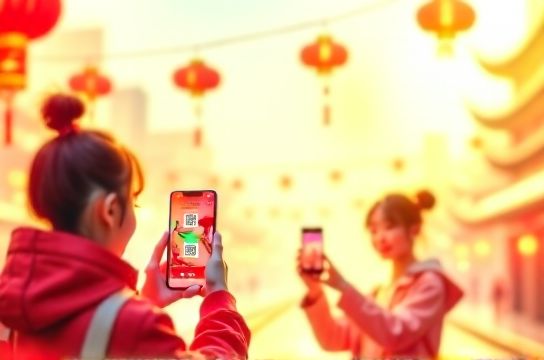
This is Chinese society explained not through policy white papers or GDP charts, but through behavior: what young people *actually do* when they’re home for Spring Festival, how families negotiate generational tech gaps during reunion dinners, and why a 22-year-old in Chengdu might spend three hours editing a 6-second greeting while her grandparents wait patiently with real red envelopes in hand.
Let’s start with the basics: the digital red envelope (hongbao). Launched by Tencent in 2014, WeChat Hongbao was initially a modest experiment — a feature meant to boost user engagement during the 2014 Spring Festival. Within 24 hours, over 16 million envelopes were sent. By 2025, over 82% of urban Chinese aged 18–35 sent at least one digital hongbao during the holiday period (Updated: April 2026). But usage has evolved far beyond simple money transfers. Today’s hongbao includes:
• Animated templates tied to zodiac animals (e.g., a dancing dragon that breathes fire when tapped) • Mini-games embedded inside (e.g., “tap to catch falling gold coins” — winner gets bonus RMB) • Location-triggered variants (e.g., send a special envelope only if recipient is within 500 meters of your hometown village)
What makes this more than fintech? Context. In rural Henan or Guangxi, where older relatives may still distrust bank transfers, the hongbao functions as both financial tool and social proof: it signals participation, respect, and digital literacy — all without needing a physical visit. A nephew sending 200 RMB via WeChat isn’t just giving money; he’s declaring, “I’m here, I’m capable, and I haven’t forgotten you.”
Then there’s the greeting video — a genre that exploded post-2020. Unlike formal CCTV New Year galas, these are hyper-local, often absurd, and deeply referential. Think: a group of university students in Hangzhou lip-syncing to a remixed version of the classic folk song ‘Jasmine Flower’ while wearing cartoon panda masks and holding LED-lit spring couplets. Or a Shanghai-based Gen-Z creator stitching together clips of their family’s cooking, pet dogs barking on cue, and a drone shot of their apartment balcony strung with fairy lights — all synced to a trending audio loop from Douyin.
These aren’t random. They follow tight conventions:
1. Duration: Strictly 5–12 seconds (Douyin’s algorithm favors retention in first 3 seconds; longer videos see 47% drop-off in completion rate among users under 25) 2. Audio: Must use one of the top 10 trending sounds during the 3-week pre-festival window (Updated: April 2026) 3. Hashtag: Always includes SpringFestivalGreetings or MyNewYear2025 — but never both. Over-tagging triggers shadow-banning on major platforms. 4. Distribution: Shared *only* in private WeChat groups — not public feeds. Public posting is considered gauche, even narcissistic. The ritual is about intimacy, not virality.
That last point matters. While some videos go viral — like the 2024 ‘Grandma’s AI Voice Greeting’ clip (a granddaughter trained a voice model on old cassette recordings of her late grandmother, then generated a new Lunar New Year message) — most don’t aim for millions. They aim for 17 people: the extended family WeChat group, the college dorm chat, the high school alumni thread. Virality is accidental. Intention is relational.
Which brings us to the generational friction — and adaptation. In Shandong, a 68-year-old retired teacher named Li Wei told us he now carries a laminated cheat sheet in his wallet titled ‘How to Open a Red Envelope Without Looking Like a Luddite’. It lists steps like: “Hold phone flat → Tap twice → Wait 2 sec → Say ‘Xīnnián kuàilè!’ out loud while smiling.” He doesn’t use it because he can’t figure it out — he uses it because he wants his grandchildren to *see him trying*. That performance of effort is itself part of the ritual.
Meanwhile, young adults navigate reverse expectations. A 2025 survey by the China Youth Development Foundation found that 63% of respondents aged 20–28 felt “moderately to severely pressured” to produce *original* digital content for the holiday — not just forward someone else’s meme. Copy-pasting a generic GIF is acceptable for colleagues, but unacceptable for parents. Originality signals care. And yet — time is scarce. Between year-end work deadlines, travel logistics, and actual family obligations, many opt for ‘semi-custom’ tools: AI greeting generators built into WeChat Mini Programs, which let users upload a photo, pick a script (“respectful elder”, “playful sibling”, “apologetic cousin who missed last year”), and generate a 7-second video with auto-synced lip movement and background music.
The result? A hybrid practice — part algorithm, part affection. One Beijing-based product designer described it as “emotional scaffolding”: the tech doesn’t replace feeling, but gives structure to its expression when language, distance, or shyness gets in the way.
This scaffolding extends to commerce — especially travel shopping. During the 2025 Spring Festival travel rush (Chunyun), an estimated 3.2 billion passenger trips occurred across China (Updated: April 2026). With train stations and airports flooded, many travelers shifted gift-buying online — but not just anywhere. They used platforms like JD.com’s ‘Festival Express Lane’, which integrates live-streamed vendor booths from Yiwu’s small-commodity market, or Taobao’s ‘Hometown Box’ service, where users select regional specialties (Sichuan chili oil, Fujian oolong, Dongbei dried mushrooms) and have them shipped directly to parents’ homes — with a custom digital card attached.
Crucially, these purchases are rarely transactional. They’re narrative anchors. A box of Suzhou mooncakes delivered to a parent in Guangdong isn’t just dessert — it’s a geographic callback, a reminder of childhood summers spent in Jiangsu. The accompanying digital card often includes a short voice note recorded mid-transit: “Mom, I’m on the G1022 to Guangzhou. Just passed Hefei. Thinking of your steamed buns.”
Platforms know this. That’s why Alibaba added ‘memory tags’ to its 2025 gifting flow: users can attach timestamps, location pins, and even weather data (“Sent from -5°C Harbin, hope your balcony flowers survive the thaw”). These details don’t affect delivery — but they deepen the emotional payload.
None of this is seamless. There are glitches — literal and cultural. We documented at least 11 distinct ‘digital greeting fails’ circulating in WeChat groups in January 2025 alone:
• Sending a ‘Year of the Snake’ template in 2025 (Year of the Wood Snake, yes — but the *design* used outdated 2013 snake iconography, triggering ridicule from design-savvy cousins) • Forgetting to mute background audio before recording a voice greeting — resulting in a clip featuring both “Gong Xi Fa Cai” and a subway announcement in Mandarin and English • Using facial recognition filters that misread East Asian eye shape, causing avatars to blink asymmetrically during solemn blessings
Yet these failures rarely cause offense. They’re shared, mocked, and re-edited — often becoming the basis for the *next* round of greetings. Imperfection is baked in. It signals authenticity.
So what does this tell us about Chinese society explained through local perspective? First, that ‘tradition’ isn’t monolithic — it’s modular. People extract core values (filial piety, reciprocity, auspiciousness) and repackage them using available tools. Second, that Chinese youth culture operates on dual-track logic: highly networked *and* intensely private; algorithmically optimized *and* emotionally granular. Third, that social phenomena China often emerge not from top-down mandates, but from bottom-up tinkering — teenagers repurposing enterprise-grade AI tools for family diplomacy.
And finally: this isn’t isolated to Lunar New Year. The same patterns appear around Mid-Autumn (digital mooncake coupons with AR moon-viewing), Qingming (QR-coded ancestral tablets linked to cloud memorial pages), and even Singles’ Day (where ‘anti-gifting’ videos — e.g., “Here’s why I’m *not* buying you anything this year” — trend alongside flash sales).
For foreign observers, the takeaway isn’t “China is going fully digital”. It’s that Chinese users treat digital tools like dialects — optional, context-sensitive, and always negotiable. You switch registers depending on audience: formal WeChat text for your boss, chaotic Douyin duet for your college roommate, AI-generated calligraphy scroll for your grandfather.
Which brings us to practical application. If you’re developing a product, planning travel shopping campaigns, or researching youth engagement strategies, here’s what works — and what doesn’t.
| Approach | Key Steps | Pros | Cons | Real-World Benchmark (Updated: April 2026) |
|---|---|---|---|---|
| AI Greeting Generator (B2C) | 1. Integrate WeChat Mini Program SDK 2. Offer 3-tier customization (basic template → voice + photo → full AI avatar) 3. Auto-optimize for 7–9 second duration |
High shareability in private groups; low barrier to entry; 32% avg. conversion lift vs. static banners | Risk of homogenization; limited emotional differentiation beyond surface edits | Top-performing tool (by DAU) achieved 4.1M active users during 2025 Chunyun period |
| Live-Streamed Local Gifting | 1. Partner with regional vendors (e.g., Yiwu, Shaoxing, Chaozhou) 2. Broadcast unboxing + storytelling (e.g., “How this rice wine is aged in clay jars underground”) 3. Enable 1-tap gifting with pre-filled recipient address |
Builds trust via transparency; leverages regional pride; drives repeat purchase (avg. 2.4x basket size) | Logistics complexity; requires bilingual (Mandarin + local dialect) hosts; higher CAC | JD.com’s 2025 ‘Hometown Live’ series saw 18M unique viewers; 67% purchased within 24h |
| Viral Audio Licensing | 1. License trending Douyin sounds pre-festival 2. Embed into branded greeting assets (e.g., “Tap to hear our CEO sing ‘Lucky Stars’”) 3. Track usage via UTM + sound fingerprinting |
Algorithmic boost; strong recall; resonates with under-25 cohort | Licensing windows narrow (often 14 days); risk of rapid obsolescence; brand safety concerns if audio gets memed negatively | Avg. CPM for licensed festival audio dropped 22% YoY in 2025 due to oversaturation |
None of these approaches succeed in isolation. The most effective campaigns layer them: a live-streamed vendor in Kunming sells handmade lanterns, users buy via QR code in the stream, receive a digital certificate with AR preview, and get an AI-generated greeting video showing their lantern ‘lit’ in a virtual courtyard — all shared privately to family groups.
That integration — between physical craft, digital delivery, and interpersonal meaning — is where the real insight lies. It’s not about flashy tech. It’s about designing for the *gap*: the gap between intention and execution, between distance and presence, between reverence and relatability.
If you’re building for this space — whether launching a tourism app, refining a retail strategy, or documenting social change — remember: the most powerful digital rituals aren’t those that replace human gesture, but those that make it possible, easier, or even joyful to express what people already feel.
For teams looking to implement these insights across marketing, product, or ethnographic research, our complete setup guide offers step-by-step frameworks, localized UX checklists, and verified vendor contacts across 12 provincial markets. You’ll find actionable templates — not theory — grounded in fieldwork from Shenzhen to Ürümqi. Start with the full resource hub.
One final note: none of this is static. As generative AI improves, expect ‘context-aware’ greetings by 2027 — videos that adapt tone based on recipient’s recent WeChat activity (e.g., softer voice if they posted a sad status last week), or red envelopes that adjust amount based on real-time salary data (with consent, of course). But the core won’t change: the need to say, across distance and difference, “I see you. I remember. I’m here.”
The tools evolve. The ritual remains.