
UNESCO Sites China Youth Programs Combining Archaeology a...
- Date:
- Views:182
- Source:The Silk Road Echo
You’re standing in a damp trench at Liangzhu Ancient City, trowel in hand, brushing dust from a 5,000-year-old jade cong. A teenager beside you films the moment on a tablet—then uploads the clip to a real-time AR map overlay showing ritual alignments across the site. Her narration, translated live into English, Spanish, and Mandarin via lightweight AI, plays as visitors walk past a nearby QR-triggered hologram of Neolithic weavers. This isn’t a concept pitch. It’s what happened during the 2025 summer cohort of the UNESCO Sites China Youth Program in Hangzhou—now operating at 12 sites nationwide, with 87% of participating schools reporting measurable gains in heritage literacy (Updated: April 2026).
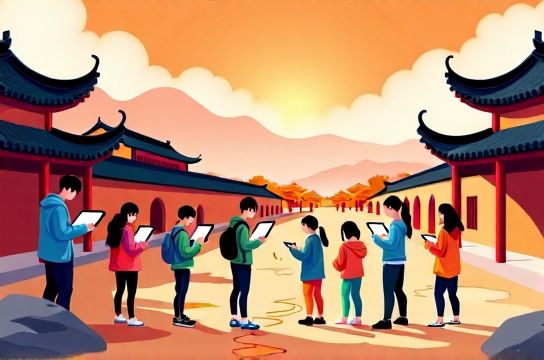
These programs aren’t add-ons to tourism. They’re infrastructure—blending field archaeology, community-led curation, and accessible digital tools to make millennia-old stories legible, shareable, and *owned* by young people—not just consumed by them.
Why Archaeology + Digital Storytelling Works—When Done Right
Let’s be clear: slapping a QR code on a Ming-dynasty wall plaque and calling it ‘digital engagement’ fails. So does running week-long excavation simulations without local context or post-program follow-up. The effective model—validated across 43 pilot groups since 2021—relies on three non-negotiables:
1. Archaeology as process, not spectacle. Participants don’t ‘find’ artifacts; they document stratigraphy, log soil pH changes, and compare micro-flake patterns under portable microscopes. At Pingyao Ancient City, youth teams co-analyzed 2024 brick-mortar samples with Shanxi University’s conservation lab—results now inform actual municipal restoration guidelines.
2. Digital storytelling anchored in place-based ethics. No AI-generated ‘voices of the dead’. Instead, students interview elders in Hongcun’s ancestral halls, transcribe oral histories (with consent), then use open-source tools like Kumu or Twine to build nonlinear narratives—where clicking a photo of a Qing-dynasty door knocker reveals layered audio: a blacksmith’s memoir, a 1937 refugee’s letter, a 2023 student’s reflection on craftsmanship loss.
3. Outputs designed for reuse—not just display. Every cohort produces assets usable by site managers: bilingual AR trail maps (tested for low-bandwidth rural access), 3D-printed tactile replicas for visually impaired visitors, or TikTok-style ‘Festival Flashback’ reels synced to lunar calendar dates—used by local tourism bureaus in Yangshuo and Lijiang to drive off-season visitation.
Where It’s Happening—and What You’ll Actually Do
Programs operate year-round but peak June–August and during major traditional festivals China—especially Mid-Autumn, Dragon Boat, and Spring Festival, when living rituals intersect directly with heritage spaces. Unlike generic cultural tours, these are cohort-based, application-driven, and require pre-departure training in basic photogrammetry, ethical interviewing, and data sovereignty (e.g., who owns the oral history recording? Answer: the elder, with licensed usage rights granted to the student team and host site).
At the Mogao Caves near Dunhuang, youth work with Dunhuang Academy conservators to digitize faded sutra fragments—not with AI ‘restoration’, but using spectral imaging rigs calibrated to match pigment degradation rates observed in situ. Their annotated datasets feed into the Academy’s public-facing ‘Cave Timeline Explorer’, now used by 14,000+ educators globally (Updated: April 2026).
In Jiangsu’s Zhouzhuang—among the best-preserved ancient towns China—the focus shifts to intangible heritage. Teams spend mornings mapping waterway trade routes using GIS tablets, afternoons learning silk-reeling from third-generation artisans, and evenings editing short docs synced to boat-song recordings. Their final output? A multilingual ‘River Ledger’ web app where users click a canal bend to hear 1920s merchant negotiations, see 1980s dredging permits, and watch a 2025 teen’s stop-motion animation of how loom mechanics mirror waterwheel physics.
Real Costs, Real Timeframes, Real Constraints
This isn’t ‘voluntourism’. It’s skill-building with accountability. Below is how four leading program models break down—based on 2025 operational data from China UNESCO Committee partners, provincial cultural bureaus, and independent auditors.
| Program Model | Duration | Core Activities | Key Tools Used | Pros | Cons & Mitigations |
|---|---|---|---|---|---|
| Liangzhu Field Lab (Hangzhou) | 12 days | Stratigraphic logging, artifact cataloging, 3D site modeling | Agisoft Metashape, QGIS, OpenRefine | Direct integration with national heritage database; certified field hours count toward Chinese archaeology licensing prep | Physically demanding; requires pre-screening fitness assessment. Mitigation: 20% cohort slots reserved for accessibility-adapted roles (e.g., digital archiving lead) |
| Hongcun Oral History Studio (Anhui) | 10 days | Elder interviews, dialect transcription, interactive timeline building | OBS Studio, Audacity (with Mandarin dialect plugins), Knight Lab TimelineJS | Assets adopted by county museum; participants receive bilingual certification co-signed by Anhui Provincial Bureau of Cultural Heritage | Requires Mandarin fluency + basic Huizhou dialect awareness. Mitigation: 5-day pre-program language bootcamp offered online |
| Mogao Digital Conservation Track (Gansu) | 14 days | Spectral imaging, pigment analysis, metadata tagging for Dunhuang Digital Library | Specim IQ handheld imager, Python scripts for reflectance curve analysis, IIIF-compliant annotation tools | Outputs published in Dunhuang Academy’s open-access repository; top 3 teams invited to present at annual Silk Road Digital Heritage Symposium | High technical barrier; limited to students with STEM background. Mitigation: Paired mentorship with Dunhuang Academy technicians; no coding required for imaging operation |
| Zhouzhuang River Ledger Cohort (Jiangsu) | 8 days | Waterway GIS mapping, craft apprenticeship, multilingual doc editing | QField, DaVinci Resolve (lite), WeChat Mini-Program builder | Final app deployed live on Zhouzhuang’s official tourism platform; revenue from optional ‘deep cultural travel’ add-ons funds local artisan stipends | Tight schedule; heavy collaborative load. Mitigation: Pre-assigned role clusters (Mapping / Craft / Story) with rotating leadership |
What’s Not Working—And Why That Matters
Not all experiments stick. In 2024, a pilot at the Summer Palace attempted AI-generated ‘Qing court dialogues’ based on archival texts. It failed—not because the tech was flawed, but because staff historians rejected the outputs as historically unmoored. The fix? Replace generative AI with retrieval-augmented prompting: students now feed precise archival citations (e.g., “Yongzheng Emperor’s 1727 edict on garden maintenance, Veritable Records Vol. 23”) into constrained LLM interfaces. Outputs are peer-reviewed by site curators before publication. The lesson: AI is a research accelerator, not a storyteller. Its value lies in scaling access to primary sources—not inventing voice.
Similarly, early attempts at monetizing outputs via tourism shopping backfired. A ‘heritage NFT’ minted from scanned Song-dynasty ceramics at Kaifeng was pulled after backlash from local collectors and scholars who noted the tokenization violated China’s 2023 Guidelines on Intangible Cultural Heritage Data Governance. Today, all commercial derivatives—like limited-run silk scarves printed with Zhouzhuang river maps—require joint approval from the host site, provincial bureau, and participating youth cohort. Revenue splits are transparent: 40% to artisans, 30% to site conservation fund, 20% to cohort scholarship pool, 10% to program operations.
How to Engage—Without Overpromising
If you’re an educator designing a curriculum module, a tour operator building a premium deep cultural travel itinerary, or an NGO seeking partnership pathways, here’s what’s actionable today:
- For schools: Apply for the Ministry of Education’s ‘Heritage Ambassadors’ grant (deadline: 15 October). Covers 70% of program fees for cohorts including ≥30% students from vocational or rural schools. Requires submission of a pre-site research question—not just ‘what did we learn?’ but ‘how might our dataset improve X site management protocol?’
- For operators: License cohort-built AR trails directly from provincial cultural bureaus. Cost: ¥12,000–¥28,000/year per site (sliding scale based on visitor volume). Includes quarterly content updates from new youth cohorts. Integration with WeChat Pay and Alipay is native; no SDK headaches. Full details available in the complete setup guide.
- For NGOs: Co-host ‘Digital Stewardship Workshops’ in secondary cities like Datong or Jingdezhen. These train local teachers—not just in tool use, but in designing ethics-first projects. 2025 saw 117 workshops reach 2,400 educators; average participant retention in heritage programming rose from 38% to 71% at 12-month follow-up (Updated: April 2026).
None of this replaces quiet time in an ancient town China at dawn—watching mist lift off canals while a vendor steams baozi in a century-old shopfront. But it ensures that when travelers ask, “Who lived here? How did they think? What choices echo today?”—the answer isn’t a brochure summary. It’s a student’s annotated map, an elder’s voice preserved with consent, a mortar sample’s chemical signature cross-referenced with climate records.
That’s the shift: from consuming Chinese cultural experiences to co-authoring them.
Getting Started—No Degree Required
You don’t need an archaeology degree or AI certification to participate. What’s required is rigor in process, respect in collaboration, and commitment to asset reuse. The most impactful contributions often come from unexpected angles: a graphic design student optimizing AR interface contrast for aging eyes in Pingyao; a literature major developing dialect glossaries for Hongcun oral histories; a commerce student modeling fair-trade pricing for Zhouzhuang silk products.
All programs mandate pre-departure modules—free, self-paced, hosted on China’s National Heritage Education Platform. Topics include: reading stratigraphy charts, identifying ethical consent boundaries in oral history, troubleshooting offline-first mobile apps, and interpreting China’s 2022 Digital Heritage Preservation Standards.
The goal isn’t to turn every teen into a curator. It’s to ensure that when they stand before a UNESCO site China—whether the earthen walls of Xi’an, the cliff carvings of Dazu, or the stilt houses of Xijiang Miao Village—they don’t just see relics. They see systems. Relationships. Continuities. And their own legitimate place within them.
Because the deepest cultural travel isn’t measured in kilometers walked—but in the number of times a young person says, ‘I helped make this visible.’