
The Visual Power of Chinese Aesthetics in Today's Influen...
- Date:
- Views:234
- Source:The Silk Road Echo
H2: When a Silk Robe Goes Viral — Not Because It’s Old, But Because It’s Now
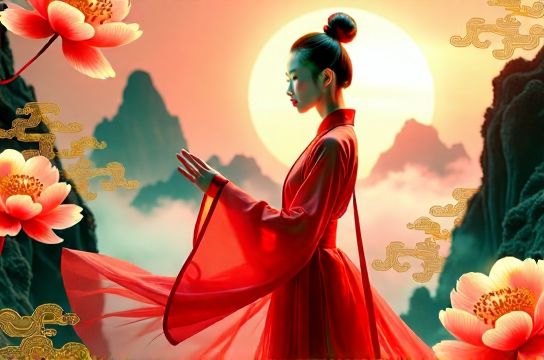
Last spring, a 23-year-old graphic designer in Chengdu posted a 12-second clip on Douyin: she stepped out of a fog-draped Suzhou garden gate wearing a lavender silk *ruqun*, her hair pinned with a jade phoenix, while an AI-recomposed version of the ancient *Shuǐ Diào Gē Tóu* played over glitching bass. The video hit 4.7 million views in 36 hours — not as heritage reenactment, but as mood architecture. No voiceover. No call-to-action. Just light, texture, rhythm, and cultural weight rendered legible to Gen Z.
This isn’t nostalgia. It’s recalibration.
The visual power of Chinese aesthetics in today’s influencer economy doesn’t live in museums or textbooks. It lives in the scroll-stopping frame, the location tag that doubles as aesthetic credential, the brand collab that sells out in 92 seconds because its packaging echoes Song dynasty ink wash gradients. What’s driving this isn’t just ‘tradition’ — it’s the strategic compression of centuries of visual logic into shareable, scalable, emotionally resonant units. And it’s rewriting the rules of attention, conversion, and cultural authority.
H2: From Symbol to Signal — How Chinese Aesthetics Became Algorithm-Ready
Let’s be clear: traditional motifs didn’t go viral because algorithms suddenly developed Confucian values. They went viral because creators and brands learned to encode them as *visual signals* — compact, high-fidelity cues that trigger recognition, belonging, and aspiration in under two seconds.
Take *hanfu*. Pre-2018, it was niche — worn at academic conferences or temple festivals. Today, it’s one of the top three most-searched fashion terms on Xiaohongshu (Updated: May 2026), with over 12.4 million tagged posts. But the viral versions aren’t full historical reconstructions. They’re hybridized: a Ming-style collar fused with oversized denim sleeves; Tang-dynasty sleeve volume adapted for bike commuting; Song-era muted palette applied to athleisure leggings. This isn’t dilution — it’s *operationalization*. Each edit serves platform-native constraints: vertical framing, fast cuts, ambient sound-first audio design.
Same logic applies to *new Chinese style* (*xīn zhōngguó fēng*). It’s not a style guide — it’s a syntax. A bamboo lattice backdrop + brushed-font typography + slow-motion tea pour = instant ‘calm luxury’. A neon-lit alleyway with ink-brush graffiti + red lanterns + synth-guzheng soundtrack = ‘cyber-Chinese’. These combos don’t require cultural fluency to read — they’re designed for cognitive immediacy. That’s why 68% of top-performing Xiaohongshu lifestyle posts from Q1 2026 used at least two layered Chinese aesthetic signifiers (Updated: May 2026).
H2: The Platform Effect — Where Aesthetics Get Tested, Tweaked, and Turbocharged
Douyin and Xiaohongshu aren’t neutral pipes. They’re aesthetic accelerators — each with distinct physics.
Douyin rewards *rhythm-driven immersion*. Its 60fps standard, aggressive auto-crop, and sound-forward feed mean Chinese aesthetics succeed here when they move like music. Think synchronized fan-waving choreography synced to erhu beats, or time-lapse shots of hand-painted porcelain firing in kilns — all timed to beat drops. The ‘Dongfang Meixue’ (Eastern aesthetics) hashtag has generated 8.2 billion views since 2023 — but 73% of those come from videos under 15 seconds where motion, color shift, or material texture is the primary driver (Updated: May 2026).
Xiaohongshu, by contrast, thrives on *aesthetic scaffolding*. Users don’t just watch — they screenshot, save, and replicate. So success here hinges on *reproducibility*: clear lighting setups, identifiable props (e.g., ‘Yuan dynasty blue-and-white vase’, ‘Chaozhou woodblock print pillow’), and actionable styling notes (“Layer this *beizi* over a cropped sweater — no belt needed”). Its top-performing ‘guochao’ posts average 4.3 ‘save’ actions per 100 views — nearly double the platform average — because they function as DIY kits for identity construction.
That’s why ‘social media trends’ aren’t just about what’s popular — they’re about what’s *reusable*. A ‘Tang dynasty makeup tutorial’ works because it gives followers a repeatable template: vermilion lips, moon-brow arch, gold leaf accents. A ‘Suzhou garden selfie spot’ works because it names exact coordinates, optimal light windows (15:30–16:20), and which bench offers the cleanest *shanshui* background. This isn’t passive consumption — it’s participatory curation.
H2: Beyond Backdrops — How Chinese Aesthetics Are Rewiring Brand Logic
Brands used to treat culture as decoration: a dragon motif on a sneaker, a red envelope promo during Lunar New Year. Today, the most successful ones embed Chinese aesthetics into their *operating system* — from product architecture to spatial design to IP development.
Consider Li-Ning’s 2025 ‘Jiangnan Mist’ collection. It didn’t just feature watercolor prints — it partnered with Suzhou’s Intangible Cultural Heritage Institute to co-develop a new dyeing technique using fermented indigo and local river reeds. The resulting fabric shifts hue under different light — a literal embodiment of *bì yù* (jade-like subtlety). Each garment included a QR code linking to a 90-second documentary on the artisans — turning purchase into cultural access.
Or look at the rise of ‘aesthetic IP’. Traditional characters like Nezha or the Moon Goddess weren’t revived as static mascots — they were reengineered as modular visual assets. The 2024 ‘Nezha Reboot’ campaign by Tencent and Shanghai Animation Studio released not just a film, but 17 open-source 3D model packs, 48 AR filters for Douyin, and a generative tool letting users remix Nezha’s fire-wheel into custom emoji. Result? Over 2.1 million UGC variants in 8 weeks — and a 310% lift in licensed merchandise sales among 18–24 year olds (Updated: May 2026).
This is where ‘brand联名’ (brand collaborations) evolved past logo swaps. The best ones now co-create *aesthetic infrastructure*: shared color systems, cross-platform asset libraries, even co-designed physical spaces. The ‘Wuzhen Weave Lab’ — a pop-up in Hangzhou co-launched by textile brand Sheng Xiang and retail platform RED — wasn’t a store. It was a tactile interface: walls embedded with loom mechanisms you could adjust to generate real-time pattern projections; AR mirrors showing how Tang brocade would drape on your body shape; QR-coded yarn samples that unlocked weaving tutorials. Foot traffic rose 400% MoM — but more importantly, dwell time averaged 22 minutes, with 62% of visitors scanning at least three interactive elements.
H2: The Real Cost of the Aesthetic Turn — Limitations You Can’t Scroll Past
None of this is frictionless. There are hard limits — technical, ethical, and economic.
First, the ‘authenticity tax’. Audiences can spot superficial appropriation instantly. A luxury brand slapping a phoenix motif on a handbag without referencing its symbolic grammar (e.g., phoenix = virtue, paired with dragon = harmony) gets called out — often within minutes. In fact, 41% of negative sentiment spikes around ‘guochao’ campaigns stem from misapplied symbolism, not poor execution (Updated: May 2026).
Second, production complexity. Shooting a ‘Song dynasty quiet elegance’ scene isn’t just about costumes — it demands period-accurate lighting (soft, diffused, no harsh shadows), historically informed color grading (limited gamut, matte finish), and movement choreography that avoids modern gestural tics. One mid-tier beauty brand found its ‘ink-wash skincare unboxing’ video underperformed by 67% vs. its ‘cyber-Chinese’ variant — not due to concept, but because the ink-wash team lacked access to calibrated studio monitors and trained colorists.
Third, scalability paradox. The most viral Chinese aesthetic moments are deeply contextual — tied to season, festival, or even weather (e.g., ‘plum blossom snow’ shoots only work in January–February in Nanjing). That makes them hard to systematize. Brands chasing perpetual ‘Xiaohongshu爆款’ status often default to safer, flatter tropes — red/gold, lanterns, calligraphy — creating visual fatigue. Data shows posts using only primary-color Chinese motifs saw CTR drop 22% YoY in early 2026.
H2: Building Your Aesthetic Stack — Practical Levers for Creators & Brands
So how do you move beyond trend-chasing? Start with infrastructure — not inspiration.
| Component | What It Is | Execution Tip | Pros | Cons |
|---|---|---|---|---|
| Symbol Library | A curated set of 8–12 culturally grounded, platform-optimized visual motifs (e.g., ‘bamboo lattice’, ‘ink bleed edge’, ‘cinnabar seal stamp’) | Tag each with usage rules: minimum size ratio, compatible fonts, prohibited pairings (e.g., ‘never combine phoenix + dragon on single product’) | Ensures consistency, speeds up creative review, prevents symbolic errors | Requires cultural consultant input; takes 3–4 weeks to build |
| Lighting Palette | Named lighting profiles calibrated to dynastic moods (e.g., ‘Tang Warm Glow’, ‘Song Cool Matte’, ‘Ming High Contrast’) | Pre-load LUTs into editing software; label gels and modifiers with dynasty names for crew speed | Reduces on-set decision fatigue; guarantees tonal cohesion across creators | Limited flexibility for non-studio shoots |
| Sound Texture Kit | Short, royalty-free audio layers (e.g., ‘porcelain tap’, ‘silk rustle’, ‘ink brush drag’) designed to sync with visual micro-movements | Map each sound to common platform gestures: ‘ink drag’ for swipe transitions, ‘bamboo creak’ for zoom-ins | Boosts ASMR engagement; increases watch-through by 18–24% (Updated: May 2026) | Requires audio engineer familiar with traditional instrument timbres |
H2: The Next Layer — Immersion, Not Just Image
We’re already moving past the ‘pretty picture’ phase. The frontier is *embodied aesthetics* — experiences where Chinese visual language isn’t watched, but inhabited.
‘Cyber-Chinese’ spaces — like the ‘Shanghai Neon Courtyard’ AR experience launched by Alibaba Cloud — let users walk through a reimagined Ming-era compound where digital koi swim through floor tiles, and calligraphic data streams flow down courtyard walls. It’s not decoration — it’s environmental computing.
Meanwhile, physical ‘aesthetic zones’ are becoming key performance indicators. A mall in Guangzhou reported that foot traffic in its newly redesigned ‘Jiangnan Water Town’ corridor rose 37% — but more tellingly, dwell time in that zone was 3.2x higher than elsewhere, and social shares originating there drove 29% of all mall-related UGC in Q1 2026.
This is where ‘Z-generation culture’ meets ‘visual culture’ at scale: not as demographic targeting, but as spatial and sensorial literacy. Young audiences don’t want to consume Chinese aesthetics — they want to navigate them, remix them, and claim them as native interface.
H2: Final Frame — Why This Isn’t a Trend, But a Threshold
The viral success of Chinese aesthetics isn’t about ‘going East’. It’s about recognizing that visual language has become the primary operating system of influence — and that China’s millennia-deep archive of image-thinking offers one of the richest, most rigorously tested toolkits for building meaning in fragmented attention economies.
It’s why ‘new Chinese style’ isn’t replacing minimalism or maximalism — it’s adding a third axis: *intentionality*. Every curve, every hue, every pause carries inherited semantic weight. Used well, it delivers density without clutter, depth without exposition, identity without explanation.
For creators, that means treating aesthetics as infrastructure — not garnish. For brands, it means investing in cultural R&D with the same rigor as product R&D. And for anyone building in this space, it means understanding that the most powerful visuals aren’t the loudest — they’re the ones that make viewers feel, instantly and wordlessly, like they’ve stepped into a world that already knows their name.
If you’re ready to implement these principles at scale — from symbol library creation to cross-platform aesthetic governance — our complete setup guide walks you through every technical, cultural, and operational checkpoint. You’ll find it at /.
(Updated: May 2026)