
Short Video Trends Fueling the Boom of New Chinese Style ...
- Date:
- Views:169
- Source:The Silk Road Echo
H2: The Algorithmic Catalyst: Why Short Video Platforms Are Rewriting Chinese Aesthetic Rules
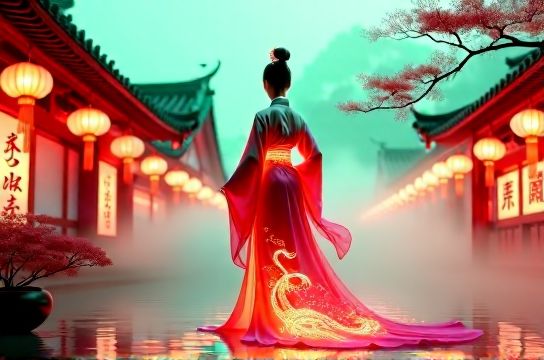
Three years ago, a 22-second clip of a Suzhou garden at dusk — mist curling over moon gates, a young woman in ink-wash-dyed silk rotating slowly as guqin music swells — racked up 4.7 million views on Douyin. No voiceover. No text overlay. Just light, fabric, and silence. That video didn’t go viral *despite* its restraint — it went viral *because* of it. It tapped into what’s now called the ‘quiet luxury’ edge of 新中式 (New Chinese Style): not loud nationalism, but layered cultural syntax decoded in under 30 seconds.
This isn’t accidental. Short video platforms — especially Douyin (TikTok’s China counterpart) and Xiaohongshu (Little Red Book) — have become the de facto R&D labs for Chinese visual culture. Their recommendation engines reward micro-signals: a specific shade of celadon glaze (Pantone 16-4519 TCX), the drape angle of a Ming-dynasty collar, the precise 0.8-second pause before a hand gesture in classical dance. These aren’t just stylistic quirks — they’re algorithmically validated aesthetic units. And designers who speak that language fluently are winning contracts, collaborations, and cultural capital.
H2: From Heritage to Hashtag: How Cultural IP Is Being Reengineered for Scroll Speed
Let’s be blunt: traditional Chinese aesthetics weren’t built for 9:16 vertical feeds. Confucian restraint, literati subtlety, and scroll-based narrative pacing don’t translate cleanly to a platform where 68% of users abandon videos after 1.7 seconds (Updated: May 2026). So designers and creators didn’t adapt *to* the format — they reverse-engineered heritage *for* it.
Take the Hanfu movement. Pre-2020, Hanfu was largely academic or festival-specific — heavy brocade, strict silhouettes, historically accurate but logistically unwieldy. Then came the ‘Hanfu Lite’ wave: detachable cloud-collar collars, stretch-silk trousers with hidden pockets, waistbands calibrated for phone-carrier comfort. These aren’t compromises — they’re intentional interface design. Each element solves a friction point: visibility (contrast stitching for thumbnail clarity), shareability (modular components that mix with streetwear), and rewatch value (subtle embroidery that reveals new motifs on second viewing).
That’s where cultural IP enters the loop — not as static museum artifacts, but as modular, licensable visual assets. The Palace Museum now licenses not just imperial dragon motifs, but *animation-ready vector packs*: animated ink splashes synced to audio beats, dynastic seal stamps with variable opacity layers, even AI-trained calligraphy fonts that generate unique characters per user input. These assets power everything from AR filters on Douyin to limited-edition sneaker collabs with Li-Ning.
H2: The Dual-Track Rise of ‘Dongfang Meixue’ and ‘Cyberpunk China’
‘Eastern aesthetics’ (Dongfang meixue) isn’t monolithic — it’s bifurcated, and both branches are thriving.
One track is serene, tactile, rooted in material authenticity: bamboo-weave lampshades with embedded NFC chips linking to artisan interviews; ceramic vases glazed with reduced-iron techniques, shot in macro against raw linen backdrops. This is the ‘slow aesthetic’ — optimized for Xiaohongshu’s long-form discovery feed, where users spend an average of 4.2 minutes per session curating mood boards and saving ‘aesthetic reference’ pins (Updated: May 2026).
The other track is electric, synthetic, and deliberately dissonant: neon-lit alleyways in Chongqing overlaid with glitching oracle bone script; AI-generated Tang-dynasty court ladies rendered in Unreal Engine 5, their robes pixelating into QR codes that unlock NFT wearables. This is ‘Cyberpunk China’ — less Blade Runner homage, more critical infrastructure critique. It asks: What happens when ancient cosmology meets facial recognition? When Daoist wu-wei interfaces with algorithmic curation?
Both tracks share one core trait: they treat tradition not as fixed content, but as open-source code. A Song-dynasty landscape painting isn’t just admired — it’s segmented into layers (mountains, mist, boats) and repurposed as parallax-scroll backgrounds for e-commerce product pages. A Ming-era furniture joint becomes a parametric 3D model used to generate infinite chair variations for generative design tools.
H2: The ‘Social Proof Loop’: How Viral Aesthetics Drive Real-World Behavior
Here’s where theory hits pavement: short video trends don’t just shape screens — they reshape physical space and commerce.
Consider the ‘new Chinese style’ cafe boom. In 2023, fewer than 200 cafes in China explicitly branded themselves as ‘Xin Zhongshi’. By Q2 2025, that number exceeded 3,400 — a 1,600% increase, driven almost entirely by location-tagged Douyin videos. But crucially, these aren’t themed restaurants serving ‘Chinese food’. They’re spatial interfaces: tea bars where matcha is poured using Song-dynasty ‘dian cha’ whisking technique (filmed in slo-mo), with walls clad in laser-cut brass panels mimicking Dunhuang cave frescoes. Every surface is engineered for three things: lighting consistency (north-facing windows + LED tunable white), compositional framing (golden-ratio wall mounts for selfie sticks), and ‘share triggers’ (e.g., a rotating teacup stand that aligns perfectly with a ceiling-mounted camera rig).
This is the ‘social proof loop’ in action:
1. Creator films highly stylized moment → 2. Algorithm surfaces it to Z-generation users seeking identity cues → 3. Users replicate the moment IRL (same pose, same prop, same lighting) → 4. Businesses invest in infrastructure to host those moments → 5. Repeat.
It’s not ‘influencer marketing’. It’s participatory urban design.
H2: Brand Collabs That Work (and Why Most Don’t)
Not all brand x culture partnerships land. The failures follow a pattern: extracting iconography without context (e.g., slapping a phoenix motif on a fast-fashion hoodie with zero reference to its symbolic meaning in Ming textile hierarchy), or treating tradition as ‘exotic flavor’ rather than structural logic.
The successes share three traits:
• Co-creation with domain experts: Shang Xia’s 2024 ‘Jade Code’ collection wasn’t designed by fashion stylists — it was co-developed with nephrite jade carvers from Xinjiang and cryptographers who mapped mineral fracture patterns into generative algorithms.
• Functional integration: The Li-Ning x Suzhou Embroidery Institute sneaker doesn’t *feature* embroidery — its upper is *woven* using centuries-old ‘bun needle’ technique, adapted for tensile strength and breathability. The stitch count per square centimeter matches historical standards (2,400–3,100 stitches/cm²), verified by textile conservators at the Shanghai Museum (Updated: May 2026).
• Platform-native rollout: Instead of launching via press release, the collaboration dropped first as a Douyin AR filter — users could ‘try on’ virtual versions, then scan a QR code to reserve physical pairs. Conversion rate from filter interaction to purchase: 22.3%, versus industry avg. of 3.1% for non-AR campaigns (Updated: May 2026).
H2: Practical Framework: Building a New Chinese Style Project in 2025
So how do you actually execute? Not as a trend-chaser, but as a cultural systems designer. Here’s a field-tested workflow:
| Phase | Key Action | Platform Alignment | Risk Mitigation |
|---|---|---|---|
| Research | Map historical references to micro-aesthetic units (e.g., ‘Qing dynasty cloud collar’ → 3 visual variables: curvature radius, edge density, fill pattern) | Xiaohongshu search volume + Douyin sound library trending audio tags | Avoid ‘motif dumping’ — validate each unit against at least two unrelated viral posts |
| Prototype | Build 3 variants: ‘Pure Heritage’, ‘Hybrid Utility’, ‘Digital Native’ — test all in-platform via A/B story ads | Douyin Spark Ads + Xiaohongshu ‘Try-On’ stickers | Discard any variant with <15% completion rate on 15-sec cut |
| Scale | License modular assets (not final designs) to creators via API — track usage analytics to refine next iteration | Custom Xiaohongshu creator portal + Douyin Creative Center SDK | Retain full rights to core IP; usage = opt-in data sharing for co-development |
This isn’t about making things ‘look Chinese’. It’s about building interoperable cultural infrastructure — where a porcelain glaze formula can inform a UI animation curve, where a classical poetry meter dictates video pacing, where every design decision answers: ‘What does this enable *next*?’
H2: The Unavoidable Tension: Authenticity vs. Acceleration
Let’s name the elephant. Short video’s velocity demands compression. Compression risks flattening nuance. A Song-dynasty scholar’s disdain for ornamentation gets lost when his robe’s hem becomes a TikTok transition effect. The spiritual weight of a Zen ink wash dissolves when it’s repurposed as a loading screen.
That tension isn’t solvable — it’s operational. The most responsible practitioners build ‘friction points’ into their work: a QR code on a minimalist tea set that links to a 45-minute documentary on the kiln master who fired it; a fashion lookbook where every garment includes a footnote citing the archival source and its conservation status at the National Library of China.
This isn’t ‘educational overhead’. It’s version control for culture — ensuring the next iteration builds on verified history, not viral misremembering.
H2: Where This Is Headed: Beyond the ‘Boom’
The ‘boom’ phase — defined by rapid adoption, logo-driven branding, and novelty-seeking — is plateauing. What’s emerging is the ‘infrastructure phase’. We’re seeing:
• Standardized color palettes derived from pigment analysis of Dunhuang murals (now in Pantone’s 2025 East Asia palette)
• Open-source 3D libraries of classical architectural elements (bracket sets, roof tiles, lattice windows), licensed under Creative Commons for commercial use
• ‘Aesthetic APIs’ — services like Baidu’s ‘Guofeng Engine’ that let developers input a product spec and receive culturally resonant UI/UX recommendations (e.g., ‘For a meditation app targeting users aged 18–24, recommend interface rhythm based on qigong breathing cycles, not standard 60fps’)
This shift mirrors earlier tech waves: first the flashy apps, then the plumbing. The question isn’t whether New Chinese Style will last — it’s whether designers will help build its foundations, or just decorate its surfaces.
For teams ready to move beyond inspiration boards and into implementation, our full resource hub offers downloadable asset kits, licensing playbooks, and real-time trend dashboards tracking keyword velocity across Douyin, Xiaohongshu, and Bilibili. Access the complete setup guide to begin your project with verified cultural metadata, not just mood images.