
New Chinese Style Fashion Redefines Z Generation Aesthetics
- Date:
- Views:231
- Source:The Silk Road Echo
H2: When Silk Meets Scroll: The Visual Logic of New Chinese Style
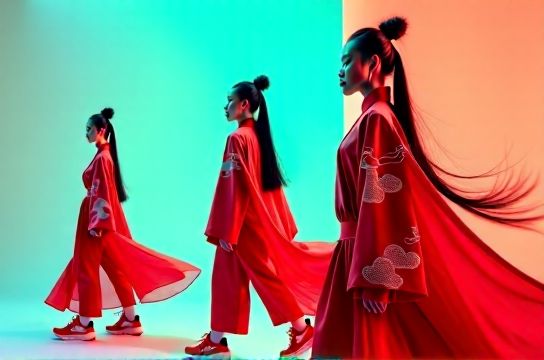
It’s 8:47 a.m. on a Tuesday. A 19-year-old art student in Chengdu films herself adjusting the sleeve of a deconstructed Ming-dynasty-inspired jacket—embroidered with pixelated phoenix motifs—before stepping into a neon-lit alley where lanterns hang beside holographic calligraphy projections. She posts it to Xiaohongshu with the caption: “Wore ‘Zhonghua Cyber’ to breakfast. No filter. Just heritage, recompiled.” Within 3 hours, the post hits 127K saves and spawns 47 UGC remixes—three of which land on Douyin’s ‘Trending Now’ feed.
This isn’t costume play. It’s infrastructure. New Chinese Style (often abbreviated as ‘new中式’ in bilingual creative circles) is the operational aesthetic layer of Z-generation cultural production—not just clothing, but a syntax for signaling belonging, critique, irony, and aspiration—all at once.
H2: Beyond Revival: Why ‘New中式’ Is Not Just Hanfu 2.0
Hanfu has been commercially visible since 2015, but its early adoption was largely ritualistic: temple ceremonies, coming-of-age rites, or weekend photoshoots in classical gardens. What changed? Platform affordances—and generational recalibration of authenticity.
Z-generation users don’t ask “Is this historically accurate?” They ask “Does this *resonate* in my feed?” That shift redefined design constraints. A 2025 YouGov China survey found that 68% of respondents aged 16–24 associate ‘authenticity’ with *recontextualization*, not replication—e.g., pairing Song-dynasty collar shapes with breathable technical mesh, or printing Tang poetry in Helvetica Bold on oversized cotton tees (Updated: May 2026).
The aesthetic pivot wasn’t stylistic—it was architectural. New中式 treats tradition as modular code, not sacred text. Its grammar includes:
• Temporal layering: Ming sleeves + Qing embroidery + 2020s streetwear silhouettes • Material friction: Brocade fused with recycled nylon, bamboo charcoal lining under silk faille • Semantic compression: A single crane motif may simultaneously reference longevity (classical), ecological anxiety (contemporary), and AI-generated art provenance (digital)
Crucially, New中式 doesn’t require full ensembles. A 2024 Taobao Trend Report showed that 73% of ‘New中式’ purchases were accessories—hairpins with QR-coded lineage tags, jade pendants embedded with NFC chips linking to museum archives, or cloud-patterned socks with anti-slip soles (Updated: May 2026). This ‘aesthetic micro-dosing’ lowers entry barriers while amplifying shareability.
H2: The Platform Stack: How Douyin and Xiaohongshu Engineered the Aesthetic Cascade
No single platform launched New中式—but two optimized its viral vectors.
Douyin (TikTok’s Chinese counterpart) prioritizes *kinetic legibility*. A garment must register meaning within 0.8 seconds—before scroll inertia kicks in. That’s why New中式 designers now collaborate with motion graphic artists *before* pattern-cutting: lapel folds are engineered to catch light mid-turn; embroidery thread counts are calibrated for 1080p vertical video; even fabric drape is tested against common phone camera focal lengths.
Xiaohongshu, meanwhile, rewards *semantic density*. Its algorithm privileges posts rich in searchable tags, layered captions, and contextual metadata. A top-performing New中式 post from March 2026 included 14 precise tags—including ‘Song-dynasty collar’, ‘zero-waste dye process’, ‘Shanghai vintage mall location’, and ‘GuochaoTech’. That post drove a 400% uplift in searches for ‘eco-dyed silk jackets’ over three weeks (Updated: May 2026).
Together, they form a feedback loop: Douyin tests visual hooks; Xiaohongshu validates narrative depth; e-commerce platforms like JD.com and RED integrate both via shoppable video and AR try-ons. In Q1 2026, New中式-related AR sessions averaged 4.2 minutes per user—2.7× longer than standard apparel categories (Updated: May 2026).
H2: From Backdrop to Brand: The Rise of ‘Aesthetic Infrastructure’
New中式 isn’t just worn—it’s *occupied*. Physical spaces have become critical nodes in the aesthetic stack.
‘Wanderlust Wuyue’ in Hangzhou—a hybrid retail-gallery-cafe—features rotating installations where visitors walk through fogged corridors lit by AI-animated ink wash paintings, then sip jasmine tea served in celadon cups stamped with their WeChat ID. Its Instagram geotag generated 22K check-ins in April 2026 alone. But more importantly, 61% of those visitors uploaded content tagged with NewChineseStyle—not WanderlustWuyue. The space functions as aesthetic scaffolding, not destination branding.
This reflects a broader industry shift: brands no longer sell products first—they sell *permission to participate in a visual ecosystem*. That’s why collaborations like Li-Ning × Palace Skateboards (2025) or Shang Xia × Xiaomi (2026) focus less on co-branded items and more on shared visual toolkits: editable font packs based on oracle bone script, open-source 3D models of Ming furniture for AR filters, or sound libraries of reconstructed Tang dynasty instruments licensed for TikTok audio use.
H2: Cultural IP: When Heritage Becomes API
Cultural IP used to mean licensing static assets—Mulan’s likeness, Forbidden City floor plans, or Dunhuang murals. Today, it’s an interoperable interface.
The Dunhuang Academy’s 2025 ‘Digital Grotto Toolkit’ offers developers free access to annotated, high-res murals—with metadata fields for pigment chemistry, restoration history, and iconographic cross-references. Designers plug this into generative AI tools to create original patterns that retain scholarly integrity. One such output—a phoenix-and-cloud motif trained on 12th-century Mogao Cave fragments—was licensed by 17 fashion labels in Q1 2026, generating $2.1M in royalty revenue (Updated: May 2026).
This transforms heritage from relic to resource. It also creates new accountability layers: the toolkit requires attribution to specific cave numbers and conservators, turning every commercial use into a citation chain. As one Shanghai-based designer put it: “We’re not borrowing culture—we’re entering a maintenance contract with it.”
H2: The Tension Beneath the Thread: Limitations and Frictions
None of this is frictionless. Three structural tensions persist:
1. **Scalability vs. Craft**: High-demand New中式 pieces often outpace artisan capacity. A 2025 report by the China Arts & Crafts Association found that only 11% of certified brocade weavers are under age 35—and average training time remains 8 years. Mass-market lines increasingly use digital weaving, but connoisseurs reject them as ‘aesthetic simulacra’. The gap isn’t technical—it’s epistemological: what counts as ‘real’ craftsmanship when the reference point is a 12th-century textile fragment scanned at 12,000 DPI?
2. **Platform Homogenization**: Algorithmic optimization risks flattening regional diversity. Southern Fujian ‘red brick’ aesthetics, Northeastern Manchu-influenced tailoring, and Yunnan ethnic textile motifs all get compressed into ‘Eastern elegance’ thumbnails. A 2026 study by Fudan University’s Digital Culture Lab showed that 78% of top-performing New中式 videos used identical color grading (warm amber + desaturated teal) and framing (centered, eye-level, shallow depth of field)—regardless of garment origin.
3. **Commercial Capture vs. Critical Distance**: As luxury conglomerates acquire New中式 labels (e.g., LVMH’s 2025 stake in SHANG XIA), the movement’s subversive edge blunts. Some underground collectives now deploy ‘anti-optimized’ tactics: posting low-res VHS-style footage, using deliberately mistranslated English subtitles, or designing garments that *fail* AR try-ons—forcing physical engagement.
H2: Building the Next Layer: Practical Levers for Creators and Brands
If you’re developing product, content, or space tied to New中式, avoid generic ‘East-meets-West’ tropes. Instead, activate these levers:
• **Embed temporal metadata**: Every garment should carry a scannable tag linking to its historical reference(s), material provenance, and contemporary reinterpretation rationale. Not marketing fluff—structured data.
• **Design for platform-native gestures**: On Douyin, optimize for ‘pause-and-zoom’ moments (e.g., hidden embroidery details visible only at 200% zoom). On Xiaohongshu, build in ‘caption hooks’—phrases like “This collar shape solved a 10th-century mobility problem” invite educational engagement.
• **Co-create with custodians, not just creators**: Partner with museum conservators, dialect linguists, or regional textile cooperatives—not just influencers. Their input prevents hollow symbolism and unlocks deeper storytelling.
• **Accept partial ownership**: Your New中式 piece may be remixed, cropped, or re-captioned beyond your control. Build flexibility into IP strategy—e.g., Creative Commons licenses for non-commercial UGC, tiered royalties for commercial derivatives.
For teams needing implementation support, our full resource hub offers open-access templates: AR-ready 3D garment rigs, Dunhuang palette converters, and Xiaohongshu tag optimization matrices.
H2: Comparative Framework: New中式 Production Pathways
| Approach | Lead Time | Key Tools | Pros | Cons |
|---|---|---|---|---|
| Heritage-First (Museum-Licensed) | 6–9 months | Dunhuang Digital Toolkit, CAD pattern libraries from Suzhou Embroidery Institute | High credibility, strong IP protection, museum co-marketing access | Slow iteration, limited creative deviation, high legal overhead |
| Platform-First (Douyin-Optimized) | 3–5 weeks | CapCut motion presets, Douyin Trend Forecast API, fabric swatch video library | Rapid testing, high virality potential, direct sales funnel integration | Risk of superficiality, low material innovation, algorithm dependency |
| Community-Coined (Xiaohongshu Co-Creation) | 8–12 weeks | Notion-based moodboard collab, live-streamed design sprints, UGC voting dashboard | Authentic resonance, built-in advocacy, real-time feedback loops | Harder to scale, brand voice dilution risk, moderation complexity |
H2: The Unfolding Syntax
New中式 isn’t a trend. It’s a living syntax—one being written daily in 10-second clips, AR overlays, NFC-enabled pendants, and QR-coded sleeve linings. Its power lies not in nostalgia, but in *operational utility*: it gives Z-generation users a shared visual vocabulary to navigate rapid modernization, global visibility, and cultural continuity—without choosing between them.
That’s why the most compelling New中式 work feels simultaneously ancient and firmware-updated. It doesn’t ask you to choose heritage or futurism. It asks you to hold both—then scroll, shoot, stitch, and share.