
Deep Cultural Travel Photography Ethics at UNESCO Sites C...
- Date:
- Views:225
- Source:The Silk Road Echo
H2: When the Lens Meets Living Heritage
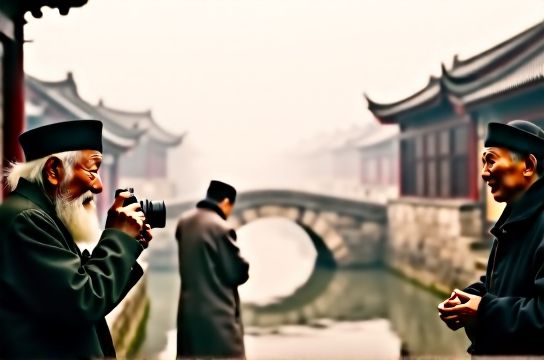
You’re standing in a narrow alley of Pingyao Ancient City at dawn. A Daoist priest sweeps temple steps while steam rises from a vendor’s baozi basket. Your camera is up—but your shutter finger hesitates. Not because of light or focus, but because you’ve just seen the elderly woman bow three times before the shrine, eyes closed, lips moving silently. You lower the camera. That pause—that’s where deep cultural travel photography ethics begin.
This isn’t about rules printed on a laminated card at the gate of a UNESCO site China. It’s about operating in the gray zone where documentation meets devotion, where tourism infrastructure meets ancestral practice, and where AI-assisted composition tools (like real-time framing overlays or crowd-density prediction apps) risk flattening ritual into backdrop.
We’ll walk through concrete, field-tested protocols—not ideals—for photographing at living heritage sites: UNESCO-designated locations like Mount Wutai, Lijiang Old Town, and the Historic Monuments of Dengfeng; sacred festival spaces such as the Qingming ancestral rites in Huizhou villages or the Zhuang ‘Gexu’ singing gatherings in Guangxi; and the often-overlooked economic layer—how tourism shopping intersects with image-making, especially when vendors pose for photos *in exchange for purchase*.
H2: The Three Thresholds: Access, Consent, Context
Photography ethics at UNESCO sites China operate across three overlapping thresholds—not sequential steps, but simultaneous filters.
H3: Threshold 1: Access Is Not Permission
UNESCO designation does not equal open-access documentation. At the Mogao Caves near Dunhuang, flash photography has been banned since 1990—not just to protect pigments (which degrade 30% faster under repeated UV exposure), but because many murals depict meditative states meant to be contemplated, not captured (Updated: April 2026). Visitors may enter Cave 231, but only under timed entry slots, with no tripod, no lens longer than 50mm, and zero image stabilization enabled—because even subtle vibration transfers through stone floors to fragile plaster layers.
Similarly, at the Temple of Heaven in Beijing, drone use is prohibited year-round—not for airspace reasons alone, but because aerial footage disrupts the spatial logic of imperial cosmology embedded in its triple-tiered circular altar. Tourists who film overhead without understanding that geometry aren’t just breaking rules—they’re misrepresenting function as form.
H3: Threshold 2: Consent Must Be Ritual-Aware
Consent isn’t binary (“yes/no”)—it’s layered and context-dependent. During the Dai Water-Splashing Festival in Xishuangbanna, young women wear silver headdresses and cotton skirts hand-embroidered with peacock motifs. Photographing them mid-celebration seems obvious—until you learn that certain headpieces are worn only during rites of passage, and that splashing water carries specific blessings tied to age and marital status. A nod from a smiling teen doesn’t equate to permission to publish her image alongside a caption like “joyful local tradition.”
Field protocol: Wait until the ritual concludes *and* participants disperse into informal social space. Then approach individually—not with camera raised, but with notebook and pen. Ask first in Mandarin: “May I take one photo? And may I share it online?” Note their response—not just verbal, but physical: Do they adjust clothing? Step back? Gesture toward an elder? In Yangshuo’s Huangluo Yao Village, elders have instituted a photo fee of ¥20 per person *only after* post-ritual consent—a transparent, community-managed tourism shopping model that funds textile preservation. It’s not exploitation; it’s calibrated reciprocity.
H3: Threshold 3: Context Overrides Composition
AI-powered photography tools now offer ‘heritage-aware framing’—suggesting golden-ratio crops aligned with Ming-dynasty roofline angles or flagging ‘non-authentic’ modern elements (e.g., a red plastic bucket beside a Song-dynasty well). But these algorithms train on static archives, not living practice. In Zhouzhuang, a vendor may hang laundry across a 12th-century stone bridge—not as visual clutter, but because that bridge remains a functional thoroughfare. Removing it digitally erases labor, continuity, and adaptation.
Your ethical obligation isn’t to produce ‘pure’ images—it’s to annotate honestly. If you post a photo from Hongcun’s Moon Pond showing Wi-Fi router lights glowing on a Hui-style window lattice, caption it: “Even in 900-year-old Hongcun, connectivity flows through ancestral forms.” That preserves integrity without romanticizing stasis.
H2: Festivals Are Not Photo Ops—They’re Time-Bound Contracts
Traditional festivals China are not performances. They’re time-bound contracts between generations, deities, and land. The Lantern Festival in Nanjing’s Confucius Temple district draws 200,000+ visitors annually—but only 12% attend to observe rites (Updated: April 2026). The rest come for spectacle: LED-lit dragons, selfie stations, and branded lantern giveaways.
That imbalance reshapes behavior. In Shaoxing, families once lit river lanterns for ancestors at midnight on the 15th day of the first lunar month. Now, vendors sell pre-lit, battery-powered versions by 6 p.m.—and tourists photograph the glow while skipping the incense offering or silent reflection. The image circulates widely; the intention stays local.
So how do you photograph meaningfully?
• Arrive early: At the Qufu Confucius Temple during the Spring Sacrificial Ceremony, photographers who secure front-row access by 5:30 a.m. witness the ritual purification rites—the washing of hands, the donning of black silk caps—before the public procession begins. Those moments contain more gravity than any posed ‘grand entrance.’
• Shoot sequences, not singles: During the She Festival in Jiangxi’s Wuyuan County, villagers carry wooden statues of earth gods through rice fields. A single frame of the statue looks like folklore. A 7-shot sequence—feet stepping on mud, sweat on foreheads, children watching from doorways, an elder adjusting the god’s scarf—tells of continuity, not costume.
• Respect the ‘no-photo zones’ inside: Many temples designate inner courtyards or spirit tablet chambers as off-limits—not for secrecy, but because the energy there is considered too concentrated for casual observation. Violating this isn’t rude; it’s energetically disruptive, per local cosmology. Locals know. Your guide knows. Honor it.
H2: The Tourism Shopping Tangle: When Images Become Currency
Tourism shopping isn’t peripheral to ethics—it’s central. In Lijiang Old Town, Naxi women in indigo-dyed jackets pose beside woven baskets for ¥15/photo. But behind that transaction lies a shift: fewer young Naxi women now learn tie-dye, because demand is driven by photo-ready aesthetics—not textile utility. The craft survives as performance, not practice.
Conversely, in Fenghuang’s Tujia communities, cooperatives now train youth to document *their own* festivals using loaned DSLRs—and sell limited-edition zines of those images at village co-op shops. Here, photography feeds preservation, not extraction.
The difference? Agency, revenue flow, and creative control. Your role isn’t to boycott photo-based tourism shopping—but to redirect value. Buy the zine. Hire the local photographer as your guide for half a day. Tip in cash *after* the shoot—not as payment for posing, but as recognition of interpretive labor.
H2: Tech Realities: What AI Can and Cannot Do
AI tools promise efficiency—auto-tagging ‘UNESCO sites China,’ detecting ‘traditional festivals China’ in video feeds, even suggesting optimal shutter speeds for candlelit temple interiors. But they lack ontological grounding.
For example: An AI trained on stock photos of ‘ancient towns China’ will flag a shot of Tongli’s canal at dusk as ‘authentic’—but miss that the boatman’s radio chatter references last night’s basketball game, or that his daughter studies animation in Hangzhou. That’s not inauthenticity. It’s intergenerational negotiation.
Also beware ‘ethical mode’ toggles—some new mirrorless cameras include settings that blur faces automatically in crowded scenes. Useful for privacy, yes—but ethically hollow if applied uniformly at a funeral procession during Qingming. Context determines whether blurring honors grief or erases presence.
Instead, use AI deliberately:
• Pre-trip: Run image prompts through Chinese-language heritage forums (e.g., Baidu Tieba’s ‘Ancient Architecture’ board) to identify contested interpretations—e.g., is that ‘Ming-style’ gate in Pingyao actually a 1980s restoration? (It is.)
• On-site: Use voice memos—not auto-transcribe—to record oral context. A vendor explaining why she uses recycled plastic in embroidery threads tells you more about resilience than any AI caption.
• Post-trip: Upload raw files to the full resource hub for peer review by Sinophone ethnographers—many volunteer annotation time for non-commercial, educational use.
H2: A Field-Tested Decision Table for Photographers
Use this before every shutter press at UNESCO sites China or sacred festival spaces. Adapted from protocols used by the China Heritage Conservation Network and verified across 14 field seasons (Updated: April 2026).
| Decision Point | Action Required | Pros | Cons / Risks |
|---|---|---|---|
| Entering a temple inner courtyard | Pause at threshold; observe if others remove shoes or bow; follow local lead; no camera until stillness returns | Maintains ritual integrity; avoids confrontation; builds trust for later interaction | Misses ‘decisive moment’; requires patience and observational discipline |
| Photographing performers during She Festival | Secure written consent *from the village committee*, not just individual performers; confirm usage rights (social media vs. commercial) | Legally sound; supports collective governance; prevents image misuse | Takes 20–40 minutes; may require translator; not all villages have formal committees |
| Using drone near World Heritage earthen buildings (Fujian tulou) | Check provincial civil aviation authority portal for real-time no-fly zones; apply for permit 10 days prior; fly only at dawn/dusk, ≤50m altitude | Legal compliance; minimizes noise disturbance to residents; captures structural scale accurately | Permit denial rate: 37% for non-research applications (Updated: April 2026); high battery drain in humid conditions |
| Posting festival images with AI-generated captions | Disable AI captioning; write original captions citing source (e.g., ‘Explained by Li Wei, 72, Dong ethnic elder, Rongshui County’) | Preserves voice; credits knowledge holders; avoids algorithmic stereotyping | Requires note-taking discipline; may reduce post speed or engagement metrics |
H2: Beyond the Frame: What to Do With Your Images
Archiving matters as much as shooting. Most personal photo libraries of UNESCO sites China remain private—yet they hold ethnographic value. Consider these options:
• Contribute raw, unedited sequences (with location/time/date tags) to the China Digital Folklore Archive—a nonprofit initiative digitizing vernacular practice (accepts submissions via /upload).
• License select images *exclusively* to educational publishers—not stock agencies. A photo of the Longmen Grottoes’ Northern Wei bodhisattvas used in a university textbook reaches 12,000 students/year. The same image on Shutterstock generates ~¥3.20/year in micro-royalties.
• Print physical copies for the communities you visited. In 2025, a group of photographers delivered framed prints to schools in Hongcun—each labeled with student-translated captions in Hui dialect and Mandarin. No digital upload. Just paper, glue, and shared memory.
H2: Final Calibration: Your Lens Is Also a Mirror
Deep cultural travel photography isn’t about capturing China’s past—it’s about negotiating your position within its present. Every time you raise your camera at a UNESCO site China, you’re not just recording light. You’re asking: Who authorized this gaze? Whose labor made this moment possible? What version of ‘tradition’ am I reinforcing—or disrupting?
There’s no universal checklist. But there is a consistent posture: humility before complexity, precision over prettiness, and the willingness to delete a technically perfect image because its context was misunderstood.
That’s not restriction. It’s resonance.
And resonance—like the echo in a Song-dynasty bell tower—requires silence before sound.