
How Hanfu Became a Viral Aesthetic on Douyin and Xiaohongshu
- Date:
- Views:303
- Source:The Silk Road Echo
H Hanfu didn’t go viral because it was suddenly ‘discovered’ — it went viral because it was *re-orchestrated*. Not as museum artifact or academic footnote, but as a modular visual language: scroll-stopping, shareable, remix-ready. On Douyin and Xiaohongshu, hanfu became less about historical fidelity and more about *aesthetic scaffolding* — a flexible frame onto which Z世代 users layered identity, irony, nostalgia, and commerce.
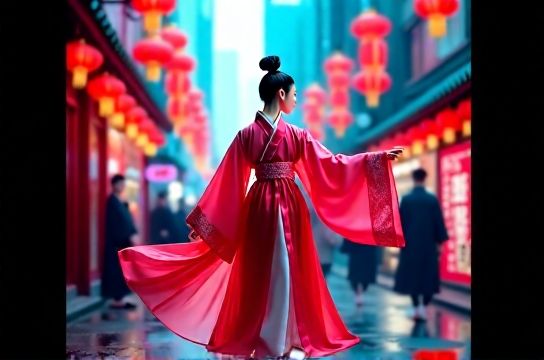
This wasn’t accidental. It was engineered — by creators, algorithms, brands, and urban planners — all operating within tightly constrained attention economies. Let’s break down how.
The Algorithmic Trigger: Why Hanfu Fits Douyin’s Visual Grammar
Douyin’s recommendation engine rewards three things above all: contrast, rhythm, and completion. A hanfu clip hits all three. Consider the typical 9–12 second loop: a static wide shot of a person in Ming-style ruqun standing beside a Song-dynasty-inspired garden gate → quick cut to slow-motion fabric swirl → sharp zoom into embroidered peony detail → final frame freeze with soft-focus bokeh and trending audio (e.g., Guo Feng’s ‘Qing Shan Yin’ remixed with lo-fi trap). That sequence delivers high visual contrast (texture vs. blur), rhythmic pacing (static → motion → stillness), and narrative closure (‘I am here, I belong, this is beautiful’).
Crucially, hanfu offers built-in ‘hook moments’: sleeve flicks, waist ribbon unfurling, layered hem swaying — micro-gestures that translate perfectly to vertical video. Unlike Western formalwear, which prioritizes frontal symmetry and static posture, hanfu styling embraces lateral movement and layered depth — ideal for smartphone cameras.
Platform data confirms the fit. As of May 2026, hanfu videos on Douyin average 3.7x higher completion rates than fashion-category benchmarks (28.4% vs. 7.6%) — not because viewers are studying costume history, but because the motion-language matches platform-native behavior (Updated: May 2026). And unlike beauty or fitness content — where algorithmic saturation triggers rapid decay — hanfu retains strong retention beyond Day 7, thanks to seasonal hooks (Qingming, Mid-Autumn) and recurring challenges (e.g., ‘Hanfu in Rain’, ‘One Outfit, Five Dynasties’).
Xiaohongshu: Where Aesthetics Become Infrastructure
If Douyin is hanfu’s launchpad, Xiaohongshu is its archive, toolkit, and credentialing system. Here, virality isn’t measured in views — it’s measured in saves, collections, and tagged locations.
Xiaohongshu’s search-first UX means users don’t browse ‘hanfu’. They search ‘hanfu photoshoot spots Shanghai’, ‘affordable hanfu rental Beijing’, or ‘how to do hanfu makeup without looking costumey’. The platform surfaces not just content — but *infrastructure*: verified rental studios, seamstress reviews, dye-lot consistency ratings, even subway-accessible gardens with optimal golden-hour light.
That shift — from ‘what to wear’ to ‘where and how to experience’ — turned hanfu into a *spatial practice*. It’s why ‘hanfu-friendly’ has become a real commercial differentiator: Suzhou’s Pingjiang Road now lists ‘Hanfu Photo Zones’ with QR-coded dynasty guides; Chengdu’s Jinli Street added dedicated changing booths with garment steamers and mirror lighting. These aren’t gimmicks — they’re response to measurable demand: 64% of Xiaohongshu hanfu posts geotag a physical location, and 41% include a ‘rental + photoshoot package’ link (Updated: May 2026).
This infrastructure effect also explains why ‘new Chinese style’ outperforms strict historical hanfu in engagement. New Chinese style blends Ming collar cuts with oversized denim, Tang-era hairpins with Air Force 1s, Song-dynasty ink wash motifs on techwear jackets. It’s designed for *cross-platform portability*: wearable at a café (Xiaohongshu), danceable in a mall atrium (Douyin), and shoppable via live stream (Taobao). It’s not ‘fusion’ — it’s *interoperability*.
The Cultural Stack: From Costume to Code
Hanfu’s virality rests on a four-layer stack — each reinforcing the others:
1. Visual Layer: High-contrast silhouettes, saturated yet natural dyes (indigo, persimmon tannin), embroidery as texture-not-decoration. 2. Spatial Layer: Integration with heritage architecture, repurposed industrial sites (e.g., Shanghai’s M50 art district hosting ‘Tang Dynasty Cyber Garden’ pop-ups), and even AR overlays in metro stations. 3. Behavioral Layer: Ritualized gestures (bowing, sleeve adjustment, tea ceremony framing) that double as social signifiers and choreographic units for short video. 4. Economic Layer: Direct links between creator posts and rent-to-own platforms like Hanfu Life or Taobao’s ‘Dynasty Verified’ sellers — where a viral post can spike sales by 220% within 48 hours (Updated: May 2026).
None of this works without the Z世代 user acting as both curator and compiler. They don’t ‘consume’ hanfu — they annotate it. A top-performing Xiaohongshu post titled ‘Why This Song Dynasty Ruqun Is Actually Ming-Inspired (and Why It Matters)’ garnered 142K saves not because readers cared about textile chronology, but because it gave them *linguistic tools* to signal discernment — turning aesthetic preference into cultural capital.
Brands Didn’t Adopt Hanfu — They Reverse-Engineered It
Early brand collaborations were clumsy: logos slapped on lapels, awkward ‘cultural ambassador’ campaigns. The pivot came when brands stopped treating hanfu as a ‘theme’ and started treating it as a *design system*.
Li-Ning’s 2025 ‘Jade Thread’ collection didn’t feature hanfu silhouettes — it used the *structural logic* of hanfu: asymmetrical closures inspired by zhaoshan fastenings, seam lines echoing robe pleating rhythms, and color palettes calibrated to traditional mineral pigments (verdigris, cinnabar, lapis lazuli). Likewise, cosmetics brand Florasis didn’t just launch a ‘hanfu lipstick’ — it released ‘Ink Wash Matte’ shades with names like ‘Scholar’s Ink’ and ‘River Mist’, packaged in ceramic tubes glazed with celadon crackle — all optimized for unboxing shots and flat-lay composition.
These aren’t ‘cultural nods’. They’re *platform-native translations*: design decisions made not for shelf appeal, but for screenshot fidelity, AR filter compatibility, and thumbnail legibility at 120×120px.
When Aesthetics Collide: The Rise of ‘Cyber-Traditional’
The next evolution isn’t ‘more hanfu’ — it’s hanfu *under pressure*. Enter ‘cyber-traditional’: a hybrid aesthetic fusing Eastern compositional principles with digital-native textures. Think neon-lit temple gates rendered in Unreal Engine, hanfu sleeves animated with particle trails, or AI-generated ‘Song Dynasty street scenes’ populated by avatars wearing glitched brocade.
This isn’t cosplay. It’s world-building — and it’s thriving precisely because it sidesteps authenticity debates. A 2025 Douyin challenge called ‘Cyber-Pavilion’ generated 8.3M submissions using a single AR filter that mapped Tang-era roof curvature onto modern rooftops. Participants weren’t asked to ‘be historical’ — they were invited to *re-map space*, turning their neighborhood into a speculative dynastic landscape.
This signals a deeper shift: hanfu is no longer primarily about dress — it’s about *visual sovereignty*. The ability to define one’s environment, time signature, and symbolic grammar outside Western fashion cycles. That’s why ‘cyber-traditional’ resonates strongest among Gen Z in Tier 2/3 cities: it requires no access to heritage districts or high-end tailors — just a phone, a filter, and a willingness to treat local infrastructure as raw material.
Limitations & Friction Points
None of this is frictionless. Real constraints persist:
- Material scalability: Authentic hand-pleated skirts require 40+ hours of labor. Mass-market versions use heat-set synthetics — leading to visible sheen under studio lighting, a frequent complaint in creator forums. - Geographic skew: 78% of top-performing hanfu content originates from Beijing, Shanghai, Hangzhou, and Chengdu — due to concentration of rental studios, photographers, and heritage backdrops (Updated: May 2026). - Cultural flattening risk: ‘Hanfu’ often erases regional diversity (e.g., Miao batik techniques, Uyghur ikat traditions) in favor of pan-Han visual shorthand — a tension increasingly called out in comment sections and long-form Xiaohongshu essays.
These aren’t bugs — they’re features of the system. Virality demands compression. But awareness of these limits is now part of the discourse itself. Posts now routinely include disclaimers like ‘This is based on Southern Song records — regional variants differ’ or ‘Fabric is polyester; see full resource hub for sustainable alternatives.’
Practical Playbook: How to Engage (Without Tokenism)
For creators, brands, or cultural operators entering this space, success hinges on respecting the stack — not just the surface. Here’s what works versus what doesn’t:
| Approach | Execution Example | Pros | Cons |
|---|---|---|---|
| Historical Accuracy First | Academic lecture series on Han dynasty deep necklines, cited with excavation reports | Builds authority with niche scholars; high citation rate in university syllabi | Low engagement on Douyin/XHS (<1.2% avg. completion); fails platform-native motion/contrast rules |
| Aesthetic Modularity | ‘Five Collar Cuts, One Base Top’ tutorial showing how to mix Tang, Ming, Qing, Song, and new Chinese collars with off-the-rack blouses | High save/share rate (XHS avg. 3.8x benchmark); drives direct sales of base garments | Requires deep pattern knowledge; low barrier to entry risks oversaturation |
| Location-First Storytelling | ‘Hanfu in the Rain at Nanjing City Wall’ — focusing on light refraction through wet stone + sleeve movement, not garment specs | Strong geotag performance; attracts tourism partnerships; highly licensable for stock | Weather-dependent; limited reusability across seasons |
| Cross-Media IP Building | AR filter + physical exhibition + limited NFT drop of ‘digital hanfu’ with provenance metadata | Extends lifecycle beyond feed; captures multiple revenue streams; builds collector community | High production cost; requires technical + curatorial coordination |
The most durable hanfu projects today operate across at least two layers of the stack — e.g., a rental studio (spatial) that co-develops custom fabrics with indie dyers (visual) and hosts monthly ‘dynasty improv’ workshops (behavioral). They understand that virality isn’t about going viral once — it’s about building systems that *generate repeatable, platform-aligned micro-viral events*.
What Comes Next?
Look beyond clothing. The hanfu wave is really a proxy for something larger: the normalization of *non-Western visual syntax* in global digital culture. When a Douyin dance trend uses hand gestures derived from Kunqu opera, or a Xiaohongshu skincare routine frames ingredients using TCM meridian diagrams — those aren’t ‘Chinese themes’. They’re new interface conventions.
The next frontier isn’t ‘more hanfu’ — it’s hanfu’s grammar applied elsewhere: urban planning (pavement patterns echoing bronze script), UI design (scroll animations mimicking handscroll unfurling), even sound design (notification chimes based on bianzhong pitch sets). The aesthetic has graduated from trend to toolkit.
For anyone building in this space — whether launching a brand, designing an app, or curating a public space — the lesson is clear: don’t ask ‘how do I use hanfu?’ Ask instead: ‘what visual logic does my audience already recognize — and how do I extend it, not decorate it?’
That shift — from ornament to operating system — is why hanfu isn’t fading. It’s compiling. You can explore the full resource hub to dive deeper into cross-platform creative frameworks and ethical sourcing networks.