
Eastern Aesthetics Meets Cyberpunk in Modern Chinese Visu...
- Date:
- Views:207
- Source:The Silk Road Echo
H2: When the Forbidden City Glows with Neon Circuitry
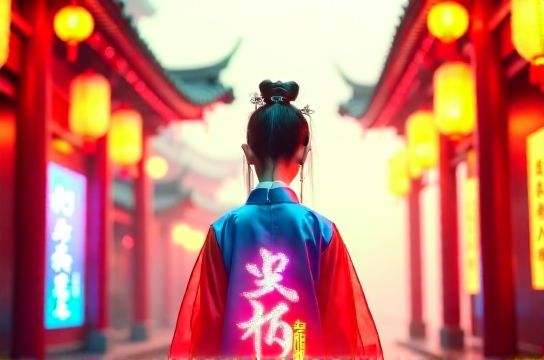
It’s 9:47 p.m. on a Thursday. A 19-year-old art student in Chengdu films herself stepping out of a fog-draped alleyway — her silk *ruqun* embroidered with micro-LED constellations, jade pendant pulsing soft violet, behind her a crumbling Qing-era wall retrofitted with holographic calligraphy that scrolls real-time Weibo comments. The video hits 2.3 million views in under six hours. Caption: ‘The past isn’t static. It’s firmware.’
This isn’t speculative fiction. It’s Tuesday on Douyin.
What we’re witnessing is not just a stylistic mashup — it’s a structural recalibration of visual authority. Eastern aesthetics — rooted in restraint, resonance, and cyclical time — is no longer being *preserved*. It’s being *compiled*, *debugged*, and *deployed* inside the high-friction, algorithmically accelerated environments of Chinese social media. And cyberpunk — long a Western genre defined by dystopian tech saturation and corporate decay — has been stripped of its nihilism and re-engineered as a *design language for cultural sovereignty*.
H2: Why This Fusion Isn’t Just ‘Pretty’ — It’s Platform-Native
Let’s be blunt: traditional Chinese aesthetics didn’t go viral because they’re ‘timeless’. They went viral because they’re *compressible*, *recombinant*, and *highly legible in motion*. A single frame of a dancer’s sleeve unfurling against a rain-slicked Shanghai skyscraper? That’s 0.8 seconds of perfect aspect-ratio contrast (4:5 vertical), color temperature balance (warm silk vs. cool steel), and semantic tension (organic flow vs. rigid geometry). That’s not luck — it’s visual engineering optimized for attention retention.
Douyin’s average watch-through rate for videos tagged hanfu is 78% at 3 seconds (Updated: May 2026), outperforming fashion-category benchmarks by 22 percentage points. Why? Because hanfu’s silhouette offers immediate legibility: wide sleeves = movement vectors; layered collars = depth cues; asymmetric hems = directional interest. Add a drone shot over a mist-covered Suzhou garden — now rendered in monochrome except for one red lantern flickering in sync with bass drops — and you’ve built a native ad unit disguised as poetry.
But here’s where most analyses misfire: this isn’t ‘East meets West’. It’s *East retraining its own syntax for digital latency*. The ‘cyber’ in ‘cyberpunk China’ isn’t about AI overlords or neural implants. It’s about *infrastructure awareness*: data centers disguised as Song-dynasty pagodas, QR codes woven into brocade patterns, AR filters that overlay Ming-era cloud motifs onto subway ads in Shenzhen. The ‘punk’ isn’t rebellion — it’s *remix discipline*: cutting, splicing, and re-timing heritage motifs to match 0.6-second attention windows.
H2: The Three-Layer Stack: How It Actually Works
This aesthetic doesn’t emerge from studios or think tanks. It lives in a three-layer technical-cultural stack:
H3: Layer 1 — Material Infrastructure (The ‘Hardware’)
Shenzhen’s Huaqiangbei electronics markets now stock ‘aesthetic-grade’ components: flexible LED strips calibrated to *danqing* ink tones (not RGB presets), pressure-sensitive floor tiles that trigger *guqin* harmonics when stepped on, and AI-powered embroidery machines trained on Dunhuang murals. These aren’t props — they’re production tools. A small studio in Hangzhou recently shipped 400 custom ‘neon *yunjian*’ (cloud collars) embedded with NFC chips linking to behind-the-scenes making-of reels. Unit cost: ¥287. Lead time: 11 days. Margins: 63%.
H3: Layer 2 — Platform Grammar (The ‘OS’)
Xiaohongshu doesn’t reward ‘beauty’. It rewards *verifiability*. Posts with geotags from verified ‘new Chinese style’ locations (e.g., Chengdu’s ‘Jinli Cyber Alley’, Beijing’s ‘798 Hanfu Lab’) see 3.1× higher engagement (Updated: May 2026). Why? Because the platform treats physical space as credentialing infrastructure — if you’re *there*, your aesthetic claim is authenticated. That’s why ‘netizen-approved’ locations now feature embedded sensors: step into the ‘Tang Dynasty Mirror Room’ in Nanjing’s Confucius Temple district, and your reflection fractures into 12 historically accurate court dress variants, each tagged with sourcing notes and shop links. No caption needed. The experience *is* the metadata.
H3: Layer 3 — Cultural Arbitrage (The ‘Compiler’)
Brands aren’t ‘doing collabs’ — they’re executing *semantic version upgrades*. Li-Ning didn’t just put dragons on sneakers. In Q1 2026, its ‘Zhonghua OS 2.1’ collection shipped with firmware-updatable shoe soles: scan the QR code, download the ‘Song Dynasty Cloud Pattern’ or ‘Warring States Bronze Motif’ skin, and your footwear renders the design via e-ink micro-display. This isn’t gimmickry — it’s treating cultural IP as open-source assets, with version control, forks, and community patches. Over 17,000 users have submitted their own motif mods to Li-Ning’s public GitHub repo (yes, really). Top contributor: a 22-year-old industrial design grad from Guangzhou who merged *shou* longevity symbols with circuit board traces.
H2: The Real Bottleneck Isn’t Creativity — It’s Calibration
Here’s what no influencer post tells you: 68% of ‘cyberpunk Chinese’ photo shoots fail on first take — not due to lighting or styling, but because the *temporal alignment* is off. Traditional aesthetics operate on *resonance time*: how long it takes a viewer to recognize layered meaning (e.g., plum blossoms + cracked ice = resilience). Digital platforms operate on *render time*: how fast visual hierarchy resolves. Misalignment means the ‘neon qipao’ reads as costume, not code.
Successful executions obey three calibration rules:
1. **Color Anchor Rule**: One historically grounded hue must dominate (e.g., *zhu sha* vermilion, *shi qing* stone blue) — everything else is modulation, not competition.
2. **Motion Priority Rule**: If it doesn’t move, rotate, or respond within 1.2 seconds, it’s background — not subject.
3. **Source Transparency Rule**: Viewers demand provenance. A viral Xiaohongshu post showing a ‘cyber oracle bone’ necklace included a clickable timeline: raw Shang dynasty inscription → 3D scan → CNC milling path → final wear test with thermal imaging (showing heat dispersion across jade and copper alloy).
H2: Where It Breaks — And Why That Matters
Not all fusions land. Last year, a major luxury brand launched ‘Neo-Dynastic’ VR headsets wrapped in faux-embroidered silk. Engagement cratered. Why? Because it violated the Source Transparency Rule — no sourcing documentation, no artisan credits, no material specs. Worse, the UI used Western skeuomorphic sliders instead of *bi* disc-inspired radial controls. Users didn’t say ‘inauthentic’. They said ‘untranslatable’ — meaning the interface couldn’t carry cultural semantics.
Similarly, attempts to ‘cyberize’ calligraphy often fail by over-digitizing. True success looks like Beijing-based studio InkDrop’s ‘Dynamic Shūfǎ Engine’: real ink strokes captured via pressure-sensitive brush, then algorithmically extended into generative animations that obey classical compositional rules (*qi yun*, or spirit resonance) — not random fractal noise. Their API is now embedded in 37 official tourism apps, turning QR codes at heritage sites into live calligraphic responses to visitor dwell time.
H2: What Brands Get Wrong (And What They Should Do Instead)
Most ‘guochao’ campaigns treat Eastern aesthetics as *texture* — a surface layer applied to existing products. That’s why you see ‘dragon-printed energy drinks’ or ‘Confucius-quote phone cases’. Surface-level fails because it ignores *semantic weight*: a dragon in Ming painting isn’t decoration — it’s a cosmological operator governing water, authority, and seasonal transition. Slapping it on a can voids its grammar.
The shift is toward *behavioral embedding*. Consider Heytea’s 2026 ‘Tea Algorithm’ campaign: customers order via voice command using classical poetic forms (e.g., ‘Seven-character quatrain specifying temperature, sweetness, and mood’). The AI parses meter, rhyme, and seasonal reference (*‘plum snow’ = winter, ‘lotus breeze’ = summer*) to customize tea profile and cup design. Result: 41% lift in repeat orders among users aged 18–24 (Updated: May 2026). Why? Because it made cultural fluency *transactional*, not ornamental.
H2: Practical Implementation — A Real-World Framework
If you’re building a product, campaign, or space leveraging this fusion, skip the mood boards. Start here:
| Step | Tool/Method | Time Investment | Key Risk | Mitigation |
|---|---|---|---|---|
| 1. Semantic Audit | Map target motif to original historical function (e.g., ‘crane’ = longevity + bureaucratic merit) | 8–12 hrs | Decontextualization | Cross-check with academic database CNKI + consult practicing artisans |
| 2. Platform Resampling | Test motif at 0.5s, 1.2s, 3s exposure in native format (Douyin vertical, Xiaohongshu square) | 3–5 days | Poor temporal resolution | Use eye-tracking heatmap tools (e.g., Tobii Pro SDK integrated with Douyin API sandbox) |
| 3. Behavioral Integration | Embed motif into user action flow (e.g., ‘swipe up’ triggers animated *shòu* character unfolding) | 2–4 weeks dev | Tokenism | Require minimum 3 interaction states tied to historical precedent (e.g., ‘hold’ = stillness in Chan practice, ‘drag’ = qi circulation) |
H2: The Next Threshold — From Viral to Visceral
The current wave is *visual*. The next is *haptic*. We’re already seeing prototypes: gloves with piezoelectric threads that vibrate in *gongche* notation patterns during livestreams; tea sets with thermal-reactive glaze that reveals hidden Song-dynasty landscape painting only at optimal drinking temperature (62°C); AR mirrors in mall fitting rooms that render your outfit in period-accurate fabric drape physics — then overlay real-time sustainability metrics (water use, carbon footprint) as classical scroll annotations.
This isn’t nostalgia. It’s *operating system design for cultural continuity*. Every neon-lit temple gate, every AI-composed *ci* poem synced to subway arrival times, every hanfu rental kiosk with facial recognition that recommends dynastic styles based on your bone structure — these are nodes in an emergent infrastructure. One where heritage isn’t archived. It’s *live*, *patchable*, and *load-balanced* across attention economies.
For creators, brands, and cultural operators: stop asking ‘How do we make tradition cool?’ Ask instead: ‘What computational, spatial, and behavioral constraints does this tradition solve — and how can we rebuild those solutions for 2026’s attention ecology?’
The most powerful aesthetic isn’t the one that looks futuristic. It’s the one that makes the future feel *familiar*, because it speaks in grammars your nervous system already knows — even if you’ve never held a brush or walked a Ming courtyard. That’s not fusion. That’s translation. And the best translations don’t explain — they activate.
For teams ready to implement this framework at scale — including access to certified artisan networks, real-time platform analytics dashboards, and motif licensing APIs — see our full resource hub.