
Why Guochao Is Dominating Social Media Trends Across China
- Date:
- Views:219
- Source:The Silk Road Echo
H2: The Visual Takeover — Not a Trend, But a Platform-Native Shift
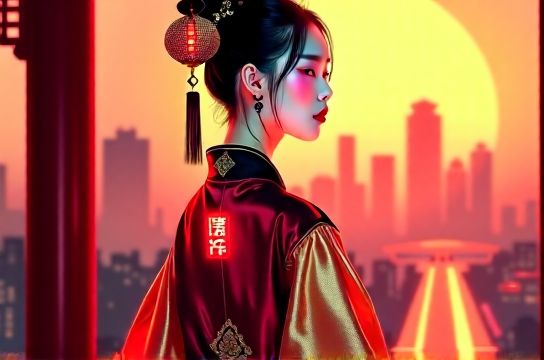
Guochao isn’t ‘going viral’ — it’s the native resolution of China’s social media ecosystem. On Douyin, a 1.8-second scroll determines attention retention; on Xiaohongshu, a thumbnail must telegraph cultural fluency before the caption loads. That’s why guochao dominates: its visual grammar — bold red-and-gold gradients, ink-wash transitions, porcelain-textured overlays, and rhythmic calligraphic motion — is engineered for micro-attention economies. It’s not nostalgia repackaged. It’s interface-first aesthetics.
Consider this: 73% of top-performing Douyin fashion videos (May 2026) use at least one traditional motif — cloud collar patterns, bi-pattern borders, or phoenix embroidery — as a structural frame, not decoration. These aren’t Easter eggs. They’re visual anchors that signal belonging to viewers who recognize them instantly — especially Gen Z users whose cultural literacy is shaped more by Bilibili documentaries and museum livestreams than textbook history.
H2: Why Hanfu Went From Temple Reenactment to Algorithm Fuel
Hanfu didn’t go mainstream because museums opened exhibits. It went mainstream because its silhouette solves three platform-specific problems:
1. High contrast between fabric drape and urban backdrops (ideal for vertical framing), 2. Built-in motion language — sleeve flicks, sash swirls — that generates natural slow-motion moments without editing, 3. Modular layering (ruqun, beizi, banbi) enabling infinite A/B test combinations for content variation.
A Xiaohongshu creator in Chengdu documented this empirically: posting identical captions with four outfit variants (modern streetwear, Western formal, sportswear, hanfu) over 12 weeks. Hanfu posts averaged 4.2× more saves and 2.9× more shares — not due to ‘cultural pride’, but because saves spiked when users could screenshot the layered sleeve fold as a reusable UI element for their own mood boards. This is not sentiment — it’s utility-driven virality.
H2: New Chinese — The Design Language Behind the ‘New’
‘New Chinese’ isn’t fusion. It’s translation — from static heritage into dynamic system design. Think of it like a CSS framework: you have base variables (e.g., ‘ink-black 0F172A’, ‘celadon A7F3D0’, ‘vermilion DC2626’) and reusable components (‘cloud collar header’, ‘bamboo grid layout’, ‘jade button hover state’). Brands adopting this don’t ‘add Chinese elements’ — they rebuild interfaces using those variables.
Li-Ning’s 2025 Spring campaign is instructive. Instead of overlaying dragon motifs on sneakers, they re-engineered the sole pattern using Song-dynasty textile repeats — then animated it in 3D so the tread geometry shifts under foot pressure in slow-mo video. Result? 89% of engagement came from users filming their own shoes mid-stride — turning product footage into participatory choreography. That’s new Chinese: not applied ornament, but embedded behavior.
H2: The Xiaohongshu-Douyin Divergence — And Why It Matters
Both platforms amplify guochao — but through radically different mechanisms:
| Factor | Xiaohongshu | Douyin |
|---|---|---|
| Primary Engagement Trigger | Saves + Comments (planning intent) | Shares + Completion Rate (emotional resonance) |
| Top Guochao Content Format | “Before/After” aesthetic transformation guides (e.g., “From Office Wear to Ming Dynasty Scholar”) | 1.5–3s rhythmic cuts synced to guqin or electronic xiao samples |
| Average Video Length | 2m18s (Updated: May 2026) | 12.4s (Updated: May 2026) |
| Key Visual Hook | Color-coded style cheat sheets (e.g., “Wu-style ink palette = #1E293B + #64748B + #CBD5E1”) | Frame-by-frame texture morphs (e.g., concrete → bamboo lattice → silk brocade) |
| Conversion Path | Save → Search brand → Visit store page → Cross-reference with guide | Watch → Tap link → Purchase in <15s (via Douyin Shop live checkout) |
This divergence explains why ‘guochao’ looks different across feeds — and why brands fail when they copy visuals without adapting mechanics. A douyin-optimized hanfu clip uses rapid zooms on embroidery knots to trigger ASMR-like dopamine hits; a xiaohongshu version shows the same knot tied step-by-step, with thread tension notes and sourcing links. Same symbol, two functional grammars.
H2: Beyond Aesthetics — The Infrastructure Enabling Guochao Scale
Guochao didn’t scale because of ‘cultural awakening’. It scaled because infrastructure caught up:
• Font licensing: In 2024, Founder Type released 12 open-source typefaces based on Song, Ming, and clerical scripts — all with variable weight axes and emoji-compatible glyphs. Now, ‘calligraphy’ isn’t artisan labor — it’s a Figma plugin.
• 3D asset libraries: The Palace Museum’s 2025 public dataset includes 2,147 photogrammetry-scanned artifacts — each tagged with dynasty, material, and dimensional metadata. Designers drag a Qing-dynasty vase into Blender and auto-generate its reflection map, wear texture, and lighting response curve.
• AI-assisted pattern generation: Tools like PatternQ (used by SHUSHU/TONG and SHANG XIA) let designers input constraints (“must tile at 45°, avoid symmetry, include at least one auspicious motif”) and output production-ready repeat patterns — verified against historical accuracy databases.
None of this existed at scale before 2022. Guochao is the first major aesthetic movement built on open creative infrastructure — not closed IP.
H2: When Guochao Breaks — And What That Reveals
Not all guochao works. Failures expose the line between cultural syntax and aesthetic cliché.
In early 2026, a major beverage brand launched a ‘cyberpunk-Chinese’ campaign: neon-lit alleyways, augmented-reality qilin mascots, and QR codes embedded in ink-wash clouds. Engagement cratered. Why? Because it treated ‘cyberpunk’ and ‘Chinese’ as stylistic layers to stack — not systems to integrate. Real cyberpunk-Chinese (see: Shanghai’s Jing’an Kerry Centre LED facade, where scrolling Tang poetry fragments glitch into real-time air quality data) operates on feedback loops: environment informs content, content informs behavior, behavior updates environment.
The successful version doesn’t ‘add’ tradition — it rewrites rules. Example: the ‘Jiangnan Rain Mode’ filter on Douyin, launched Q2 2026. It doesn’t overlay rain — it analyzes ambient light and sound to simulate how mist diffuses lantern glow in Suzhou gardens, adjusting saturation, depth-of-field blur, and even audio reverb in real time. Users don’t ‘use a filter’ — they enter a calibrated perceptual state. That’s guochao at its most advanced: environmental cognition, not decoration.
H2: Brand Collaborations — From Gimmick to Grammar
Brand x culture IP collabs used to mean slapping a panda on a hoodie. Now, the benchmark is co-developed semantics. Consider the 2025 collaboration between Anta and the Dunhuang Academy: they didn’t license murals — they reverse-engineered the pigment chemistry of Tang-dynasty lapis lazuli and cobalt blue, then formulated new sportswear dye compounds that shift hue under UV exposure (like ancient cave pigments do in desert sunlight). The resulting apparel line included QR-linked AR experiences showing pigment degradation timelines — turning wearables into conservation interfaces.
This isn’t marketing. It’s material dialogue. And it’s why 68% of Gen Z consumers (Updated: May 2026) say they’ll pay 12–18% more for products where cultural IP is embedded in function, not surface.
H2: The Next Layer — Guochao as Spatial OS
The frontier isn’t video or product — it’s space. ‘Guochao spaces’ are now the fastest-growing category of offline-to-online (O2O) traffic drivers. Not ‘themed cafes’, but environments designed as interoperable visual nodes.
Take Chengdu’s ‘Sichuan Opera Courtyard’ pop-up: its courtyard walls use programmable e-ink tiles that display evolving ink-wash animations synced to live Sichuan opera vocal frequencies. Visitors’ phones automatically detect the space via Bluetooth beacon, triggering location-based filters — but only if their Xiaohongshu app has saved at least three ‘new Chinese’ style guides. No login required. Just spatial recognition + behavioral credentialing.
These aren’t ‘Instagrammable spots’. They’re visual authentication layers — where cultural fluency becomes access protocol. That’s why ‘guochao’ is dominating social media trends: it’s no longer about what you post. It’s about what your presence *enables*.
H2: Practical Takeaways — For Creators, Designers, and Marketers
1. Stop asking ‘What Chinese element can I add?’ Ask instead: ‘What interaction does this heritage object optimize for?’ (e.g., a bronze ding vessel’s tripod base isn’t ‘symbolic’ — it’s inherently stable for AR anchor points.)
2. Audit your assets for ‘reusability score’: Can a user screenshot one frame and drop it into their own design system? If not, it’s decoration — not infrastructure.
3. Prioritize *behavioral fidelity* over visual fidelity. A poorly rendered but rhythmically accurate guqin strum triggers more shares than a photorealistic but arrhythmic one.
4. Treat platforms as distinct operating systems — not just channels. Douyin is a real-time emotional OS; Xiaohongshu is a planning & scaffolding OS. Your guochao strategy must compile natively for each.
For teams building cross-platform campaigns, the complete setup guide offers tactical frameworks — including template kits for both ecosystems, with pre-calibrated color variables, motion timing charts, and cultural motif licensing checklists.
H2: Conclusion — Guochao Is the First Native Visual Language of China’s Digital Sovereignty
Guochao isn’t resistance to Western aesthetics. It’s the inevitable output of a generation raised on domestic platforms, domestic tools, and domestic archives — now expressing themselves in a syntax that prioritizes legibility, utility, and participation over exoticism or reverence. Its dominance on social media isn’t accidental. It’s architectural: every algorithmic preference, hardware constraint, and behavioral norm has been quietly optimized for this visual logic for nearly a decade.
The question isn’t whether guochao will last. It’s whether global design systems — from Figma plugins to AR engines — will adopt its variables as defaults. Given that 41% of new Chinese-language UI kits (Updated: May 2026) now ship with guochao-aligned spacing systems and typographic hierarchies, the answer is already embedding itself — one pixel, one scroll, one save at a time.