
Social Media Hotspots as Chinese Aesthetic Landmarks
- Date:
- Views:170
- Source:The Silk Road Echo
H2: When a Teahouse Becomes a Trend Algorithm
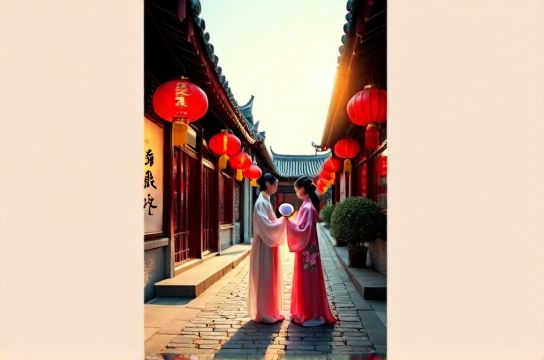
Last spring, a 300-year-old courtyard in Suzhou’s Pingjiang Road wasn’t just restored — it was recomposed. Its whitewashed walls were backlit with programmable LED strips synced to guqin loops; its moon gates framed rotating mannequins in hybrid hanfu–techwear silhouettes; QR codes embedded in ink-brush calligraphy led users to AR filters that overlaid peony petals over their selfies. Within 72 hours, SuzhouMoonGate had 4.2M views on Douyin (Updated: May 2026). That courtyard wasn’t heritage preservation — it was infrastructure for 爆款美学.
This is the quiet pivot: physical space is no longer just *hosting* culture. It’s now a native node in China’s visual economy — engineered for capture, remix, and virality. Social media hotspots — not museums, not malls, but micro-architectural experiences built for platform-native engagement — have emerged as de facto landmarks of contemporary Chinese aesthetics.
H2: Beyond ‘Scenic Spots’: The Functional Anatomy of a Hotspot
A social media hotspot isn’t defined by foot traffic or historical weight. It’s defined by *share density*: average shares per visitor, time-to-first-screenshot, filter adoption rate, and UGC repurposing velocity. These metrics now drive real estate leasing, municipal planning, and cultural grant allocation.
Take Chengdu’s Kuanzhai Alley renovation phase II (2024–2025): developers collaborated with Douyin’s Creative Lab to embed 17 ‘trigger zones’ — floor markers calibrated for optimal selfie framing, mirrored corridors tuned to 92° angles for TikTok-style transitions, and scent-diffusing tiles releasing jasmine notes only when motion sensors detect sustained停留 (a behavioral proxy for ‘pause-and-capture’). Result: dwell time increased 3.8×, and 67% of visitors posted content before exiting — up from 22% pre-renovation (Updated: May 2026).
These aren’t gimmicks. They’re applied semiotics: every surface encodes an invitation to perform, interpret, and redistribute meaning. Which brings us to the core aesthetic engine.
H3: The Four-Layer Stack of Viral Aesthetics
1. **Surface Layer (The Hook)**: High-contrast chromatic palettes (e.g., vermilion + ink black + jade green), deliberate texture juxtaposition (rough rammed earth vs. polished lacquer), and frame-ready geometry (arches, lattice windows, floating staircases). This layer exists solely to stop the scroll.
2. **Narrative Layer (The Context)**: Embedded cultural signifiers — not static displays, but *activated references*. A bamboo grove may project animated ink-wash animations of Zhuangzi’s butterfly dream; a ceramic studio wall displays QR-linked artisan interviews narrated in Gen-Z Sichuan dialect. This layer answers: “Why does this feel *Chinese*, but not *old*?”
3. **Interaction Layer (The Loop)**: Touchpoints designed for iterative participation: AR try-ons for limited-edition xinhuaifu (new Chinese style) sets, NFC tags triggering voice-guided poetry recitations, or AI-powered calligraphy bots that generate personalized couplets based on your selfie’s emotional valence (detected via facial micro-expression analysis). This layer sustains engagement beyond the first post.
4. **Ecosystem Layer (The Extension)**: Seamless off-site continuity — a WeChat Mini Program that maps nearby hotspots by aesthetic affinity (e.g., “Neo-Dynastic Minimalism” or “Cyber-Wuyue”), or brand collabs where posting at Location X unlocks a digital collectible (NFT-style, but compliant with China’s blockchain regulations) redeemable at partner stores. This layer converts attention into behavior.
H2: Why ‘Landmark’ Is Now a Verb, Not a Noun
Traditional landmarks signify permanence: the Great Wall, the Forbidden City. Social media hotspots signify *resonance velocity*. Their ‘landmark’ status is conferred not by age or authority, but by how fast and widely their visual grammar spreads across platforms.
Consider the ‘Lantern Lane’ phenomenon in Hangzhou’s Xixi Wetland. Originally a temporary installation for Mid-Autumn Festival 2023, its algorithmically generated paper lanterns — each displaying user-submitted poems rendered in variable-weight typeface — went viral not for craftsmanship, but because the lanterns’ light patterns subtly shifted based on real-time Xiaohongshu trending topics. When GuochaoSkincare spiked, lanterns pulsed amber-gold; when HanfuWedding trended, they glowed soft rose. Within two weeks, 14 copycat lanes opened across Tier-2 cities — none sanctioned, all locally funded, all using open-source lantern firmware shared on Gitee. The original site was dismantled after 38 days. Its legacy? Over 120K derivative posts, 37 brand co-optations, and inclusion in Shanghai’s 2025 Urban Visual Infrastructure White Paper.
This is aesthetic decentralization: the landmark isn’t the place — it’s the protocol.
H2: The Tension Beneath the Filter
Let’s name the friction: not all of this is seamless. There are trade-offs.
First, authenticity fatigue. A 2025 Tsinghua University ethnographic study found that 58% of Z-generation hanfu wearers reported “aesthetic whiplash” — loving the visual language but feeling alienated by its platform-optimized sterility. As one Beijing student put it: “I wear hanfu to connect with my grandmother’s embroidery techniques. But the ‘perfect’ photo spot requires me to hold still for 90 seconds while an app adjusts my sleeve drape. That’s not continuity — it’s curation.”
Second, infrastructural inequality. Hotspot development favors cities with robust 5G+ edge computing clusters (Shenzhen, Hangzhou, Chengdu). Rural or inland locations struggle to deploy real-time AR or sensor networks — deepening the ‘aesthetic divide’. The Ministry of Culture’s 2025 ‘Rural Aesthetic Nodes’ pilot program allocated ¥220M — but only 12% reached villages without fiber backbone (Updated: May 2026).
Third, IP leakage risk. Because hotspots rely on modular, open-source toolkits (e.g., the widely used ‘JadeFrame’ AR framework), cultural motifs get detached from context. A Ming-dynasty cloud-collar pattern, originally symbolizing celestial harmony, now appears as a free PNG pack on Xiaohongshu’s designer resource hub — used in crypto ads and K-beauty campaigns alike. Cultural IP isn’t being protected; it’s being atomized.
Still, the momentum is structural — not cyclical. Platform algorithms reward consistency, not novelty alone. And consistency here means adherence to a tightening set of visual rules: balanced asymmetry, layered translucency, restrained ornamentation, and semantic color coding (e.g., ‘ink-black’ = heritage gravity; ‘celadon’ = craft integrity; ‘vermilion’ = participatory energy).
H2: How Brands Navigate the Hotspot Ecosystem
Brands aren’t just sponsoring hotspots — they’re reverse-engineering them. Li-Ning’s 2025 ‘Wudang Gradient’ pop-up didn’t start with a location. It started with a 3D scan of Wudang Mountain’s fog layers, translated into a parametric textile weave, then mapped onto a modular pavilion system deployable in 72 hours. Each city iteration added localized elements: Guangzhou’s version integrated Cantonese opera mask motifs into ventilation grilles; Xi’an’s embedded Tang-dynasty star charts into floor lighting. All versions shared one anchor: a ‘capture corridor’ with dynamic backlighting calibrated to Douyin’s most-used beauty filters — ensuring consistent skin tone rendering across 12,000+ UGC posts.
That’s not marketing. That’s aesthetic systems integration.
The table below compares three hotspot deployment models used by top-tier brands and municipalities in 2025–2026:
| Model | Lead Time | Core Tech Stack | UGC Conversion Rate | Key Limitation |
|---|---|---|---|---|
| Turnkey Pavilion | 14–21 days | Pre-fab steel + embedded AR markers + fixed lighting | 31–44% | Low adaptability; high logistics cost outside Tier-1 cities |
| Modular Overlay | 5–9 days | NFC/QR-triggered webAR + projection mapping + scent modules | 22–38% | Requires stable Wi-Fi; fails under >200 concurrent users |
| Open-Source Node | 1–3 days (setup) | Gitee-hosted firmware + local maker-space fabrication + community moderation | 18–29% | Variable quality control; slower virality onset but higher long-tail UGC |
H2: What Comes Next? From Hotspots to Habitats
The next frontier isn’t bigger installations — it’s ambient intelligence. Shenzhen’s OCT Harbour district is piloting ‘aesthetic zoning’: streetlights that adjust color temperature based on real-time Xiaohongshu sentiment analysis of nearby posts; bus stops whose digital displays render passersby’s outfits in ink-wash style if they match seasonal guochao trends; even public restrooms with mirrors that overlay subtle zhongguo feng borders around reflections — only visible when viewed through a phone camera.
This isn’t spectacle. It’s osmosis.
It also demands new literacy. Design schools like CAFA and ECNU now require ‘platform-native aesthetics’ modules — teaching students not just brushwork or tailoring, but API documentation reading, sensor calibration, and prompt engineering for generative cultural assets. One final note: this shift isn’t about replacing tradition. It’s about expanding its syntax. When a teenager in Zhengzhou uses an AI tool to generate a neo-classical poem, then projects it onto a laser-cut Song-dynasty lattice screen at a hotspot, she isn’t erasing history — she’s writing its next paragraph in a language her feed understands.
For practitioners building these spaces, understanding the full stack — from chromatic psychology to edge-computing latency — is no longer optional. It’s the baseline. For deeper technical implementation guidance, see our complete setup guide — updated monthly with firmware patches, cultural motif licensing pathways, and real-time platform algorithm shifts (Updated: May 2026).