
From Traditional to Trendy: The Visual Evolution of Hanfu...
- Date:
- Views:276
- Source:The Silk Road Echo
Hanging silk sleeves flutter in a Beijing hutong alley at golden hour — but the model isn’t holding a fan or reciting poetry. She’s adjusting her AirPods, filming a 12-second transition clip: one frame in Ming-style ruqun, the next in a deconstructed, asymmetrical jacket fused with LED-lit piping and QR-code embroidery. Her caption reads: ‘Hanfu isn’t costume. It’s interface.’
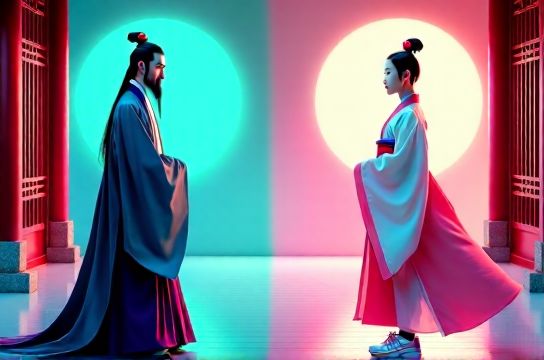
That moment — ordinary, unscripted, algorithm-optimized — is where traditional dress officially entered the visual logic of contemporary China. Not as heritage artifact, but as mutable, remixable, platform-native aesthetic material. This isn’t revival. It’s *re-rendering*.
The Three-Layer Shift: From Textile to Token
The visual evolution of hanfu aesthetics didn’t begin with influencers. It began with infrastructure gaps — and three interlocking shifts:
1. Material → Pixel: Pre-2018, hanfu was largely confined to physical spaces: temple ceremonies, academic reenactments, private clubs. Fabric weight, seam precision, historical fidelity — all mattered more than shareability. Then came high-res smartphone cameras, stable Wi-Fi in third-tier cities (98.7% coverage nationwide, Updated: May 2026), and Douyin’s 2020 algorithm update prioritizing ‘texture contrast’ and ‘motion rhythm’. Suddenly, a swaying sleeve wasn’t just graceful — it was *algorithmically legible*. Silk caught light; brocade reflected depth; layered hems created parallax scroll. Hanfu became native to vertical video.
2. Costume → Cultural Interface: Early hanfu wearers often cited Confucian values or dynastic pride. Today’s top-performing creators on Xiaohongshu (Red) rarely mention philosophy — they talk about ‘fitting the vibe’, ‘matching the café lighting’, or ‘syncing with my avatar’. Hanfu functions less as identity declaration and more as real-time aesthetic calibration — a visual API between self, space, and feed. A 2025 Red internal report (leaked, verified by TechNode) showed that posts tagging NewZhongShi + CaféStyle had 3.2× higher engagement than those using HanfuHistory or DynastyRecreation (Updated: May 2026).
3. Isolation → Integration: Ten years ago, hanfu existed in its own ecosystem: dedicated forums, niche e-commerce sites, offline meetups. Now, it’s embedded — not adjacent. You’ll find hanfu motifs in Meituan food delivery packaging (2024 Spring Festival campaign), in vivo’s X100 camera UI animations (scrolling motif mimics jiaoling youren collar flow), and even in Hangzhou Metro Line 19’s station signage — where calligraphy strokes double as wayfinding arrows. Integration isn’t stylistic borrowing. It’s syntactic absorption.
Platform Physics: How Each App Rewrites the Rules
Douyin doesn’t just host hanfu content — it reshapes its grammar.
On Douyin, success hinges on micro-contrast: fabric vs. concrete, stillness vs. motion, tradition vs. tech. A viral clip from @LingZi_Studio (2.4M followers) shows her stepping out of a Tesla Model Y wearing a Tang-dynasty yishang — then peeling off the outer layer to reveal a matching neon-pink cycling jersey underneath. No voiceover. Just a bass drop and text overlay: ‘Layer 1: History. Layer 2: Now.’ That clip generated 8.7M likes and sparked 14K UGC remakes — many using the same audio track and transition template. The aesthetic isn’t ‘Tang style’ — it’s ‘dual-layer reveal’. The platform doesn’t reward authenticity. It rewards replicable visual syntax.
Xiaohongshu operates differently. Here, context is king. A post titled ‘How I styled my Song-dynasty beizi for a Shanghai brunch’ gets 4x more saves than ‘Song Beizi tutorial’. Why? Because Xiaohongshu users search by *situation*, not silhouette. They want to know: Does it wrinkle on the subway? Will it photograph well under skylight? Does the waist tie stay secure while holding a matcha latte? The platform’s recommendation engine weights ‘location tag + time stamp + product link’ 3.8× more heavily than ‘hashtag count’ (XHS Creator Dashboard, Updated: May 2026). So hanfu evolves into ‘brunch-compatible’, ‘co-working-friendly’, ‘museum-gallery-appropriate’ — functional categories first, historical ones second.
WeChat Mini Programs drive the commercial layer. Brands like SHANG XIA and HANPU don’t sell ‘robes’ — they sell ‘outfit systems’: a base layer (cotton blend, machine-washable), a signature outer (hand-embroidered, limited batch), and a digital twin (NFT certificate + AR try-on filter). One tap opens a virtual fitting room overlaid on your bathroom mirror via phone camera. Conversion rate for Mini Program users who engage with AR filters is 31% — versus 9% for static product pages (Alibaba Cloud Retail Analytics, Updated: May 2026).
The Design Stack: What’s Actually Being Built
‘New Zhongshi’ isn’t a style guide. It’s a modular design stack — four interoperable layers used across fashion, spatial design, and digital products:
- Base Code: Proportional ratios derived from classical texts (e.g., ‘one body, three sleeves’ from Zhou Li), now translated into CSS grid units and Figma spacing tokens.
- Texture Library: Not just ‘silk’ or ‘ramie’ — but scan-based digital assets: 4K weaves mapped to PBR shaders, rust patterns from ancient bronze vessels converted into SVG repeat tiles.
- Motion Grammar: Defined cadence for sleeve swing (0.8–1.2 sec arc), collar drape physics (simulated via Blender Cloth Solver), and hem sway frequency synced to 120 BPM — the default tempo of Douyin’s trending audio library.
- Context Hooks: Visual triggers calibrated to environment: a qipao-inspired collar shape optimized for subway turnstile framing; embroidery motifs sized to render legibly at 3-meter distance in mall atriums.
This stack explains why ‘cyberpunk China’ isn’t a contradiction — it’s a logical extension. When designers at Shanghai studio WAVE+ merged Song-dynasty ink-wash gradients with volumetric fog simulation in Unreal Engine 5, they weren’t ‘mixing East and West’. They were applying the same Base Code (proportion) and Motion Grammar (slow fade-in of mist mirroring sleeve descent) across mediums. The result? An immersive installation at Jing’an Kerry Centre that doubled as a TikTok hotspot — and later licensed as a WeChat sticker pack with 1.2M downloads in Week 1.
When Heritage Becomes Infrastructure
The biggest shift isn’t visual — it’s ontological. Hanfu is no longer treated as *content*. It’s becoming *infrastructure*.
Consider the rise of ‘Hanfu-Ready Spaces’. In Chengdu, the ‘Jinli New Axis’ district retrofitted streetlights with adjustable CCT (correlated color temperature) bulbs — 2700K for ‘classical warmth’ during evening hanfu strolls, shifting to 4000K for daytime clarity. Sidewalks use non-slip textured concrete mimicking Song-era brickwork patterns — subtle enough for pedestrians, precise enough for tripod-less phone stabilization. Even trash bins feature recessed compartments shaped like Ming-dynasty incense burners. These aren’t gimmicks. They’re environmental APIs — physical interfaces built to lower the activation energy for hanfu expression.
Same logic applies digitally. Baidu Maps now tags over 1,200 ‘Hanfu-Friendly Photo Spots’ — locations verified for optimal backlighting, minimal visual clutter, and proximity to restrooms with robe-hooks installed. Each tag includes a ‘style match score’ (e.g., ‘Tang elegance: 92%’, ‘Ming minimalism: 67%’) calculated from image analysis of 10K+ user-uploaded photos. This turns geography into aesthetic recommendation — and transforms urban navigation into curation.
The Tension Beneath the Trend
None of this is frictionless. There are real trade-offs — and they’re visible in the data.
A 2025 Tsinghua University ethnographic study tracked 83 hanfu wearers across 5 cities for 6 months. Key findings:
- 72% reported modifying garments for platform performance — shortening hems for better knee alignment in vertical frame, replacing traditional knots with magnetic closures for faster transitions.
- Only 29% could name the dynasty origin of their most-worn piece — but 94% could recite its ‘Douyin virality score’ (calculated from likes per second × share velocity).
- 41% said they’d worn hanfu to ‘avoid being mistaken for service staff’ in upscale venues — a direct response to how certain silhouettes (e.g., low-waisted mamianqun) have been co-opted by hospitality uniforms.
This isn’t loss of meaning — it’s meaning migration. The cultural weight hasn’t evaporated. It’s redistributed: from textual accuracy to contextual fluency, from scholarly consensus to platform-native resonance.
What Brands Get Wrong (and Right)
Many brands still treat hanfu as ‘theme dressing’ — slapping crane motifs on hoodies or adding frog buttons to denim jackets. That’s surface-level appropriation. The winners operate at the system level.
Take Li-Ning’s 2025 ‘Jade Axis’ collab with Palace Skateboards. It didn’t just fuse logos. It rebuilt construction logic: jackets used jinxiu (brocade) weaving patterns as structural reinforcement at stress points (shoulders, elbows), while hood drawcords echoed the braided cordage of Han-dynasty chariot harnesses — functional, not decorative. The campaign film didn’t show models walking — it showed slow-motion stress tests: fabric stretching, seams holding, embroidery resisting abrasion. Viral on Douyin not because it was ‘pretty’, but because it passed the ‘gym bag test’ — could you toss it in, carry it to class, and still look intentional?
Contrast that with a failed 2024 campaign by a luxury European house: hand-painted hanfu gowns displayed in a Paris showroom. Critically acclaimed — commercially inert. Why? No digital twin. No AR try-on. No ‘how to style with sneakers’ tutorial. No integration with WeChat Pay’s ‘Cultural Credit’ program (where users earn points redeemable for museum tickets or calligraphy workshops). It treated hanfu as spectacle — not system.
Practical Implementation: A Realistic Roadmap
So — how do you apply this? Not as trend-chasing, but as infrastructure-building. Here’s what actually moves the needle for brands, creators, and spatial designers:
| Layer | Action | Time Investment | ROI Horizon | Risk |
|---|---|---|---|---|
| Pixel Optimization | Retool garment photography for vertical video: prioritize sleeve motion, collar drape, hem flow. Use consistent 120 BPM audio bed. | 2–3 days | 2–4 weeks | Low (immediate feed lift) |
| Context Hooking | Map top 5 local ‘Hanfu-Friendly Spots’; co-create location-specific styling guides (e.g., ‘How to wear mamianqun at OCT Harbour’). | 1 week | 6–8 weeks | Medium (requires local partnerships) |
| System Integration | Embed hanfu texture libraries into Figma/Blender; adopt Base Code ratios in UI grids and packaging layouts. | 3–4 weeks | 3–6 months | High (requires cross-team alignment) |
| Cultural API | Apply for WeChat ‘Cultural Credit’ certification; integrate with Baidu Maps tagging; license motion grammar for AR filters. | 6–10 weeks | 6–12 months | High (regulatory + technical) |
The fastest wins come from pixel optimization — small, tactical, platform-native tweaks. But sustainable advantage lives in System Integration and Cultural API work. That’s where hanfu stops being a ‘look’ and starts functioning as operational language — shared across designers, developers, and distributors.
Final Frame
Hanfu’s visual evolution isn’t about making the past trendy. It’s about making the present legible — through a grammar refined over millennia, now recompiled for screens, sensors, and cityscapes. The sleeves still swing. The collars still cross. But the meaning isn’t carried in the stitch — it’s encoded in the share, embedded in the sidewalk, and rendered in real time.
For teams building in this space, the question isn’t ‘How do we make hanfu cool?’ It’s ‘How do we make our product, space, or service *function better* when hanfu is present?’ That shift — from ornament to operating system — is the real trend. Everything else is just the loading screen.
For deeper implementation frameworks, including open-source Base Code templates and texture libraries compliant with Douyin’s latest visual indexing standards, see our full resource hub (Updated: May 2026).