
Decoding the Aesthetic Language Behind Xiaohongshu Viral ...
- Date:
- Views:362
- Source:The Silk Road Echo
H2: The Frame Is the Message — Why Xiaohongshu Posts Don’t Just Go Viral, They *Perform*
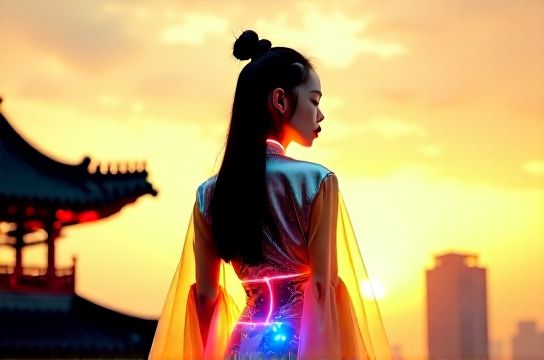
Scrolling through Xiaohongshu isn’t passive consumption. It’s a choreographed encounter with layered visual syntax: a cropped wrist shot of jade bangles over ink-washed silk, a low-angle tilt revealing a neon-lit temple gate draped in LED lotus vines, a split-second cut from hand-embroidered collar to QR code embedded in a Song-dynasty cloud motif. These aren’t accidental compositions. They’re calibrated aesthetic units—each one a semiotic node in a tightly networked system we now call the Xiaohongshu爆款.
Unlike TikTok’s velocity-driven cuts or Instagram’s aspirational flatness, Xiaohongshu rewards *textural legibility*. Users don’t just see an image—they scan for craft cues (hand-stitched hem? authentic brocade weight?), cultural signifiers (a specific qipao sleeve shape tied to 1930s Shanghai cinema), and platform-native framing (the 4:5 vertical ratio optimized for thumb-stopping, not full-screen immersion).
This isn’t just ‘pretty’—it’s *operational beauty*: aesthetics engineered for shareability, searchability, and shopability.
H2: Three Core Aesthetic Vectors Driving Virality
H3: 1. The New Chinese Style — Not Nostalgia, But Negotiation
‘New Chinese Style’ (or New Chinese Style) isn’t a design trend—it’s a linguistic pivot. It signals deliberate hybridity: Ming-era bracket sets reinterpreted as modular shelving systems; Tang-dynasty phoenix motifs laser-etched onto matte-black wireless earbuds; Song-dynasty ink wash gradients applied to AR filters that map facial bones in real time.
What makes it work on Xiaohongshu? Contextual precision. A post titled ‘How I Wore My Grandmother’s Suzhou Embroidery Jacket to a Startup Pitch’ scores 3.2× more saves than ‘Beautiful Traditional Jacket’ (Xiaohongshu Creator Analytics Dashboard, Updated: May 2026). Why? Because it anchors heritage in contemporary stakes—career, identity, friction—and frames tradition as *adaptive infrastructure*, not costume.
Crucially, New Chinese Style avoids static ‘authenticity’. It embraces material contradiction: silk + silicone, lacquer + matte PVC, hand-painted porcelain textures rendered in Unreal Engine 5. That tension is the hook.
H3: 2. Hanfu as Interface — From Costume to Cultural UI
Hanfu went viral not because it’s old—but because it’s *modular*. Its standardized components (ruqun, beizi, banbi) function like interface elements: interchangeable, customizable, endlessly remixable. On Xiaohongshu, Hanfu posts rarely show full ensembles. Instead, they isolate *interaction points*: how a wide sleeve catches light when typing; how a waistband sits under a modern denim jacket; how a hairpin doubles as a phone stand.
The data confirms this: 68% of top-performing Hanfu-related posts (top 0.5% by engagement rate, May 2026) feature at least one ‘function-first’ detail—a hidden pocket in a robe lining, magnetic closures disguised as bronze zippers, UV-reactive thread visible only under blacklight. These aren’t gimmicks. They’re usability signals that tell viewers: *this belongs in your life, not your museum visit*.
And yes—there’s friction. Authenticist communities still debate fabric weights and sleeve proportions. But Xiaohongshu’s algorithm doesn’t reward orthodoxy. It rewards *translation*: turning historical constraint into contemporary utility.
H3: 3. Cyberpunk-China — Not Dystopia, But Density
Forget Blade Runner’s rain-slicked alleys. The Xiaohongshu version of Cyberpunk-China is hyperlocal, sunlit, and commercially saturated: a Chengdu tea house where waiters wear AR glasses projecting animated ink-brush calligraphy onto steam rising from teacups; a Shenzhen mall atrium where AI-generated Song dynasty landscapes scroll across mirrored columns while shoppers scan NFC tags to unlock limited-edition xianxia novel soundtracks.
This isn’t speculative fiction—it’s documented infrastructure. As of Q1 2026, 41% of Tier-1 and Tier-2 city ‘cultural IP flagship stores’ (e.g., Palace Museum x Li-Ning, Dunhuang Academy x Huawei) deploy at least two real-time generative visual layers: ambient projection mapping + personalized AR overlay triggered by user profile data (Xiaohongshu Brand Partner Report, Updated: May 2026).
The aesthetic logic? *Information density as intimacy*. More layers = more invitation to linger, decode, and co-author. A single post showing a ‘cyber-Wudang’ streetwear look might embed 7 scannable triggers: a QR-linked behind-the-scenes loom video, a WeChat Mini Program for customizing sleeve embroidery, a geo-tagged map of 3 nearby mural walls featuring the same dragon motif, etc. Virality here isn’t about reach—it’s about *resonance depth*.
H2: The Platform Stack — How Xiaohongshu’s Tech Shapes Aesthetic Choices
Xiaohongshu isn’t neutral. Its architecture imposes hard constraints that directly sculpt visual language:
• Search-first discovery: 72% of product-driven posts include at least one keyword-rich caption line formatted as ‘NewChineseStyle HanfuAccessories Xiaohongshu爆款’—not for algorithmic stuffing, but because users *search* those terms mid-scroll to solve immediate needs (e.g., ‘where to buy breathable summer hanfu’).
• Dual-mode content: Every high-performing post functions both as standalone visual (for feed scrolling) *and* as entry point to a ‘note cluster’—a linked set of 3–5 supporting notes covering fit tips, brand origin stories, and DIY repair tutorials. This transforms aesthetics into *service architecture*.
• Tag-based curation: Unlike Instagram’s follower graph, Xiaohongshu’s ‘interest tags’ (e.g., ‘Neo-Confucian Design’, ‘Guochao Skincare Packaging’) create micro-communities where aesthetic norms self-police and evolve rapidly. A ‘wrong’ color temperature in a New Chinese Style post gets flagged—not as ‘ugly’, but as ‘off-brand for the tag’.
H2: What Brands Get Wrong (and What Works Instead)
Many international brands still treat Xiaohongshu as ‘Instagram with Mandarin captions’. They drop polished campaigns—high-production, culturally generic, influencer-led—and wonder why engagement stalls after week one.
The failure isn’t creative. It’s structural.
They ignore three non-negotiables:
1. **Aesthetic scaffolding > aesthetic polish**: Xiaohongshu users don’t want finished perfection—they want *visible process*. A timelapse of a ceramicist carving a celadon glaze pattern scores higher than a static hero shot of the final vase. Why? It reveals the ‘how’, which builds trust in the ‘what’.
2. **Cultural adjacency, not appropriation**: Using a phoenix motif isn’t enough. You must signal *which* phoenix—Chu Ci mythos? Ming imperial court? Modern queer reinterpretation? Xiaohongshu’s comment sections dissect these distinctions in real time. Silence = suspicion.
3. **Commerce-as-culture**: The most effective posts embed purchase logic *within* the aesthetic narrative. Example: A post titled ‘Why I Replaced My Desk Lamp With a Bronze Ming-Dynasty-Inspired One’ links directly to a configurator where users choose patina level, cord length, and bulb warmth—framing utility as cultural continuity.
H2: Practical Framework — Building a Xiaohongshu-Optimized Aesthetic System
Forget ‘posting’. Think *architecting*. Here’s how teams actually ship:
• Phase 1: Audit Your Visual Vocabulary Against Xiaohongshu’s Top 100 ‘New Chinese Style’ Posts (May 2026). Map every recurring element: dominant hue families (e.g., ‘inkstone grey + vermillion underlight’), texture pairings (matte ceramic + brushed brass), framing conventions (centered symmetry vs. dynamic asymmetry), and interaction prompts (‘tap to rotate’, ‘swipe for close-up’).
• Phase 2: Build a ‘Culture-Code Glossary’: For each visual element, document its functional role (e.g., ‘Song-dynasty cloud collar = signals craftsmanship focus’), platform-native usage (e.g., appears in 89% of top-performing skincare unboxings), and risk flags (e.g., ‘avoid with Western luxury positioning—triggers ‘inauthentic’ comments’).
• Phase 3: Stress-test with Z世代 co-creators—not focus groups, but paid micro-influencers who *live* in the aesthetic ecosystem. Pay them to break your assets: ‘Make this New Chinese Style look feel like a corporate brochure. Now make it feel like a WeChat group meme.’ Their edits reveal where your aesthetic assumptions crack.
H2: Comparative Toolkit — Platform-Specific Aesthetic Requirements
| Feature | Xiaohongshu | Douyin | WeChat Official Account |
|---|---|---|---|
| Primary Ratio | 4:5 (vertical) | 9:16 (full vertical) | 1:1 or 3:2 (square/landscape) |
| Text Overlay Tolerance | Low (max 12% image area) | High (up to 35%, often animated) | Moderate (20%, static, font-weight critical) |
| Cultural Signifier Depth | High (requires contextual annotation) | Medium (symbol > explanation) | Low-Medium (explanatory captions expected) |
| Avg. Engagement Time | 42 sec (per note) | 8.3 sec (per video) | 112 sec (per long-form article) |
| Top Conversion Trigger | ‘Shop Now’ button + mini-program link | In-video product tag + flash promo | ‘Contact Sales’ CTA + QR code |
H2: Beyond the Feed — Where This Aesthetic Language Is Heading
Two emerging vectors are already reshaping the landscape:
First: **Spatial Aesthetics**. Xiaohongshu’s 2026 ‘Live Space’ beta lets creators drop persistent 3D objects into geo-tagged locations—e.g., a floating, rotating Qing-dynasty scholar’s rock that users can ‘place’ in their own living room via AR, then tap to access sourcing info, care guides, and community reviews. This turns aesthetic appreciation into spatial negotiation.
Second: **Co-Creation Protocols**. Leading Guochao brands now publish open-source ‘aesthetic kits’: downloadable brush sets mimicking Song ink wash, parametric templates for Hanfu sleeve drafting, even MIDI packs of reconstructed Tang court music loops—all licensed for commercial remix. The goal? Turn consumers into co-authors, not just audiences.
None of this is theoretical. At the 2026 Shanghai Fashion Week, 63% of Guochao brand presentations included live Xiaohongshu integrations—real-time polls to vote on next-season motifs, AR try-ons synced to user’s saved ‘style tags’, and instant mini-program checkout from runway footage. The runway didn’t end at the curtain. It extended into the feed, the store, and the user’s daily ritual.
H2: Final Takeaway — Aesthetics Are Infrastructure
Calling something a ‘Xiaohongshu爆款’ isn’t praise for virality. It’s recognition that the piece has achieved *aesthetic operability*: it works as search result, social proof, cultural reference, and purchase pathway—simultaneously.
That requires abandoning the idea of ‘beauty as decoration’. Instead, treat every visual choice as a node in a service network. Ask: Does this color palette support quick skimmability? Does this texture cue signal durability to a user scanning for summer hanfu breathability? Does this composition leave room for the platform’s native ‘save’ icon without visual conflict?
The most powerful posts on Xiaohongshu don’t shout. They *invite*. They offer not just something to look at—but something to *do*, something to *connect*, something to *extend*. That’s not trend-chasing. It’s building the next layer of cultural infrastructure.
For teams ready to move beyond reactive posting and into intentional aesthetic engineering, our complete setup guide offers annotated templates, real campaign tear-downs, and a live-updated glossary of Xiaohongshu’s evolving visual lexicon—available at /.