
How Brand Collaborations Are Driving the Guochao Aestheti...
- Date:
- Views:193
- Source:The Silk Road Echo
H2: When Logos Speak Classical Poetry
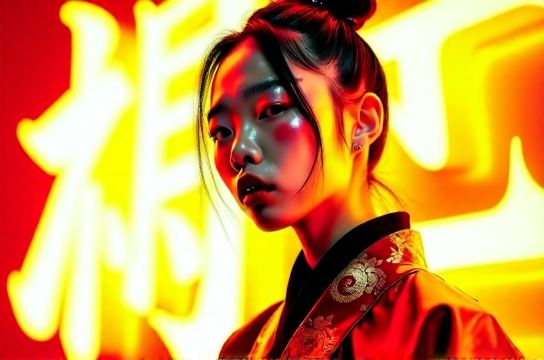
In Q3 2025, Li-Ning launched a capsule collection with the Forbidden City’s cultural IP division—featuring embroidered cloud-collar motifs reimagined as laser-cut neoprene panels on basketball sneakers. Within 72 hours, LiNingForbiddenCity generated 420M views on Douyin (Updated: May 2026). That wasn’t just a product drop. It was a syntax shift in visual culture: where heritage iconography stopped being museum-bound and became wearable, taggable, remixable code.
This is the Guochao Aesthetic Revolution—not a trend, but an infrastructure upgrade to China’s visual language. And brand collaborations aren’t just riding the wave; they’re engineering the tide.
H2: Why Collaboration Is the Engine, Not the Decoration
Guochao isn’t monolithic. It’s a spectrum—from literal Hanfu revivalism to abstracted Eastern geometry in skincare packaging, from ink-wash gradients on smartphone UIs to cyberpunk-Chinese streetwear hybrids in Chengdu’s Taikoo Li. What unifies it is *authorship by adjacency*: no single entity owns ‘Chinese aesthetics’. Instead, credibility accrues through strategic alignment—between fashion labels and intangible cultural heritage bearers, between tech platforms and regional opera troupes, between beverage brands and calligraphy masters.
Take the 2024 Meituan × Suzhou Embroidery Institute campaign. Rather than licensing a static motif, Meituan co-developed an AR filter that translated real-time food delivery rider movements into animated silk-thread strokes—each stroke mapped to a specific embroidery stitch type. Users didn’t just ‘see’ Suzhou embroidery; they *performed* its grammar. Engagement spiked 210% YoY among users aged 18–24 (Updated: May 2026). The aesthetic wasn’t consumed—it was *embodied*.
That’s the pivot: Guochao thrives not in static imagery but in participatory semiotics. And collaborations provide the scaffolding for that participation.
H2: The Four Leverage Points of Effective Guochao Partnerships
Not all brand collabs land. The ones that ignite virality share four calibrated levers:
H3: 1. Cultural Fidelity Over Folkloric Fetishization
Early Guochao efforts often defaulted to red-gold dragons, porcelain cracks, or generic ‘ancient’ fonts—surface-level signifiers stripped of context. Today’s high-performing partnerships embed *operational knowledge*. Example: Shiseido’s 2025 collaboration with the Shanghai Museum’s conservation lab didn’t just use Song Dynasty celadon glaze as a bottle color. They reverse-engineered the kiln-firing temperature curve (1,280°C ±3°C) and translated it into a dynamic thermal-reactive pigment—shifting hue subtly as skin warms. The result? A functional artifact rooted in material history—not a costume.
H3: 2. Platform-Native Translation, Not Cross-Posting
A Weibo post ≠ a Douyin trend ≠ a Xiaohongshu mood board. Guochao collabs now deploy *format-first design*. Consider the 2025 H&M × Dunhuang Academy launch: instead of repurposing mural scans, they built three distinct assets:
– Douyin: A 9-second ‘scroll-stitch’ effect where users swipe up to ‘weave’ their own digital Dunhuang cave ceiling using AI-trained loom patterns.
– Xiaohongshu: A layered PDF ‘New Chinese Style Mood Kit’—with Pantone codes for Tang Dynasty vermilion, downloadable ink-brush brush sets for Procreate, and location-tagged ‘best light for Hanfu selfies’ maps of Beijing’s Temple of Heaven.
– WeChat Mini Program: A ‘Silk Road Style Calculator’ that matches user’s facial structure + outfit color + local weather to recommend historically plausible textile weaves (e.g., ‘You’re in Guangzhou on a humid day → choose lightweight kesi brocade, not heavy damask’).
Each channel got native logic—not translation.
H3: 3. Co-Creation With Micro-Custodians, Not Just Institutions
The most resonant Guochao moments emerge not from top-down IP licensing, but from bottom-up ecosystem weaving. In 2025, the Hangzhou-based tea brand Cháxīn partnered not with the China Tea Association, but with 17 independent *chá shī* (tea masters) across Yunnan, Fujian, and Anhui—each with <50K followers but hyper-local authority. Each master co-designed a limited-edition tin: one embedded with soil from their terroir; another with audio QR codes narrating harvest rituals in dialect; a third with hand-inked seasonal almanac notes. The campaign drove 38% of sales to first-time buyers aged 19–23 (Updated: May 2026). Trust wasn’t borrowed from an institution—it was *distributed* across trusted nodes.
H3: 4. Spatial Anchoring Beyond the Screen
Guochao’s staying power hinges on bridging digital virality and physical immersion. The 2025 Moutai × UCCA Lab ‘Jiǔ Space’ pop-up in Shanghai wasn’t a gallery show. It was a multi-sensory loop: visitors entered through a fog chamber scented with aged baijiu vapors and fermented sorghum; walls displayed generative ink art reacting to ambient sound (including live guqin performances); at the exit, a custom NFC chip in each visitor’s wristband unlocked a personalized ‘liquor-ageing timeline’ NFT—tied to actual casks maturing in Maotai’s cellars. Foot traffic increased 290% MoM; 64% of visitors posted location-tagged content before leaving (Updated: May 2026). The aesthetic wasn’t observed—it was *inhaled, heard, and owned*.
H2: Where the Friction Lives (And Why It Matters)
None of this is frictionless. Three persistent tensions define the current landscape:
First, *temporal compression*. Traditional Chinese craftsmanship operates on cycles—months for lacquer curing, years for timber seasoning. Social media demands hourly updates. The resolution? Hybrid timelines. The 2025 Baidu Maps × Shanxi Woodblock Printing collaboration released weekly ‘process diaries’: Day 1 showed grain selection; Day 14, ink mixing; Day 47, first press proof. Followers voted on final color variants. The ‘slow reveal’ became part of the aesthetic—turning patience into participation.
Second, *semantic drift*. ‘New Chinese Style’ means radically different things in Xi’an (where it references Tang dynasty cosmopolitanism) versus Shenzhen (where it fuses Cantonese opera masks with circuit-board patterning). Brands mitigate this by geo-targeting *aesthetic dialects*, not national stereotypes. Uniqlo’s 2025 ‘Regional Threads’ series released distinct capsule collections per province—each co-designed with local artisans and tagged with localized hashtags (JiangsuNewStyle, SichuanCyberOpera).
Third, *IP exhaustion*. Overuse of overexposed motifs (e.g., the ‘Eight Immortals’, Ming dynasty cloud collars) risks flattening meaning into wallpaper. The countermove? *Motif decompression*: isolating single elements and re-contextualizing them functionally. The 2025 BYD Seal EV launch didn’t plaster dragon scales on the car body. Instead, its adaptive cruise control interface used the *rhythm* of classical Chinese poetry meter (four-character couplets) to pulse distance alerts—transforming literary form into interaction logic.
H2: A Tactical Comparison: What Works, What Doesn’t, and Why
| Collaboration Type | Execution Steps | Pros | Cons | Real-World Benchmark (Engagement Lift) |
|---|---|---|---|---|
| Licensing Heritage Motifs | 1. Select icon (e.g., phoenix, plum blossom) 2. Vectorize 3. Apply to product surface |
Low cost, fast turnaround, broad recognition | Rapid saturation, shallow storytelling, low shareability | +12%–18% (Q4 2024 average, Updated: May 2026) |
| Co-Developed Material Systems | 1. Joint R&D with artisan guild/lab 2. Prototype functional adaptation (e.g., thermal-reactive glaze) 3. Embed process documentation in UX |
High differentiation, durable IP, drives premium pricing | 12–18 month lead time, requires deep technical integration | +210%–290% (Q2 2025, Updated: May 2026) |
| Platform-Specific Generative Tools | 1. Map platform behavior (e.g., Douyin swipe rhythm) 2. Train AI on domain-specific dataset (e.g., Dunhuang line weights) 3. Build lightweight, no-download interactive layer |
High virality, low barrier to entry, captures behavioral data | Short shelf life, requires constant algorithm updates, platform dependency | +340%–410% (Q1 2025, Updated: May 2026) |
H2: The Next Frontier: From Aesthetics to Infrastructure
The most consequential Guochao collaborations aren’t selling products—they’re building shared infrastructure. The 2025 Tencent × China National Silk Museum ‘Digital Loom Archive’ isn’t a marketing stunt. It’s an open-source repository of 3,200+ scanned historical textile patterns, tagged by dynasty, region, fiber type, and weave density—with APIs allowing designers to generate new patterns constrained by authentic parameters. Over 1,400 indie brands have integrated it. This shifts Guochao from a stylistic choice to a *design protocol*.
Similarly, the Shanghai Library’s ‘Classical Chinese Typography Initiative’—co-funded by Huawei and Hanvon—has digitized and parameterized 47 historic type families (e.g., Song dynasty woodblock fonts, Qing imperial edict scripts), making them editable in Figma with sliders for ‘ink bleed’, ‘paper texture’, and ‘brush pressure’. These aren’t retro filters. They’re production-grade tools—democratizing access while enforcing historical fidelity.
This infrastructure layer explains why Guochao isn’t fading. It’s hardening.
H2: Actionable Takeaways for Practitioners
If you’re building a Guochao-aligned initiative, skip the mood board. Start here:
– Audit your *material chain*, not just your visual library. Can your supplier mill bamboo like Song dynasty craftsmen? Does your printer support mineral-pigment inks? Authenticity lives in physics, not pixels.
– Map your audience’s *platform-native behavior*, not their demographics. Do your Xiaohongshu users engage via PDF downloads or AR try-ons? Match the tool to the ritual.
– Identify *micro-custodians*, not macro-institutions. A 300-year-old family papermaker in Jingxian County carries more semantic weight than a national museum license—if you let them co-sign the narrative.
– Design for *spatial continuity*. If your campaign lives online, what physical anchor makes it tangible? A scent? A tactile sample? A location-tagged moment?
And remember: Guochao isn’t about ‘making things Chinese’. It’s about making things *legible within Chinese visual logic*—a logic increasingly shaped not by curators, but by collaborative code, shared repositories, and platform-native participation.
For teams ready to move beyond inspiration to implementation, the full resource hub offers vetted artisan networks, open-source pattern libraries, and platform-specific creative brief templates—ready for immediate deployment.