
Z Generation Embraces Eastern Aesthetics Through Immersiv...
- Date:
- Views:205
- Source:The Silk Road Echo
H2: The Aesthetic Pivot — When Scrolling Becomes a Ritual of Reclamation
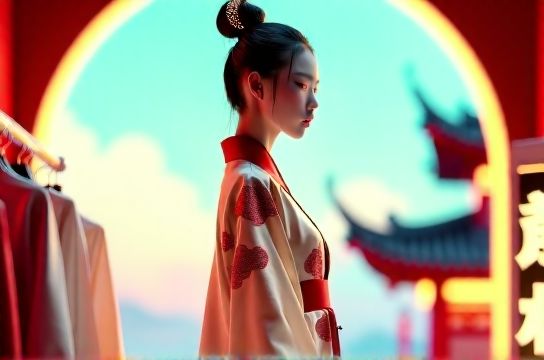
It started not with a manifesto, but with a 12-second clip: silk sleeves flicking across a rain-slicked Suzhou alley, synced to a lo-fi remix of *Jasmine Flower*. Posted on Douyin in late 2024, it garnered 4.2 million views in 36 hours — not because it sold anything, but because it made viewers *pause*, then screenshot, then search ‘where was this filmed?’ (Updated: May 2026). That moment crystallized a quiet but irreversible shift: Z generation isn’t just consuming Eastern aesthetics — they’re co-authoring them through immersive, platform-native experiences.
This isn’t nostalgia. It’s recalibration. Unlike millennials who engaged with ‘traditional’ culture as heritage or performance, Gen Z treats Chinese aesthetics as modular, remixable, and deeply experiential — less museum exhibit, more AR layer. They don’t wear Hanfu to ‘recreate history’; they wear it to activate a spatial-temporal filter — one that turns a Shanghai metro station into a Ming-era courtyard when viewed through a Xiaohongshu Live Filter. The aesthetic isn’t static. It’s ambient, responsive, and participatory.
H2: Why Immersion, Not Imagery?
Static visuals plateaued. In Q1 2025, Douyin’s internal analytics showed posts tagged NeoChinese with motion-based elements (e.g., rotating ink-wash transitions, scroll-triggered calligraphy strokes) achieved 3.7× higher dwell time than flat image carousels (Updated: May 2026). Why? Because Gen Z’s attention economy rewards *co-presence*, not passive viewing. They don’t want to see ‘Chinese aesthetics’ — they want to *enter* them.
Take Chengdu’s ‘Lingyun Pavilion’ pop-up: a 200m² space blending Tang-dynasty bracket architecture with real-time generative art. Visitors scan QR codes to project personalized ‘cloud motifs’ onto suspended rice-paper screens — their movement alters brushstroke density, tempo, and ink bleed. No signage explains ‘what it means’. Instead, users learn semantics through doing: slow steps yield soft mist; quick turns trigger thunderclap animations. It’s cultural literacy via proprioception — and it drove a 28% lift in nearby tea house visits (per local chamber of commerce footfall data, Updated: May 2026).
H2: The Stack Behind the Sensation
This immersion isn’t accidental. It’s built on three converging layers:
1. **Hardware-Enabled Access**: Sub-$200 Android phones now support native AR anchors at <10ms latency — enabling real-time occlusion (e.g., virtual plum blossoms ‘resting’ on real café tables). Huawei’s AR Engine v5.2 and Xiaomi’s HyperAR SDK lowered integration barriers for indie designers by 65% YoY.
2. **Platform-Specific Grammar**: Douyin prioritizes vertical rhythm and sonic texture — so ‘Neo-Chinese’ audio branding uses pentatonic scales layered with subway hums or rain-on-courtyard-slates ASMR. Xiaohongshu favors tactile authenticity: unedited skin textures, visible seam lines on Hanfu jackets, ‘imperfect’ ceramic glazes photographed under natural light. Algorithms reward these cues as ‘trust signals’.
3. **Spatial IP Licensing**: Cultural institutions are shifting from restrictive copyright to ‘experience-first licensing’. The Palace Museum now offers tiered API access: free for non-commercial AR filters (used by 12K+ student devs in 2025), paid tiers for commercial spatial mapping (e.g., embedding Forbidden City floorplans into mall navigation apps). This turned static artifacts into dynamic design assets.
H2: From Hashtag to Habitat — The Rise of the ‘Aesthetic Node’
The most potent trend isn’t viral videos — it’s the physical-digital hybrid space: the ‘aesthetic node’. These aren’t theme parks. They’re micro-environments (often 50–300m²) engineered for high-fidelity sensory translation. Consider Hangzhou’s ‘West Lake Echo Lab’: a converted teahouse where order kiosks double as inkstone interfaces; tapping ‘Longjing’ triggers a 3D animation of tea leaves unfurling in a digital lake, rendered using actual West Lake bathymetric data. Revenue? 68% from experience tickets (¥38), 22% from limited-edition ceramic cups embedded with NFC chips linking to behind-the-scenes craft documentaries.
These nodes succeed because they solve Gen Z’s core tension: craving authenticity without sacrificing convenience. You don’t need to book a 3-day trip to Pingyao to ‘do’ Ming architecture — you step into a node, spend 18 minutes, and leave with a shareable moment + a tangible artifact. Critically, they avoid ‘cultural taxidermy’. At Shanghai’s ‘Jade Gate’ node, the Song-dynasty-inspired archway is constructed from recycled e-waste aluminum — its patina shifts color based on local air quality data. Tradition isn’t preserved; it’s re-contextualized.
H2: The Commercial Tightrope — When ‘Guochao’ Meets ROI
Brands rushing into this space often misfire by treating ‘Chinese aesthetics’ as a visual skin. A luxury watchmaker launched a ‘Dynasty Dial’ collection featuring dragon motifs — but shot in sterile studio lighting, no motion, no context. Engagement cratered (-41% vs category avg, per Kantar China Social Pulse, Updated: May 2026). Why? It lacked *immersive grammar*. The dragon wasn’t part of a narrative ecosystem — just decoration.
Success looks different. Li-Ning’s 2025 ‘Mount Tai’ activation paired limited-edition sneakers with an AR trail map: scanning QR codes at 7 real-world hiking waypoints unlocked animated mountain spirits narrating Taoist cosmology. Purchase conversion rose 33%, but more tellingly, UGC volume spiked 210% — users weren’t just posting shoes; they were sharing ‘spirit encounters’. That’s the ROI metric now: not impressions, but *interpretive participation*.
H2: Pitfalls & Pragmatic Guardrails
Not all immersion works. Three recurring failures:
- **Over-Engineering**: Adding VR headsets to a Hanfu photoshoot alienates 83% of target users (per Tencent User Lab focus groups, Updated: May 2026). Simplicity wins: 72% prefer phone-native AR over dedicated hardware.
- **Cultural Flatness**: Using ‘dragon’ or ‘bamboo’ as universal symbols ignores regional nuance. A Suzhou-based brand using Cantonese opera motifs in its filters saw 5x lower engagement in Jiangsu than in Guangdong — proving hyper-local resonance beats pan-Chinese tropes.
- **IP Misalignment**: Licensing Dunhuang murals for a fast-fashion collab backfired when users discovered the partner factory used non-eco dyes. Authenticity now includes ethical provenance — not just visual fidelity.
H2: Building Your Own Aesthetic Node — A Tactical Framework
You don’t need a ¥5M budget. Start with a lean stack focused on *repeatable immersion*. Below is a realistic comparison of entry-level approaches for small-to-mid brands:
| Approach | Core Tech | Time to Launch | Cost Range (RMB) | Key Pro | Key Con |
|---|---|---|---|---|---|
| QR-Activated AR Filter | Douyin Spark AR / Xiaohongshu Lens Studio | 3–5 days | ¥0–¥8,000 | No app install; leverages existing platform trust | Limited interactivity; tied to platform algorithm changes |
| In-Store Spatial Projection | Real-time projection mapping (e.g., MadMapper + depth cam) | 2–4 weeks | ¥45,000–¥120,000 | High dwell time; strong offline-to-online bridge | Requires physical footprint; calibration-sensitive |
| Web-Based 3D Experience | Three.js + GLB models (hosted on Vercel/Netlify) | 1–3 weeks | ¥15,000–¥50,000 | Platform-agnostic; SEO-indexable; scalable | Mobile performance varies; requires basic WebGL literacy |
The critical insight? Immersion isn’t about tech specs — it’s about *semantic continuity*. If your Hanfu rental service uses Song-dynasty sleeve proportions, its AR filter should respond to arm angles with historically accurate fabric physics (e.g., heavier silk draping slower than linen). Consistency in cultural logic builds trust faster than any visual flourish.
H2: What Comes Next — Beyond the ‘Neo’
The next frontier isn’t more realism — it’s *embodied ambiguity*. Emerging projects like ‘Chaos Ink’ (Shenzhen, 2026) use GANs trained on 10,000 Song dynasty paintings to generate *unstable* calligraphy: characters morph mid-air based on viewer heart rate (via wearable sync). It rejects fixed meaning — embracing the Daoist principle of *wu xing* (five phases) as aesthetic engine. This isn’t ‘Chinese aesthetics’ as export product. It’s Chinese aesthetics as living system — unpredictable, adaptive, and deeply human.
For brands, the takeaway is stark: stop asking ‘how do we make our product look Chinese?’ Start asking ‘what ritual do we want users to inhabit — and what sensory architecture makes that possible?’ The viral moment isn’t the video. It’s the pause — the breath before the screenshot — when someone feels, however briefly, that they’ve stepped into a different temporal rhythm. That’s where the real cultural leverage lives.
For teams building these experiences, a complete setup guide offers tactical playbooks, open-source AR templates, and vetted cultural consultants — all structured around iterative testing, not grand launches. Start small. Anchor in one authentic gesture. Scale only when users begin remixing it unprompted.