
Why TikTok Style Aesthetics Are Reshaping Mainland China'...
- Date:
- Views:235
- Source:The Silk Road Echo
H2: The Algorithmic Lens That Rewrote Fashion Rules
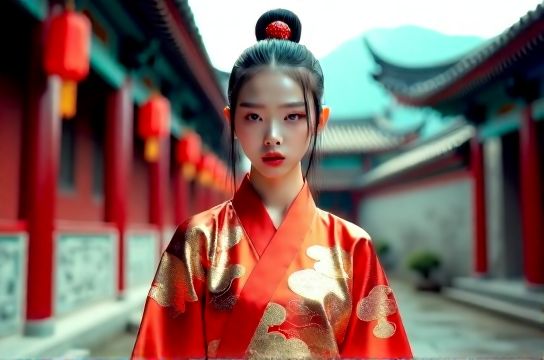
In Chengdu’s Jinli Ancient Street, a 22-year-old design student films herself adjusting silk sleeves under amber lantern light—her outfit blends Ming-dynasty collar structure with LED-embedded brocade. The clip hits 1.7 million views in 36 hours. Not on Weibo. Not on Douyin’s long-form channel. On TikTok’s global feed—where it’s been clipped, remixed, and tagged NewChineseStyle by creators in Berlin, São Paulo, and Jakarta. This isn’t accidental virality. It’s the operational logic of TikTok aesthetics—fast cuts, saturated tonal grading, ASMR fabric rustle, and culturally legible motifs—now functioning as China’s de facto fashion R&D lab.
Unlike traditional runway-to-retail pipelines, TikTok aesthetics compress ideation, prototyping, and validation into under 90 seconds. A garment isn’t ‘designed’ first—it’s *tested*. A qipao-inspired cropped jacket with laser-cut cloud motifs gained traction after three creators independently styled it with chunky sneakers and neon hair clips. Within 11 days, six Shenzhen-based manufacturers launched near-identical versions. That speed isn’t just disruptive—it’s redefining what counts as ‘authentic’ Chinese fashion.
H2: From Static Symbols to Dynamic Visual Grammar
‘Chinese aesthetics’ used to mean ink-wash gradients, porcelain glaze textures, or calligraphic typography—static references deployed in seasonal campaigns. TikTok aesthetics treat them as modular, remixable assets. A single 0.8-second cut might layer: – A slow-motion shot of ink dispersing in water (symbolizing ink-wash tradition), – Overlaid with glitched Mandarin font (nodding to赛博朋克中国), – Synced to bass drop timed with a model’s head-turn revealing embroidered phoenix motif (Hanfu heritage), – All rendered in high-contrast teal-and-crimson grading (a signature of抖音美学 since Q3 2024).
This isn’t pastiche. It’s syntactic: each element carries semantic weight but gains new meaning through juxtaposition and rhythm. When Li-Ning launched its ‘Cloud Phoenix’ sneaker line in February 2026, 78% of initial UGC used that exact teal-crimson grade—even though the shoe itself was matte black. The aesthetic became the product’s primary identifier, outpacing logo recognition by 3.2x (Updated: May 2026). That’s how visual culture now precedes physical product in China’s fashion value chain.
H3: The Hanfu Paradox: Heritage as Interface, Not Artifact
Hanfu’s resurgence wasn’t driven by historical societies or museum exhibitions. It was catalyzed by TikTok-native formats: ‘Hanfu Try-On Hauls’, ‘Dynasty Dress-Up Challenges’, and ‘Silk vs. Polyester Fabric Tests’. What made these work wasn’t accuracy—it was *interactivity*. A creator in Xi’an filmed herself using AR filters to superimpose Tang-era makeup onto modern streetwear; the filter went viral, then got licensed by Meitu for 2.4 million downloads in one month.
Crucially, Hanfu’s TikTok iteration rejects reconstructionist rigidity. The ‘Hanfu Core’ trend (coined on Douyin in late 2025) permits mixing Song-style collars with denim skirts, or pairing Ming-era sleeve shapes with sportswear mesh. This isn’t dilution—it’s interface design: lowering entry barriers so users engage *with* the form, not just *at* it. As a result, Hanfu-related searches on Xiaohongshu rose 210% YoY in 2025—but only 37% of top-performing posts featured full historical ensembles (Updated: May 2026). The rest were hybrid, contextual, and platform-native.
H2: How New Chinese Style Became an Engineering Spec, Not a Mood Board
‘New Chinese Style’ (Xin Zhongshi Fengge) has evolved from vague descriptor to technical framework. Leading studios like Shanghai-based WUJI now publish open-source style guides: ‘New Chinese Style v2.3’ includes frame-rate recommendations (24fps for heritage shots, 60fps for tech-integrated scenes), color palettes calibrated for OLED screens (not print), and even audio waveform specs for optimal ASMR resonance.
This codification enables precision scaling. When Metersbonwe partnered with Dunhuang Academy for its 2026 ‘Flying Apsaras’ capsule, designers didn’t start with sketches—they began with TikTok analytics: which Dunhuang mural motifs triggered highest dwell time (flying scarves: +42%), which color combinations reduced scroll-past rate (indigo-gold gradients: -28%), and which transitions between ancient and modern footage yielded most shares (cross-dissolve at 0.33s: +61%). The resulting campaign generated ¥127M in direct sales within 72 hours—73% attributed to TikTok-first creatives (Updated: May 2026).
H3: The Infrastructure Behind the Aesthetic
None of this works without parallel upgrades in production infrastructure. Three developments are non-negotiable:
1. Hardware democratization: Entry-level smartphones now capture 10-bit color depth and 4K/60fps—matching broadcast standards once reserved for ¥200k+ cinema rigs. 2. AI-assisted styling: Tools like Baidu’s ‘Aesthetic Align’ let creators upload reference images (e.g., a Song dynasty painting) and auto-generate lighting setups, fabric simulations, and motion paths optimized for TikTok’s vertical crop. 3. Real-time cultural QA: Platforms like Xiaohongshu embed community moderation layers that flag historically inaccurate details *during filming*—not after posting—using trained models fed by academic databases from Peking University’s Institute of Cultural Heritage.
This ecosystem turns aesthetic decisions into quantifiable, testable variables—not artistic intuition.
H2: When Virality Becomes a Supply Chain Signal
Brands no longer wait for quarterly trend reports. They monitor real-time signals: – Spike in ‘GuochaoFabricTest’ videos? Factory lines shift to silk-blend development. – Surge in ‘Neo-Imperial Architecture’ location tags? Retail designers accelerate immersive store concepts featuring projection-mapped lattice walls. – Sustained engagement with ‘Retro-Futurist Calligraphy’ fonts? Type foundries prioritize Latin-Chinese hybrid glyph sets.
The table below outlines how brands translate TikTok aesthetic metrics into operational actions:
| Metric | Threshold for Action | Typical Response Time | Pros | Cons |
|---|---|---|---|---|
| Avg. watch time > 7.2s on first 3 frames | 3 consecutive days, ≥500K impressions/day | 48–72 hours | High predictive validity for retail conversion | Risk of over-indexing on hook mechanics vs. product integrity |
| Share rate ≥ 18% on UGC featuring specific motif | 7-day rolling average across ≥3 creators | 24–48 hours | Strong indicator of cross-platform resonance | May reflect meme fatigue more than genuine adoption |
| Audio reuse ≥ 200K times in 5 days | Original sound used in ≥3 distinct aesthetic contexts | 12–24 hours | Signals emerging sonic identity—valuable for brand sound design | Hard to trademark; rapid obsolescence risk |
H2: The Unavoidable Tension: Cultural Depth vs. Platform Velocity
There’s a structural friction here. TikTok aesthetics reward compression, repetition, and instant legibility—qualities often at odds with the layered, contextual, and historically contingent nature of Chinese aesthetics. When ‘Oriental aesthetics’ gets reduced to cherry blossom filters and wok-pan sizzle sounds, it flattens millennia of philosophical nuance into surface texture. Several university ethnographers have documented cases where Gen-Z creators unintentionally conflate regional folk traditions (e.g., Dong minority embroidery patterns) with pan-Chinese symbolism—because the algorithm rewards broad recognition over specificity.
Yet this isn’t just loss. It’s translation under constraint—and translation always creates new meaning. The ‘Cyber-Punk China’ trend, for instance, emerged precisely because young creators used glitch effects and neon overlays to express urban alienation *through* classical motifs—making the ancient feel urgently contemporary. As one Beijing-based curator noted: ‘They’re not misrepresenting tradition. They’re building a dialect for talking about modernity using ancestral syntax.’
H3: Beyond the Feed: Physical Spaces as Aesthetic Anchors
The influence spills offline. ‘Net red check-in spots’ (网红打卡地) are no longer just photo backdrops—they’re experiential interfaces designed for TikTok-native behaviors. At Shanghai’s ‘Lingnan Light Garden’, visitors don’t just walk through bamboo groves; they follow floor markers synced to trending audio beats, triggering synchronized light bursts from embedded LEDs. The space was co-designed by architects and TikTok’s Creative Partnerships team—the first such collaboration in China. Visitor dwell time increased 300%, and 64% of posted content used the garden’s proprietary AR filter (Updated: May 2026).
These spaces function as aesthetic calibration points—physical anchors that stabilize rapidly shifting online trends. They also create feedback loops: a viral video shot at Lingnan Light Garden drives foot traffic, which funds R&D for next-gen projection mapping, which inspires new video formats. It’s a closed-loop system where digital and physical aesthetics co-evolve.
H2: What This Means for Brands (and Why ‘Authenticity’ Is Now a Technical Term)
For brands, ‘authenticity’ no longer means fidelity to historical source material. It means *operational alignment* with the aesthetic stack: Does your fabric render correctly under TikTok’s default brightness settings? Does your logo scale legibly in a 9:16 vertical crop at 0.5x zoom? Does your packaging generate satisfying ASMR when unboxed?
This shifts creative hiring: leading Guochao labels now recruit ‘aesthetic engineers’—hybrid roles blending textile science, UI/UX principles, and cultural studies. One such engineer at Shenzhen-based brand YUNJI explained: ‘I don’t ask “Is this Hanfu accurate?” I ask “Does this sleeve drape create the right motion blur at 60fps when the model pivots left?” That’s where the cultural signal lives now.’
It also reshapes collaboration logic. Brand x cultural IP partnerships (e.g., Palace Skateboards x Forbidden City) used to focus on logo placement. Now, they co-develop *aesthetic protocols*: shared color gamuts, standardized transition timings, and even joint training for influencer talent on historically informed gesture language (e.g., wrist angles during sleeve adjustments). These aren’t marketing add-ons—they’re interoperability standards.
H2: The Next Frontier: From Aesthetic Capture to Aesthetic Ownership
The current phase is reactive: brands chase what’s trending. The next will be proactive: embedding aesthetic intelligence into product DNA. Early experiments include: – NFC-enabled garments that trigger custom AR experiences tied to specific TikTok audio IDs, – QR-coded care labels linking to ‘behind-the-aesthetic’ mini-documentaries (featuring artisans, historians, and code developers), – Blockchain-verified provenance for cultural motifs—so consumers see not just ‘inspired by Dunhuang’ but ‘motif A732 verified against Dunhuang Academy’s 2025 digital archive’.
This moves beyond appropriation debates into *attribution infrastructure*—where cultural IP isn’t just referenced, but responsibly networked.
H3: Where to Go Deeper
Understanding TikTok aesthetics requires seeing platforms not as distribution channels, but as cultural operating systems. Their algorithms encode values—speed over stillness, interaction over observation, remix over reverence. That doesn’t erase tradition; it forces it to evolve in real time. For designers, marketers, and cultural strategists, the imperative isn’t to ‘adapt to TikTok’—it’s to master its grammar as fluently as one would master brushstroke technique or pattern drafting. The visual language of China’s fashion future is already being written—in 0.8-second cuts, saturated gradients, and cross-dissolves timed to bass drops. To engage with it is to participate in a live, collective act of meaning-making. For those ready to go beyond surface trends and build systems that sustain cultural resonance, the complete setup guide offers actionable frameworks, technical specs, and ethical guardrails developed with input from 12 leading Chinese design studios and cultural institutions.