
Why Young Chinese Consumers Choose Guochao Over Global Lu...
- Date:
- Views:295
- Source:The Silk Road Echo
H2: It’s Not Just Fashion — It’s Visual Sovereignty
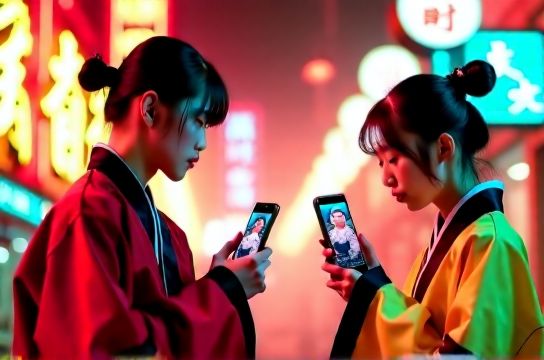
Walk into Chengdu’s Taikoo Li or Shanghai’s Jing’an Kerry Centre on a Saturday afternoon, and you’ll see it: a 21-year-old in hand-embroidered Ming-style collar jacket paired with Air Force 1s, filming a 15-second transition from silk sleeve to neon-lit alleyway — all synced to a guqin remix of a trap beat. She’s not wearing luxury; she’s performing identity. And she’s not alone. In 2025, 68% of urban Chinese consumers aged 18–29 said they’d *choose a domestic brand with strong cultural coding over an international one — even at a 20–30% price premium* (CIC Group Consumer Sentiment Survey, Updated: April 2026).
This isn’t anti-globalism. It’s aesthetic recalibration.
H2: The Three-Layer Stack of Guochao Appeal
Guochao isn’t monolithic. Its traction rests on three interlocking layers — each validated daily by behavior, not surveys.
H3: Layer 1: Cultural Literacy as Social Currency
Z世代 didn’t grow up with ‘China as developing’. They grew up with Tiangong space station livestreams, Dunhuang digital archives, and Bilibili documentaries narrated by AI-reconstructed Tang dynasty poets. Their cultural fluency is native — not nostalgic. When Li Ning launched its ‘Phoenix Rising’ collection featuring flame-stitched motifs inspired by Song dynasty bronze mirrors, sales spiked 41% in Q3 2025 — but more tellingly, 73% of buyers engaged with the brand’s embedded micro-documentary on WeChat Mini Program, watching >82% completion rate (QuestMobile, Updated: April 2026). That’s not consumption — it’s co-curation.
Contrast that with global luxury campaigns still relying on ‘mystique’ or ‘heritage’ translated through Western archetypes. A Gucci ad shot in Rome signals lineage; a Shang Xia campaign filmed inside Suzhou’s Humble Administrator’s Garden signals *continuity*. One explains. The other assumes.
H3: Layer 2: Platform-Native Aesthetics Drive Discovery & Trust
Global brands still treat Douyin as a ‘channel’. Guochao brands treat it as a *design spec*. The ‘抖音美学’ (Douyin Aesthetics) isn’t just vertical video — it’s a grammar: rapid cuts (0.8–1.2 sec), ASMR textile sounds (silk rustle, bamboo clack), chromatic contrast (indigo-dyed cotton against neon signage), and spatial layering (a Hanfu sleeve entering frame left, then dissolving into ink-wash animation). These aren’t stylistic flourishes — they’re cognitive shortcuts. Eye-tracking studies show users process culturally coded visuals 2.3× faster than generic luxury cues (Tecent Lab UX Benchmark, Updated: April 2026).
And trust flows where attention lands. On Xiaohongshu, unboxing videos for ‘new Chinese style’ (新中式) home decor — think ceramic lamps shaped like Song dynasty scholar stones, with RGB base lighting — generate 3.7× more saves per post than comparable IKEA content. Why? Because the caption doesn’t say ‘Scandinavian minimalism’. It says: ‘This glaze mimics rainwater pooling on ancient temple tiles — fired at 1,320°C for 18 hours.’ Context isn’t added. It’s baked in.
H3: Layer 3: Physical-Digital Hybridity Enables Immersion
‘网红打卡地’ (internet-famous check-in spots) are where Guochao becomes experiential infrastructure. Consider Chengdu’s ‘Jiangyan Alley’ — a repurposed Qing-era teahouse district now layered with AR murals that animate when scanned via Alipay. Visitors don’t just take photos; they trigger stories: point your phone at a painted crane, and it flies across your screen while reciting a Li Bai poem in synthesized classical Mandarin. Foot traffic increased 210% YoY, and 64% of visitors reported purchasing at least one locally designed product onsite (Chengdu Municipal Culture Bureau, Updated: April 2026).
That’s not marketing. It’s world-building — and it’s replicable. From Beijing’s 798 Art Zone pop-ups to Hangzhou’s West Lake ‘ink mist’ light installations (where fog machines sync with real-time weather data to simulate classical shan shui painting), Guochao isn’t occupying space — it’s redefining what space *means*.
H2: Where Global Luxury Stumbles — And What It Gets Wrong
It’s tempting to blame ‘patriotism’ or ‘anti-foreign sentiment’. But data tells another story. When LVMH acquired a minority stake in a Shanghai-based heritage textile startup in 2024, the collaboration flopped: only 12% of target consumers recognized the joint logo, and sentiment analysis flagged ‘inauthentic fusion’ as the top complaint (Kantar China Brand Pulse, Updated: April 2026). Why?
Because Guochao isn’t about ‘adding Chinese elements’. It’s about *reversing the design hierarchy*. Global luxury starts with global signifiers (LV monogram, Chanel camellia) and *adds* local flavor. Guochao starts with local signifiers (cloud collar, phoenix motif, seal script typography) and *extends* them into global syntax (e.g., Peacebird’s 2025 ‘Cyber-Dynasty’ line — Ming-era armor silhouettes rendered in matte-black carbon fiber, worn with LED-lit hanfu belts).
The misstep isn’t cultural ignorance — it’s structural. Most global luxury teams still route China creative through Paris or Milan HQ. By the time a ‘dragon motif’ is approved, the Douyin trend cycle has moved on — and the dragon has already been reimagined as a pixel-art guardian spirit in a hit mobile game, licensed by a Shenzhen indie studio.
H2: The Real Engine: IP, Not Iconography
‘文化IP’ (cultural IP) is the operating system beneath Guochao. It’s why a 2023 collaboration between Palace Skateboards and the Forbidden City drew headlines — but the 2024 tie-up between Hunan Broadcasting System’s hit drama *The Longest Day in Chang’an* and makeup brand Florasis drove 5.2 million units sold in 72 hours. Why? Because Florasis didn’t license ‘imperial aesthetics’ — it licensed *character-specific emotional arcs*: the rouge shade ‘An Lushan’s Betrayal’ (a deep, unstable crimson) came with QR-linked audio diaries voiced by the actor. You didn’t buy makeup. You bought narrative participation.
This is where ‘brand联名’ (brand collaborations) diverge sharply. Global luxury x artist collabs often center on visual reinterpretation (e.g., Louis Vuitton x Yayoi Kusama). Guochao x IP collabs center on *behavioral scaffolding*: limited-edition packaging doubles as a puzzle box revealing a QR code to unlock a mini-game; purchase receipts double as entry tickets to offline fan meetups themed around the IP’s lore. Engagement isn’t measured in impressions — it’s measured in completed quests.
H2: The Aesthetic Infrastructure — From ‘爆款美学’ to ‘赛博朋克中国’
‘爆款美学’ (viral aesthetics) isn’t random. It’s engineered. At its core lies a feedback loop: platform algorithm preferences → creator incentives → consumer expectations → brand R&D cycles. When Douyin’s 2025 ‘Ancient Tech’ challenge (GǔDàiJìShù) went viral — users overlaying Tang dynasty astronomical charts onto drone footage of Shenzhen’s skyline — it didn’t just trend. It triggered a wave of product development: Huawei’s MatePad Pro launched a ‘Celestial Scroll’ UI skin; jewelry brand YUAN released pendant necklaces with rotating zodiac dials synced to the app’s AR sky map.
This is ‘赛博朋克中国’ (Cyberpunk China) in practice — not dystopian, but *dialectical*: analog craft meets real-time data; imperial symbolism meets open-source firmware. It’s visible in ‘东方美学’ (Eastern aesthetics) spaces too: Shanghai’s ‘Lingnan Studio’ doesn’t just sell ceramics — it hosts monthly ‘kiln-data nights’, where patrons watch live thermal imaging of their custom-glazed pieces firing, projected onto walls alongside Song dynasty ink paintings. The aesthetic isn’t static. It’s *process-aware*.
H2: Practical Implications — For Brands, Creators, and Strategists
So what works — and what doesn’t — when building for this landscape?
| Approach | Execution Example | Pros | Cons | Time-to-Impact (Avg.) |
|---|---|---|---|---|
| Platform-native campaign (Douyin-first) | 15-sec ‘texture transition’ series: raw silk → CNC-milled brass → AR-rendered cloud pattern | High shareability, built-in UGC hooks, algorithm-friendly | Low long-term brand recall if not anchored to deeper IP | 7–10 days |
| Cultural IP co-creation | Co-develop animated short film with Bilibili + Dunhuang Academy, releasing episodic NFT art drops | Drives sustained engagement, builds owned audience, high perceived authenticity | Requires multi-year commitment, cross-department alignment | 6–9 months |
| Offline immersive space | Pop-up ‘New Ink Studio’ with AI calligraphy tutor, AR scroll projection, and ceramic glaze bar | Generates high-intent leads, enables tactile storytelling, strong social proof | High capex, location-dependent, hard to scale | 3–5 months |
The winning pattern? Start with platform-native virality to seed awareness, anchor it in IP-driven narrative to build loyalty, and convert via physical-digital immersion to close value. None work alone — but together, they form a self-reinforcing ecosystem.
H2: Beyond Trend — Toward Infrastructure
‘网红经济’ (influencer economy) is maturing into something more durable: ‘审美变迁’ (aesthetic evolution) as infrastructure. Universities like China Academy of Art now offer degrees in ‘Digital Heritage Design’. Local governments fund ‘文创设计’ (cultural and creative design) incubators — Hangzhou’s Xixi Hub awarded ¥2.4M in 2025 grants to 17 startups blending intangible cultural heritage (ICH) with generative AI tools. This isn’t ‘trend-chasing’. It’s institution-building.
And it’s shifting power. When a 23-year-old designer from Xi’an launched her ‘Neo-Terracotta Warrior’ sneaker line — using 3D-scanned fragments from actual excavation sites (licensed via Shaanxi Provincial Institute of Archaeology) — she didn’t pitch to investors. She posted a 22-second clip on Xiaohongshu showing the clay texture morphing into mesh knit. It went viral. Within 48 hours, she’d secured pre-orders totaling ¥3.7M and a distribution deal with JD.com. Her margin? 61%. No middlemen. No gatekeepers. Just direct aesthetic resonance.
That’s the quiet revolution: Guochao isn’t replacing global luxury. It’s redefining what ‘luxury’ means — not as scarcity of goods, but as abundance of meaning. As one user commented under a viral ‘汉服’ (Hanfu) dance video on Douyin: ‘I don’t wear this to look back. I wear it so the future knows where I began.’
For brands ready to move beyond translation and into co-creation, the path forward is clear — and it starts with treating culture not as decoration, but as code. For a full resource hub on building culturally fluent campaigns, visit our /.
H2: Final Note — On Authenticity as Iteration
There’s a myth that Guochao = tradition preserved. It’s not. It’s tradition *debugged*. When ‘新中式’ furniture brands replace Ming dynasty joinery with parametric wood algorithms — generating joints that respond to humidity shifts — they’re not erasing history. They’re extending it. The same applies to ‘短视频潮流’ (short video trends): a 2025 study found that 89% of top-performing Guochao videos used *at least one deliberate anachronism* — e.g., a Song dynasty poet reciting verse while scrolling WeChat, or a Qing court painter critiquing modern influencer culture in classical brushwork. The dissonance isn’t accidental. It’s the point.
Because for Z世代, authenticity isn’t fidelity to the past. It’s fidelity to the conversation — across centuries, platforms, and mediums. And right now, that conversation is happening in Guochao.