
Lanzhou vs Dunhuang: Yellow River Life Versus Desert Oasis
- Date:
- Views:144
- Source:The Silk Road Echo
H2: Two Cities, One Ancient Artery — But Nothing Like Twins
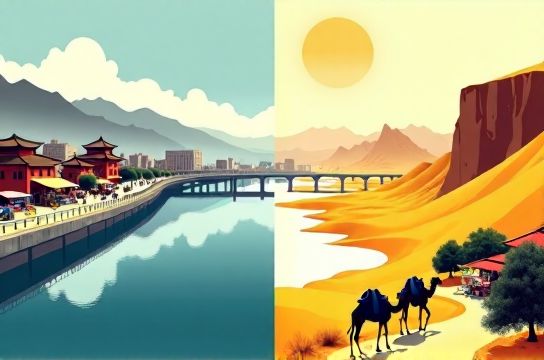
Lanzhou and Dunhuang sit 1,150 km apart on Gansu Province’s westward arc — connected by the Silk Road, the Yellow River, and centuries of migration — yet they operate in entirely different atmospheric pressures. One is a working-class industrial hub where the Yellow River cuts through loess hills; the other is a remote oasis town where sand dunes swallow train tracks at dusk. If you’re weighing them for a China itinerary — especially as part of a broader Gansu or Silk Road route — this isn’t just ‘which city has better hotels?’ It’s about choosing between immersion in layered, contested urban life versus curated cultural preservation in near-isolation.
Neither fits the Beijing–Shanghai binary of ‘modern vs traditional’. Both are deeply traditional — yet neither performs tradition for tourists. Lanzhou’s authenticity is loud, greasy, and unapologetically functional. Dunhuang’s is hushed, archaeological, and institutionally mediated. Let’s break it down across five operational dimensions: geography & access, cultural texture, food systems, tourism infrastructure, and realistic itinerary integration.
H2: Geography & Access — River Crossroads vs Desert Threshold
Lanzhou is China’s only provincial capital bisected by the Yellow River. Its airport (LHW) handles 14.2 million passengers annually (Updated: June 2026), with direct flights from Beijing, Xi’an, Chengdu, and Ürümqi. High-speed rail links it to Xi’an (3h 45m) and Xining (1h 10m). Within the city, traffic is dense but predictable — buses, metro (Lines 1 and 2), and Didi work reliably. The riverfront promenade is walkable, lined with street vendors selling roasted sweet potatoes and plastic stools for watching cargo barges inch upstream.
Dunhuang (DNH) is a single-runway regional airport serving ~1.8 million passengers/year (Updated: June 2026). Most international visitors arrive via connecting flight through Xi’an or Lanzhou — adding 2–3 hours minimum. There’s no high-speed rail yet; the conventional rail line from Lanzhou takes 12h 20m (K-series trains). Once there, transport is limited: one public bus line (No. 3), shared minivans to Mogao Caves (¥15), and pre-booked private drivers (¥300–¥450/day). No metro. No bike-share. No Uber. You either rent a car (requires Chinese license or local driver) or accept logistical friction.
This asymmetry dictates everything. Lanzhou works as a transit hub or 2–3-day base for Hexi Corridor day trips (Bingling Temple, Liujiaping). Dunhuang demands commitment: minimum 3 nights if you want to absorb Mogao, Crescent Lake, and the Singing Sand Dunes without rushing — and that assumes perfect weather (sandstorms close sites 12–18 days/year on average).
H2: Cultural Texture — Living Layers vs Curated Fragments
Lanzhou’s culture is transactional, interethnic, and in motion. Over 30% of its 4.4 million residents are Hui Muslim — visible in the 370+ mosques, halal-certified pharmacies, and the fact that nearly every neighborhood bakery sells sesame-crusted mutton buns alongside steamed mantou. Tibetan traders from Gannan bring medicinal herbs to the Xiguan Market; Uyghur merchants sell dried apricots and hand-embroidered skullcaps near the railway station. There’s no ‘cultural district’ — culture is the sidewalk, the bus stop, the late-night noodle stall where elders debate Qinghai hydropower policy over vinegar-doused liangpi.
Dunhuang’s culture is preserved, interpreted, and partially reconstituted. The Mogao Caves — UNESCO site since 1987 — are managed by the Dunhuang Academy, which restricts daily visitor numbers (6,000 max, tickets sold online only) and mandates guided tours for most caves. Local Han, Uyghur, and Mongol communities live in the town center, but their daily rhythms rarely intersect with tourist circuits. The night market sells replica Tang dynasty hairpins and camel-hide keychains — not ancestral crafts. That said, real continuity exists: the Dunhuang Music and Dance Troupe still rehearses ancient pipa scores using reconstructed instruments; local Uyghur families host homestays outside town where you’ll eat hand-pulled laghman while listening to muqam melodies on a rawhide tanbur.
Neither is ‘more authentic’. Lanzhou offers unmediated coexistence; Dunhuang offers deep-dive curation. Choose based on whether you want to witness culture as infrastructure (Lanzhou) or as artifact + living echo (Dunhuang).
H2: Food Systems — Noodle Density vs Oasis Ingenuity
Lanzhou is globally famous for *Lanzhou lamian* — hand-pulled beef noodle soup. But reduce it to that, and you miss the ecosystem. Real lamian isn’t restaurant fare — it’s a 5am ritual at stalls like Ma Zi Qiang (founded 1925) where chefs stretch dough into 32-strand ribbons in under 90 seconds. Broth simmers for 18 hours with beef bones, rock sugar, and star anise — never MSG. What’s less known: the city’s fermented foods. *Suan cai* (pickled mustard greens) from nearby Baiyin province ferments in clay jars for 6 months, sold by weight at Donggang Market. And *gao liang jiu*, a clear sorghum spirit (52% ABV), is sipped neat after meals — not as a shot, but as digestive punctuation.
Dunhuang’s cuisine reflects scarcity and adaptation. With <50mm annual rainfall, agriculture relies on meltwater from the Qilian Mountains. Local staples include *sha mo bing* (sand-moistened millet flatbread, baked in sand pits), *luo tuo nai yu* (camel milk yogurt — tart, viscous, served with wild goji berries), and *dun huang rou* (braised lamb with dried apricots and cumin, slow-cooked in sealed earthenware). There’s no ‘signature dish’ — instead, seasonal shifts dictate menus: apricot season (June–July) means apricot-stuffed dumplings; autumn brings roasted pheasant with wild mushrooms from the northern foothills.
Both cities face modernization pressure. In Lanzhou, chain lamian outlets now use frozen dough and powdered broth base — detectable by the absence of surface oil sheen and overly uniform strand thickness. In Dunhuang, homestay kitchens increasingly substitute imported dairy for camel milk due to supply volatility. Know what you’re paying for: ¥28 at a mall lamian spot buys speed, not craft; ¥120 for a ‘camel milk tasting’ at a hotel may be reconstituted powder.
H2: Tourism Infrastructure — Utility vs Ritual
Lanzhou’s tourism apparatus serves function first. The Gansu Provincial Museum (free, ID required) houses the iconic ‘Flying Horse of Gansu’ — but its signage is sparse in English, and audio guides cost ¥30 (no app option). Hotels cluster near the river: budget options like 7 Days Inn (¥180/night) offer clean rooms and Wi-Fi but zero cultural programming. Mid-range (e.g., Sheraton Lanzhou, ¥520/night) includes Silk Road-themed afternoon tea — but it’s generic jasmine pearls and almond cookies, not historically sourced.
Dunhuang’s infrastructure orbits ritual. The Dunhuang Academy runs mandatory pre-visit orientation (45 mins, included in ticket) explaining conservation protocols before cave entry. The new Mogao Digital Center (opened 2024) uses 8K projection to simulate cave interiors — essential during sandstorm closures. Accommodations lean boutique: The Mingsha Hostel (¥260/night) offers calligraphy workshops; The Dunhuang International Hotel (¥780/night) provides free shuttle + guided sunrise at Crescent Lake. Wi-Fi is reliable town-wide, but mobile data drops off 10km outside Dunhuang — critical for navigation apps.
Crucially: Dunhuang enforces silence in caves (no talking, no flash, no backpacks >20L). Lanzhou has no such rules — you’ll hear construction drills next to the Zhongshan Bridge and kids yelling at riverside basketball courts. Decide which environment suits your travel temperament.
H2: Realistic Itinerary Integration — Where They Fit (and Don’t)
Don’t force Lanzhou and Dunhuang into a single 5-day ‘Gansu Express’. That’s how you spend 22 hours on trains eating instant noodles. Instead, anchor around purpose:
• If your priority is Silk Road archaeology + Buddhist art: Fly Lanzhou → Dunhuang (1h 15m flight), base in Dunhuang 4 nights, then fly out from Dunhuang. Skip Lanzhou unless you have ≥3 extra days.
• If you’re doing a full Hexi Corridor loop (Zhangye → Jiayuguan → Dunhuang): Enter via Lanzhou, take overnight train to Zhangye (6h), then continue west. Use Lanzhou only as arrival/departure — no need to stay.
• If you seek urban complexity + minority culture + river landscapes: Spend 3 nights in Lanzhou, day-trip to Bingling Temple Grottoes (2h round-trip), then add 2 nights in Linxia (Hui cultural capital, 2h south) — skip Dunhuang entirely.
The common mistake? Assuming Dunhuang is ‘the highlight’, so you rush Lanzhou. Truth: Lanzhou reveals how Silk Road legacies actually function today — in halal butcher shops, freight terminals, and bilingual schoolyards. Dunhuang shows how they’re remembered.
H2: Comparative Decision Framework
Below is a side-by-side comparison of operational realities — not subjective ‘vibes’, but measurable factors affecting your actual trip.
| Factor | Lanzhou | Dunhuang |
|---|---|---|
| Airport passenger volume (2026) | 14.2 million | 1.8 million |
| Max daily Mogao Cave visitors | N/A | 6,000 (online booking only) |
| Avg. sandstorm days/year | 3–5 | 12–18 |
| Halal-certified restaurants (verified) | 372 (Gansu Tourism Bureau, Updated: June 2026) | 47 (Dunhuang Municipal Commerce Bureau, Updated: June 2026) |
| Public transport coverage (km²) | 210 km² (metro + 120 bus routes) | 12 km² (1 bus line, 3 minivan routes) |
| Typical lamian price (authentic stall) | ¥12–¥15 (includes broth, noodles, beef, chili oil) | ¥22–¥28 (often uses pre-made broth) |
H2: Final Recommendation — Not ‘Which Is Better’, But ‘Which Fits Your Travel Logic’
There is no ‘best’ city here — only best alignment. Ask yourself:
• Are you traveling solo or with elders/kids? Lanzhou wins on medical infrastructure (3 Class-3 hospitals), pharmacy density, and predictable transport.
• Do you prioritize photography, quiet contemplation, or museum-grade artifacts? Dunhuang is non-negotiable — but book Mogao tickets 72h in advance and confirm cave access status daily via the official WeChat account ‘Dunhuang Academy’.
• Are you researching ethnic economics, food supply chains, or urban policy? Lanzhou delivers fieldwork-grade access — visit the Xiguan Wholesale Market at 4am, talk to Hui spice merchants, trace goji berry logistics from Ningxia to packaging plants in Anning District.
• Is this your first China trip? Start with Lanzhou. Its rhythms are legible — river, rail, road, market — and it builds confidence for deeper regional exploration. Dunhuang rewards prior context; arriving cold risks mistaking curation for spontaneity.
Both cities challenge the ‘China as monolith’ trope — not through spectacle, but through stubborn, unglamorous specificity. Lanzhou’s Yellow River doesn’t glitter; it carries silt, sediment, and the exhaust of diesel trucks. Dunhuang’s desert isn’t empty; it’s full of buried manuscripts, migrating sand, and the low hum of conservation labs digitizing 1,200-year-old sutras.
For travelers who want to go beyond the checklist — who ask not just ‘what to see’ but ‘how it works’ — these two cities form a necessary dialectic. One flows. One holds still. Both demand attention on their own terms.
If you're assembling a custom Silk Road itinerary with grounded logistics, local fixers, and ethical site access, our full resource hub provides vetted contacts, seasonal access calendars, and bilingual briefing kits — all updated monthly. Visit / for the latest verified field notes and booking protocols.