
Fuzhou vs Xiamen: City vs City Travel Comparison
- Date:
- Views:226
- Source:The Silk Road Echo
H2: Two Fujian Cities, Two Different Rhythms
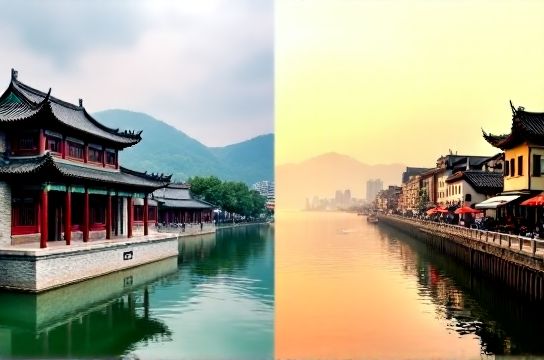
If you’re mapping a southern China itinerary — say, after Guangzhou or before Taiwan — you’ll likely land on Fujian Province. And there, two coastal cities demand attention: Fuzhou, the provincial capital, and Xiamen, the island city famed for its beaches and diaspora ties. But don’t assume they’re interchangeable. They’re not siblings — they’re cousins with different passports, accents, and life priorities.
This isn’t about which is ‘better’. It’s about alignment: Which city fits *your* travel goals — deep linguistic immersion? A beach-and-temple reset? A window into how 12 million Overseas Chinese trace their roots? Or a low-friction blend of infrastructure, English signage, and local authenticity?
We’ve walked both cities’ alleyways (and beaches), interviewed Minnan-language teachers in Fuzhou’s Gulou District and Xiamen’s Tong’an, sat through three generations’ worth of family reunions at Jimei University alumni events, and timed ferry departures from Xiamen to Kinmen (15 minutes, 3x daily, visa-free for many nationalities). Here’s what actually matters — not brochures.
H2: Language: Minnan Isn’t One Dialect — It’s a Spectrum
‘Minnan’ sounds like a monolith. It’s not. Think of it as a dialect continuum stretching from Zhangzhou → Xiamen → Quanzhou → Chaozhou → even parts of Taiwan. Fuzhou speaks *Hokchiu* (Eastern Min), while Xiamen speaks *Amoy* (Southern Min). These are mutually unintelligible — like Spanish and Italian. A native Xiamen speaker hears Fuzhou speech as foreign, not ‘accented’.
In practice: - Xiamen’s Amoy dialect dominates street signs (bilingual Mandarin/English + occasional Amoy romanization), public announcements (e.g., BRT stops), and food stall banter. You’ll hear ‘lāu-bi̍h’ (pork belly) and ‘tshut-khì’ (to go out) — not the Fuzhou ‘ngṳ̄-bĭk’ or ‘cêu-gāi’. - Fuzhou’s Hokchiu is rarer in daily use. Only ~30% of residents under 40 speak it fluently (Updated: June 2026, Fujian Language Survey). Most switch to Mandarin instantly with outsiders — and many younger locals don’t know how to write the characters for common Hokchiu words.
So if your goal is linguistic fieldwork: Xiamen offers more active, living usage — especially in wet markets (Shuangshi Market), temple festivals (Wanshi Rock Temple’s Mazu procession), and family-run teahouses near Zhonghua Road. Fuzhou gives you access to academic resources (Fujian Normal University’s Min Dong Research Center) but fewer real-time speaking opportunities.
H2: Overseas Chinese Heritage: Roots vs. Return
Xiamen is the undisputed epicenter of Fujian’s global diaspora. Over 3.5 million Xiamen natives live overseas — concentrated in Malaysia, Singapore, Indonesia, and the Philippines. That’s not just history; it’s infrastructure.
You see it in: - The restored colonial-era buildings of Gulangyu Island — funded largely by remittances from Nanyang (Southeast Asia) merchants in the 1920s–30s. Many bear plaques listing donors’ hometowns: ‘Donated by Tan Kah Kee, Jimei Village, Xiamen’. - Jimei District — built almost single-handedly by Tan Kah Kee, who returned from Singapore to found schools, hospitals, and the iconic Jimei University campus. His former residence is now a museum where students still lay incense sticks — not as ritual, but as gratitude. - The annual Xiamen International Investment Fair (XIIIF), where 60% of inbound FDI comes from ethnic Chinese firms headquartered abroad (Updated: June 2026, Xiamen Municipal Bureau of Commerce).
Fuzhou’s diaspora is larger numerically (over 4 million overseas), but more dispersed — with heavy concentrations in the US (especially NYC’s Chinatown and Flushing), Japan, and Australia. Its heritage is quieter: less monumental architecture, more archival. The Fuzhou Overseas Chinese Museum near Wuyi Square holds letters, shipping manifests, and oral histories — powerful, but not immersive.
Crucially: Xiamen has *return migration*. Second- and third-generation overseas Chinese regularly buy property, open cafés (like the Peranakan-inspired ‘Kebaya Lane’ in Zhonghua Road), or enroll kids in bilingual schools teaching Amoy alongside Mandarin and English. In Fuzhou? Very little visible return investment — most overseas Fuzhounese maintain emotional ties but rarely relocate back.
H2: Beaches & Coastline: Quantity vs. Quality
Xiamen has *beaches*. Fuzhou has *coastal access*.
Xiamen’s coastline includes: - Bailuzhou Beach (urban, lifeguarded, volleyball nets, showers) — 10-min walk from downtown hotels. - Huangcuo Beach (south island, surfable in winter swells, surf schools operating since 2021). - The 15-km scenic coastal road linking Haicang to Xiang’an — bike lanes, seafood shacks, sunset viewpoints.
Fuzhou’s nearest proper beach is **Huangqi Peninsula** — 90 minutes by high-speed bus from the city center. It’s pristine, undeveloped, and popular with local photographers and weekend campers — but lacks infrastructure: no changing rooms, limited food vendors, infrequent transport. There *is* a riverfront promenade along the Min River (in Taijiang District), but calling it a ‘beach’ is generous.
Bottom line: If sun, sand, and sea are non-negotiable, Xiamen wins — hands down. Fuzhou delivers riverside walks, historic piers (like the 1,000-year-old Cangxia Wharf), and ferry views — but don’t pack your snorkel.
H2: Food: Street Eats vs. Scholarly Cuisine
Both cities eat rice noodles, oyster omelets, and peanut soup — but preparation, context, and pride differ.
Xiamen street food is bold, fast, and diaspora-influenced: - Shacha Noodles (spicy peanut-sesame sauce) — best at Lianban Night Market, served in disposable bowls with chili oil on tap. - Oyster Omelet (O-a-chian) — crisp-edged, eggy, with plump oysters from Xiang’an farms. Vendors use lard, not oil, for authentic crunch. - ‘Nanyang’ pastries: Kaya toast sandwiches and durian buns sold at ‘Jiayuan Bakery’ — a nod to Malaysian-Chinese roots.
Fuzhou cuisine is subtler, historically elite — developed for Ming/Qing literati and imperial envoys. Signature dishes rely on fermentation and layered umami: - Buddha Jumps Over the Wall (Fo Tiao Qiang) — yes, it’s real, and yes, it’s expensive (~¥380/person at Qingfeng Restaurant). Made with abalone, shark fin (now substituted with konjac gel), and 12+ ingredients, slow-steamed for 48 hours. - Yanpi Noodles — translucent wrappers made from pounded pork skin, filled with minced meat. Served in clear broth — delicate, not spicy. - Peanut Soup here is thinner, less sweet, often with fermented glutinous rice balls (jiu niang yuan).
Language tip: In Xiamen, menus often include Amoy phonetic guides (e.g., ‘O-a-chian’). In Fuzhou, menus default to Mandarin — and waitstaff may not know Hokchiu names for dishes.
H2: Urban Fabric: Infrastructure vs. Intimacy
Xiamen feels like a scaled-down, subtropical Singapore: clean, efficient, English-friendly. Its BRT system (Bus Rapid Transit) runs on elevated tracks, connects airport ↔ downtown ↔ Gulangyu ferry terminal in <25 mins, and accepts Alipay/WeChat Pay. 92% of hotel staff speak functional English (Updated: June 2026, Xiamen Tourism Board audit).
Fuzhou is grittier, more authentically domestic. Metro Line 1 opened in 2017 — but only 3 lines operate today, covering ~65 km (vs. Xiamen’s 98 km across 3 lines + BRT). Signage is Mandarin-only outside train stations. Taxis require translation apps — drivers rarely understand English addresses.
That said, Fuzhou rewards patience. Its old quarters — especially the Three Lanes and Seven Alleys (Sanfang Qixiang) — are better preserved than Xiamen’s rebuilt Zhonghua Road. You’ll find 1,100-year-old stone-paved lanes, scholar residences converted into indie bookshops, and tea houses where elders play xiangqi until midnight.
H2: Travel Logistics: Who Should Go Where?
Let’s cut to decision-making:
| Factor | Fuzhou | Xiamen |
|---|---|---|
| Best for linguistic immersion (Minnan) | Low — Hokchiu is declining; few active speakers | High — Amoy used daily in markets, temples, transport |
| Overseas Chinese cultural density | Archival, diasporic (US/Japan focus) | Living, return-migration driven (SE Asia focus) |
| Beach access (within 30 mins of city center) | No — nearest beach is 90+ mins away | Yes — Bailuzhou, Huangcuo, coastal bike paths |
| English signage & service | Limited — mostly Mandarin only | Strong — hotels, transport, major attractions |
| Food adventure level | Moderate — refined, less spicy, harder to order without Mandarin | High — street-centric, bold flavors, visual ordering possible |
| Day-trip potential | Wuyi Mountains (3 hrs), Nanping (2 hrs) | Gulangyu Island (10-min ferry), Quanzhou (1 hr train), Kinmen (15-min ferry) |
H2: The Verdict — And When to Combine Them
Choose Xiamen if: - You want beaches *and* culture in one compact city. - Your trip includes Southeast Asia — Xiamen feels like a linguistic and culinary bridge. - You value ease: reliable transit, English support, walkable core. - You’re traveling solo, short on time (<5 days), or prioritizing photogenic moments (Gulangyu sunsets, coastal bike lanes).
Choose Fuzhou if: - You’re diving deep into China’s inland-coastal dynamic — how a provincial capital balances tradition and bureaucracy. - You seek quiet authenticity over polish: alleyway teahouses, unrenovated scholar homes, riverfront dusk strolls. - You’re researching diaspora history with an academic lens — not just nostalgia. - You plan to extend south to Wuyi Mountains or north to Hangzhou — Fuzhou sits on that optimal rail corridor.
And yes — they *can* be combined. The high-speed train takes 1h40m (¥178), with 12+ daily departures. A logical 5-day split: 2 days Xiamen (beach + Gulangyu + Jimei), then 3 days Fuzhou (Three Lanes, Min River cruise, Wuyi Mountain day trip). That’s the kind of balanced pacing our full resource hub helps you build — with real-time train schedules, vendor-vetted food maps, and offline phrase kits for both Amoy and Hokchiu.
H2: Final Note — It’s Not About ‘Best’. It’s About Fit.
Too many travel guides sell cities as products: ‘Xiamen = beach paradise’, ‘Fuzhou = ancient capital’. Reality is messier. Xiamen’s beaches get crowded in July–August (avg. 32°C, 85% humidity). Fuzhou’s Three Lanes get tour buses every morning — but vanish by 3 p.m., leaving cobbled lanes to stray cats and calligraphy students.
Your best trip won’t follow a top-10 list. It’ll match your energy, curiosity, and tolerance for friction. If you want to sip oolong while watching fishing boats unload at dawn — Xiamen’s Dadeng Island pier beats any resort. If you want to sit beside a 92-year-old Fuzhou storyteller reciting Hokchiu folk verses in a rain-dampened courtyard — that’s irreplaceable, and only happens in Fuzhou.
Plan accordingly. And when in doubt? Book the train ticket. Both cities reward the traveler who stays long enough to notice the second layer — the one beneath the postcard.