
Hefei vs Nanjing: Emerging Tech Hub Versus Ancient Capital
- Date:
- Views:180
- Source:The Silk Road Echo
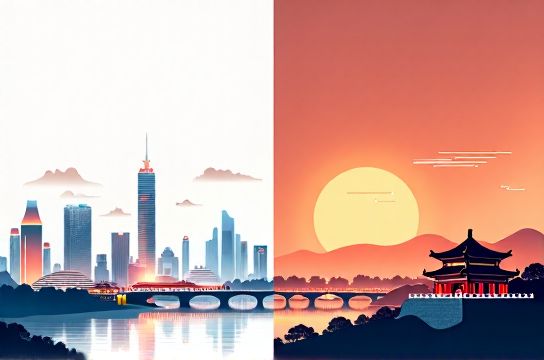
Hefei and Nanjing sit just 180 km apart on China’s eastern corridor — close enough for a high-speed rail day trip (1h 12m on G-trains), yet worlds apart in identity. One is a deliberate, state-backed engine of semiconductor R&D and quantum computing; the other breathes 1,800 years of imperial memory into every alleyway and stone tablet. If you’re weighing which city to prioritize on a 5–7-day Jiangsu–Anhui itinerary — or deciding where to base for a deeper dive into China’s dual-track evolution — this isn’t about picking ‘better’. It’s about matching the city’s rhythm to your travel intent: acceleration or reflection.
Why This Pair Matters Now
Nanjing anchors China’s cultural memory — capital of six dynasties, site of the Ming Xiaoling Mausoleum, and home to the Nanjing Museum (China’s second-largest by collection size, with 430,000+ artifacts). Hefei, meanwhile, has quietly become China’s most concentrated hub for quantum information science: home to the University of Science and Technology of China (USTC), the Hefei National Laboratory for Physical Sciences at Microscale, and over 120 quantum-related enterprises as of 2025 (Updated: June 2026). Unlike Shenzhen or Beijing, Hefei didn’t grow organically from manufacturing or policy arbitrage — it was engineered, with provincial investment exceeding ¥28 billion ($3.9B) in R&D subsidies between 2021–2025 alone.That contrast defines the traveler’s dilemma: Do you want to stand beneath the glazed tiles of the Porcelain Tower’s reconstructed base (a 2015 recreation of the Ming-era wonder destroyed in 1856), or walk through the USTC Quantum Lab’s public exhibition wing — where real-time entanglement demonstrations run every afternoon?
Heritage & Urban Fabric: Layered vs. Linear
Nanjing’s urban grain is dense, vertical, and historically contested. The city walls — the longest surviving ancient city wall in the world at 25.1 km — still enclose the core. Within them lie Confucius Temple (Fuzimiao), the Qinhuai River’s lantern-lit night cruises, and the sobering Nanjing Massacre Memorial Hall — a necessary, emotionally demanding stop that reshapes how visitors understand 20th-century Chinese history. Even newer districts like Xuanwu Lake Park integrate Ming-era pavilions with lakeside cycling paths and AI-powered visitor kiosks — tradition not preserved in amber, but actively recontextualized.Hefei’s historic core is smaller and less continuously inhabited. The old city wall fragments are preserved near Zhongmendajie, but most pre-1949 structures were lost during mid-20th century redevelopment. What remains — the Bao Gong Temple (dedicated to the Song-dynasty anti-corruption official Bao Zheng), and the nearby Shaomu Park — serves more as civic punctuation than immersive heritage. Instead, Hefei invests in *future-facing* landmarks: the Hefei Binhu Science City masterplan (22 sq km, fully wired for 5G+ IoT), the new Anhui Science Center (opened 2024, with interactive quantum and AI galleries), and the USTC East Campus — where undergraduates debug photonic chips beside centuries-old camphor trees.
For travelers seeking layered historical immersion — especially around imperial administration, Confucian ritual, and 20th-century trauma/resilience — Nanjing delivers depth per square meter. Hefei rewards curiosity about *how* China builds tomorrow’s infrastructure today — not as a glossy expo, but as lived-in urban policy.
Gastronomy: Riverine Refinement vs. Huaiyang Precision
Both cities sit within the broader Huaiyang culinary sphere — one of China’s Four Great Traditions — but execute it with distinct inflections.Nanjing’s food culture carries imperial weight and riverine pragmatism. Nanjing salted duck (Yan Shui Ya) is the undisputed icon: brined, air-dried, then poached — tender, saline, deeply aromatic. It’s served cold, often with pickled mustard tuber (xuecai) and steamed buns. Street eats reflect its port-city past: Guihua Tangyuan (osmanthus-scented glutinous rice balls in sweet syrup) sold near Confucius Temple, and Shengjianbao (pan-fried pork buns with crisp bottoms) from hole-in-the-wall stalls in the Old South Gate area. The city also pioneered nanjing-style wonton noodles, featuring delicate, translucent wrappers folded with precision and served in clear, chicken-based broth.
Hefei’s food is less internationally recognized but equally rigorous. Its signature is Hefei stinky mandarin fish (Chou Guiyu) — fermented for 3–5 days, then steamed with ginger and scallions. Don’t let the aroma deter you: the flesh is firm, clean, and umami-rich. More approachable is Li Hongzhang hotchpotch (Lihongzhang Zazhu), a Qing-era banquet dish named after the Hefei-born statesman — a stew of abalone, sea cucumber, ham, bamboo shoots, and mushrooms, slow-cooked until gelatinous. Local breakfast culture revolves around shao bing (sesame-crusted baked flatbreads) stuffed with spiced lamb or scallion-egg, best eaten fresh from clay ovens in the Lao Cheng district.
Where Nanjing offers theatrical, riverside dining with centuries-old recipes codified in imperial cookbooks, Hefei presents food as regional craft — subtle, technique-driven, and less mediated for tourism. Both reward eating early and locally: Nanjing’s best duck comes from family-run shops near Nanjing South Railway Station (e.g., Jinling Salted Duck); Hefei’s top shao bing vendors operate only until 10:30 a.m. near the Bao Gong Temple entrance.
Transit, Walkability & Practical Logistics
Nanjing operates a mature, multimodal system: Metro Line 3 connects Nanjing South Station to Confucius Temple in 22 minutes; Line 4 loops past Nanjing University and Xuanwu Lake; all stations feature English signage, QR-code wayfinding, and NFC compatibility with Alipay/WeChat Pay. The historic core (Fuzimiao–Qinhuai–Zhonghua Gate) is highly walkable — but summer humidity (July avg. 32°C, 78% RH) makes shaded alleys and riverfront promenades essential. Taxis are abundant and affordable (¥13 base fare, ¥2.8/km after 3 km).Hefei’s metro is younger (Line 1 opened 2016; now 5 lines operational), but rapidly expanding. Key gaps remain: USTC’s main campus is 2.4 km from the nearest station (USTC Station, Line 3), requiring bus transfer or Didi. That said, Hefei’s bike-share ecosystem is superior — over 85,000 shared e-bikes (Hello Bike, Meituan) with dedicated parking zones near labs and universities. For tech-focused travelers, Hefei’s advantage is logistical density: 92% of quantum startups cluster within 5 km of USTC’s East Campus — meaning you can visit three R&D centers, lunch at a university canteen, and tour the Anhui Science Center in one compact afternoon.
Tourist Infrastructure: Experience Design vs. Functional Access
Nanjing leads in curated cultural experiences. The Nanjing Museum offers free timed-entry tickets (bookable 3 days ahead via WeChat mini-program), with English audio guides covering Ming porcelain, jade carving, and Republican-era calligraphy. The Presidential Palace complex includes bilingual docent-led tours (¥30, 45 mins) explaining its dual role as Qing governor’s office and ROC seat of power. Night markets along Qinhuai River operate daily 5–11 p.m., with live kunqu opera snippets and ink-brush customization stalls.Hefei’s tourist infrastructure prioritizes access over narration. The Anhui Science Center charges ¥60 entry, but includes hands-on quantum labs, VR fusion reactor simulations, and open lab observation windows (with prior email registration required 72h in advance). There’s no English audio guide — instead, multilingual staff rotate hourly shifts, and explanatory panels use simplified diagrams + QR codes linking to English video explainers. It’s less ‘museum’ and more ‘working interface’. Similarly, USTC’s public exhibitions don’t require academic affiliation — but do require ID registration at the gate and adherence to lab safety protocols (no large bags, mandatory shoe covers in cleanroom zones).
The Traveler Decision Matrix
Who should choose Nanjing? Prioritize if: • You seek canonical Chinese history — imperial, republican, wartime, and post-1949 layers — in physical, walkable form. • Your group includes teens or elders who benefit from polished infrastructure, English support, and varied pacing (temple quiet → river cruise → museum deep dive). • You want strong regional food variety with immediate accessibility (no reservations needed for top street eats).Who should choose Hefei? Prioritize if: • You’re professionally adjacent to STEM fields (engineering, physics, computer science) and want authentic exposure to China’s quantum ecosystem — not just PR tours. • You value low crowds, functional efficiency, and the chance to observe urban planning as active policy (e.g., how Binhu Science City integrates housing, labs, and green corridors). • You’re comfortable navigating systems with limited English interfaces — and see that as part of the learning.
Can You Do Both? Yes — But Strategically
A 3-night / 4-day split works well: 2 nights Nanjing (arrival + heritage immersion), 1 night Hefei (day trip or overnight for lab access + local food). High-speed rail runs every 12–15 minutes 6 a.m.–10 p.m.; tickets cost ¥112–¥148 depending on class (Updated: June 2026). Book via 12306.cn or Trip.com — avoid third-party resellers for same-day bookings due to ID verification delays.The biggest scheduling constraint isn’t distance — it’s access. Nanjing’s top museums require advance booking; Hefei’s labs require 72-hour registration. Plan your Nanjing museum slots first, then align Hefei visits around confirmed lab availability. Also note: Nanjing’s summer heat peaks July–August; Hefei’s spring (April–May) offers ideal lab-tour weather and blooming magnolias on USTC’s campus.
| Feature | Nanjing | Hefei |
|---|---|---|
| Core Identity | Ancient capital, cultural repository, historical crossroads | State-built science city, quantum & AI infrastructure hub |
| Top Heritage Site | Ming Xiaoling Mausoleum (UNESCO) | Bao Gong Temple (Song-dynasty memorial) |
| Signature Food | Nanjing salted duck (Yan Shui Ya) | Hefei stinky mandarin fish (Chou Guiyu) |
| Key Tech Access | Nanjing University AI Lab (public lecture series, monthly) | USTC Quantum Lab (daily demos, registration required) |
| Walkability (Historic Core) | ★★★★☆ (Fuzimiao–Qinhuai zone highly pedestrian) | ★★★☆☆ (Old South Gate compact but fewer continuous sights) |
| English Support Level | ★★★★★ (Museums, metro, major hotels) | ★★★☆☆ (Science Center staff rotate; labs rely on bilingual grad students) |
| Ideal Trip Duration | 3–4 days minimum for full context | 1–2 days sufficient for focused immersion |
Final Recommendation: Match Purpose, Not Prestige
Neither city is ‘best’ — they serve different functions in China’s national narrative. Nanjing answers the question: *How did we get here?* Hefei asks: *What do we build next — and how do we govern it?*If your trip centers on understanding China’s civilizational continuity — architecture, cuisine, ritual, memory — Nanjing is non-negotiable. If you’re probing how China executes long-term technological sovereignty — not as theory, but in silicon wafers, cryogenic rigs, and zoning ordinances — Hefei delivers unmatched granularity. And if you’re undecided, start with our complete setup guide for multi-city China itineraries — including intercity rail hacks, bilingual phrase cheat sheets, and real-time lab registration workflows (Updated: June 2026). Because the most valuable comparisons aren’t about ranking cities — they’re about aligning place with purpose.