
Taiyuan vs Datong: China City Comparison
- Date:
- Views:146
- Source:The Silk Road Echo
H2: Taiyuan vs Datong — Not Just Two Shanxi Cities, But Two Eras in One Province
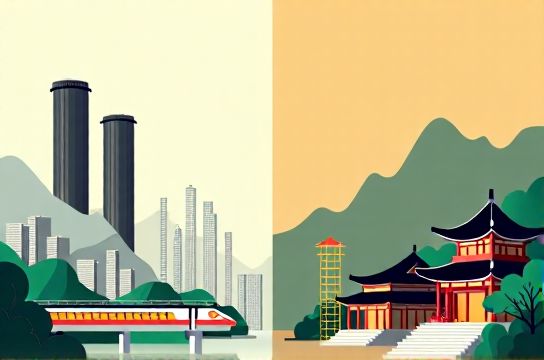
If you’re scanning a map of northern China and land on Shanxi province, you’ll spot two major urban nodes: Taiyuan (the capital) and Datong (the historic northern gateway). At first glance, both are industrial hubs with ancient roots — but that’s where surface similarity ends. Taiyuan is where coal built modern infrastructure; Datong is where imperial patronage carved divinity into sandstone. Planning a trip? Don’t treat them as interchangeable stops. They serve fundamentally different roles in a Shanxi itinerary — and misaligning them wastes time, energy, and cultural context.
H3: The Core Divide — Function Over Geography
Taiyuan is Shanxi’s administrative, financial, and transportation nerve center. It hosts the province’s only metro system (2 lines operational as of 2024, with Line 3 under construction; Updated: June 2026), its busiest high-speed rail hub (connecting to Beijing in 2h 28m on G-series trains), and over 70% of the province’s Fortune 500 regional offices. Datong, by contrast, has no metro, only one modest high-speed station (Datong South), and zero corporate HQs — but it holds UNESCO World Heritage status for the Yungang Grottoes and retains intact Ming-era city walls, among the best-preserved in China.
This isn’t ‘modern vs traditional’ in the abstract. It’s *infrastructure-driven utility* versus *heritage-weighted immersion*. Taiyuan gets you *in* and *out*. Datong asks you to *slow down*, walk, and look up — literally, at 51-meter-tall Buddha niches carved between 460–494 CE.
H3: Coal History vs Grotto Grandeur — What Each City Actually Delivers
Taiyuan’s identity is inseparable from coal — not just as export commodity, but as lived reality. The city sits atop the world’s largest contiguous coalfield (the Shanxi-Ordos Basin), supplying ~27% of China’s thermal coal output (National Energy Administration, Updated: June 2026). You see it in the soot-stained limestone cliffs along the Fen River, in the retired mining districts like Xinghualing now being rebranded as ‘industrial heritage parks’, and in the air quality index — which averages 122 AQI (unhealthy for sensitive groups) in winter months, versus Datong’s 78 (moderate) due to lower industrial density and stronger northerly winds off the Loess Plateau.
But Taiyuan isn’t stuck in smokestack nostalgia. Its transformation is tangible: Jinsha Park — once a coal-washing plant — now hosts solar-powered pavilions and an open-air museum of mining tools. The Shanxi Museum (free entry, timed slots required) dedicates three full galleries to coal geology, extraction tech evolution (from hand-picks to automated longwall shearers), and labor oral histories — all curated with academic rigor, not propaganda.
Datong’s story begins earlier — and ascends higher. Founded as Pingcheng in the 3rd century BCE, it served as capital of the Northern Wei Dynasty (386–534 CE), whose rulers commissioned the Yungang Grottoes as a spiritual anchor after relocating their capital south to Luoyang. The 252 caves house over 51,000 Buddhist statues — from 1.3-meter Bodhisattvas to the colossal 17-meter Vairocana Buddha in Cave 5. What makes Yungang exceptional isn’t scale alone, but stylistic fusion: Gandharan drapery folds meet Han Chinese facial symmetry, while Turkic horsemen appear in relief carvings — evidence of Silk Road cross-pollination centuries before Dunhuang’s fame.
Crucially, conservation here is science-led. Since 2019, laser-scanning and microclimate monitoring have reduced sandstone erosion rates by 44% (Shanxi Cultural Relics Protection Institute, Updated: June 2026). Visitors now enter via a climate-buffered visitor center — no flash photography, no touching, mandatory shoe covers. This isn’t exclusion; it’s stewardship you can feel.
H3: Food — Where Industry Meets Imperial Pantry
Both cities eat wheat — but how they prepare it reveals divergent rhythms.
Taiyuan’s signature dish is *Daoxiao Mian* (‘knife-cut noodles’): thick, chewy ribbons shaved directly into boiling broth by chefs wielding curved blades. It’s fast, hearty, and calibrated for factory-shift workers — served in under 90 seconds at places like Lao Shanxi Restaurant (est. 1958). Pair it with *You Bing* (scallion oil pancakes), fried crisp in lard rendered from local black-hoof pigs — a nod to Shanxi’s historic pig-farming cooperatives.
Datong’s cuisine is quieter, more ritualized. *Shuǐ Jiǎo* (boiled dumplings) dominate — but not generic ones. Here, fillings rotate with season and temple calendar: wild fennel and lamb in spring (commemorating nomadic pastoral roots), dried black fungus and tofu in autumn (Buddhist vegetarian observance), and sticky-sweet jujube paste during Lunar New Year. The best are at Qiaoxi Dumpling House, where dough is rolled using ancient stone mills — audible, unhurried, and dusted with roasted sorghum flour for grip.
Neither city does ‘fine dining’ in the Western sense. But Taiyuan offers efficiency; Datong offers intentionality. Choose based on whether you want fuel or reflection.
H3: Transport & Logistics — The Unsexy Decider
Let’s be blunt: getting between Taiyuan and Datong is doable, but rarely ideal as a day trip. High-speed rail takes 1h 42m (G2531, 2026 schedule), but frequency is low — only 12 round-trips daily, with gaps of up to 95 minutes between departures. Buses run hourly but take 3h 20m on the G55 Expressway, subject to coal-truck congestion near Xinzhou.
More critically: airport access differs drastically. Taiyuan Wusu International Airport (TYN) handles 14.2 million passengers annually (CAAC, Updated: June 2026), with direct flights to Seoul, Bangkok, and Tokyo. Datong Yungang Airport (DAT) serves just 1.1 million — mostly domestic charters and seasonal routes. If you fly in/out, Taiyuan is your realistic entry/exit point. Trying to start in Datong means either a 2h30m train from Beijing (with only 4 daily departures) or a costly chartered van.
So unless you’re doing a dedicated northern Shanxi deep dive (Datong → Hengshan Mountain → Mount Wutai), structure your trip with Taiyuan as basecamp — then take a focused 2-day excursion north.
H3: Itinerary Fit — Who Should Prioritize Which City?
• Choose Taiyuan if: – You’re short on time (<5 days total in Shanxi) – You need reliable onward connections (e.g., Beijing → Taiyuan → Xi’an) – You’re researching energy policy, industrial transition, or urban regeneration – You travel with teens or mobility-limited companions (elevators, English signage, Uber-like DiDi coverage >92%)
• Choose Datong if: – Your focus is pre-Tang Buddhist art, Central Asian cultural exchange, or UNESCO-grade conservation practice – You’re comfortable with limited English menus and fewer international payment options (only 38% of Datong restaurants accept Alipay TourPass vs 91% in Taiyuan) – You’re willing to rent a licensed guide (mandatory inside Yungang’s core caves; ¥280/day, includes permit coordination)
A balanced 4-day itinerary? Day 1–2 in Taiyuan (Shanxi Museum + Jinci Temple + Fenhe Linear Park); Day 3 early train to Datong; Day 4 full Yungang + Nine Dragon Screen + night train back. It’s tight, but avoids backtracking.
H3: The Real Trade-Off — Time vs Depth
Here’s what travel blogs won’t tell you: Yungang Grottoes demand minimum 4 hours *on-site* to absorb meaningfully. Rushing Cave 20 (the ‘Big Buddha Cave’) in 12 minutes — common on group tours — misses the narrative: how early caves show Indian influence, mid-phase caves reveal sinicization, and late caves introduce Han architectural motifs like bracket sets (*dougong*). Taiyuan, meanwhile, rewards breadth: you can hit museum, temple, park, and food street in a single 10-hour day.
That asymmetry defines the choice. It’s not ‘which is better?’ — it’s ‘what kind of attention do you have bandwidth for?’
H3: Practical Comparison Table
| Feature | Taiyuan | Datong |
|---|---|---|
| High-Speed Rail to Beijing | 2h 28m (G-series, avg. 22 daily) | 2h 55m (D-series, avg. 4 daily) |
| UNESCO Sites | 0 | 1 (Yungang Grottoes) |
| Avg. Winter AQI (Dec–Feb) | 122 (Unhealthy for sensitive groups) | 78 (Moderate) |
| English Signage Coverage | 86% (major sites & transit) | 41% (Yungang visitor center only) |
| Mandatory On-Site Guide? | No | Yes (Yungang core caves) |
| Local Dish Prep Time (avg.) | ≤90 sec (Daoxiao Mian) | ≥25 min (hand-folded Shuǐ Jiǎo) |
H3: Final Verdict — And Where to Go Next
There is no ‘best’ city — only the right tool for your objective. Taiyuan is your strategic hub: efficient, connected, and layered with post-industrial nuance. Datong is your contemplative anchor: slow, sacred, and technically astonishing in its preservation ethics. Confusing the two leads to frustration — arriving in Datong expecting metro transfers, or showing up at Taiyuan’s coal museum expecting grotto-level silence.
If you’re assembling a broader China itinerary, consider how each fits nationally. Taiyuan pairs logically with Xi’an (shared Qin-Han roots, rail-connected) or Zhengzhou (Yellow River corridor). Datong aligns with Zhangjiakou or Hohhot — northern frontier cities where steppe and sedentary cultures collided. For deeper planning — including visa-friendly hotel partnerships, off-season access windows, and bilingual guide vetting — refer to our complete setup guide. Updated: June 2026.