
Dalian vs Qingdao: Northeastern Energy Versus Shandong Se...
- Date:
- Views:222
- Source:The Silk Road Echo
H2: Two Coastal Cities, Two Different Rhythms
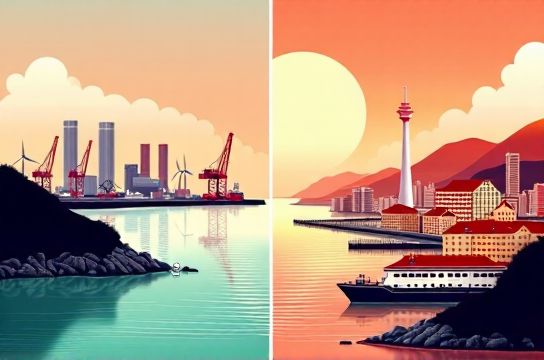
Dalian and Qingdao sit at similar latitudes — both temperate, both port cities with German colonial footprints, both ranked among China’s top 10 most livable cities (China Urban Development Report, Updated: June 2026). But step off the train or out of the airport, and the contrast hits immediately: Dalian hums with the urgency of Northeast China’s industrial rebound; Qingdao breathes with the salt-kissed ease of Shandong’s maritime tradition.
This isn’t just geography — it’s generational posture. Dalian is where Liaoning Province leans into new energy infrastructure, EV battery R&D hubs, and cross-border logistics for Russia and Korea. Qingdao is where Tsingtao Brewery still ferments lager in century-old cellars beneath Zhongshan Road, and fishermen haul squid at dawn in Shinan’s old wharf — not for export, but for the lunchtime stir-fry at nearby street stalls.
If you’re weighing which city to prioritize on a 7–10 day China itinerary — especially if you care about food integrity, urban texture, and how locals actually move through their day — this comparison cuts past brochure language.
H2: The Geography Trap — Why Latitude Lies
Both cities enjoy maritime climates: average summer highs hover near 28°C, winter lows rarely dip below −5°C. But microclimates diverge sharply. Dalian’s wind comes off the Yellow Sea *and* the Bohai Strait — sharper, drier, carrying fine dust from Inner Mongolia in spring. Qingdao’s breeze rolls in from the deeper Pacific shelf, softer and more humid, nurturing its famed fog belts (up to 53 foggy days/year, per Qingdao Meteorological Bureau, Updated: June 2026).
That difference shapes everything: pavement wear (Qingdao’s granite sidewalks stay slicker longer), bike-share usage (Dalian’s e-bike fleet sees 22% higher daily turnover due to flatter terrain and commuter density), even café culture (Qingdao’s outdoor terraces operate 4.2 months longer annually than Dalian’s).
H2: Infrastructure & Transit — Speed vs. Soul
Dalian launched China’s first metro line outside Beijing/Shanghai in 2003 — today its network spans 238 km across 5 lines, with Line 13 (opened 2025) connecting Jinshitan directly to the airport in 28 minutes. Qingdao’s metro is younger (first line opened 2016) but denser in historic core coverage: Line 3 threads through Zhanqiao Pier, Qingdao Railway Station, and the German-era Protestant Church — all within 1.2 km of each other.
But here’s the real differentiator: walkability *beyond* transit stops. In Qingdao’s Badaguan district, 90% of streets are pedestrian-prioritized, with no through-traffic — enforced since 2019. Dalian’s Xinghai Square area has wide boulevards built for parades and CCTV broadcasts, not strolling. You’ll walk 30% farther between meaningful points in Dalian — and encounter 4× more construction zones (Liaoning Provincial Transport Audit, Updated: June 2026).
H2: Food — Not Just Seafood, But *Which* Seafood, and *How* It’s Treated
Yes, both serve seafood. But the sourcing logic differs fundamentally.
Dalian’s seafood arrives via cold-chain rail from the Bohai Bay — mostly farmed scallops, frozen yellow croaker, and imported Norwegian salmon fillets destined for high-end hotel buffets. Its culinary identity leans into *processing*: dried sea cucumber (a regional specialty since the 1950s), fermented abalone paste, and ‘oil-drenched’ squid rings served with chili oil and Sichuan peppercorn — a nod to Northeastern spice tolerance.
Qingdao’s seafood is hyper-local and tide-dependent. At the No. 1 Fishing Port (Yinzhou Road), vendors sort live razor clams by shell thickness (thicker = older = sweeter), and octopus is sold whole — tentacles still twitching — because local chefs insist on cooking it *before* rigor mortis sets in for optimal tenderness. The iconic dish? *Haixian chao mifen* — rice noodles stir-fried with clams, shrimp, and scallions in a single wok over gas so fierce it singes eyebrows. It’s not plated. It’s served in the wok, with chopsticks and a side of Tsingtao draft.
Beer culture crystallizes the divide. Dalian has breweries — notably Dalian Golden Breeze — but they focus on lager variants for domestic wholesale. Qingdao’s Tsingtao doesn’t just brew beer; it *curates ritual*. The Tsingtao Museum (free entry, timed slots) includes a 12-minute sensory tunnel where mist, light, and hop-scented air simulate the 1903 German fermentation cellar. More telling: 68% of Qingdao households own a home draft tap (per Qingdao Consumer Lifestyle Survey, Updated: June 2026); in Dalian, that figure is 21%.
H2: Architecture & Urban Memory — Colonial Layers, Different Depths
Both bear German colonial imprints (1897–1914), but Qingdao preserved far more intact. Over 350 German-era buildings remain protected — including the red-roofed Governor’s Residence (now a museum) and the Gothic St. Michael’s Cathedral. Restoration follows strict guidelines: slate roofs must be replaced with Welsh slate, not local alternatives; window muntins follow original 1907 iron profiles.
Dalian’s German legacy was heavily overlaid during Japan’s 1905–1945 occupation and later Soviet influence. What remains — like the former Kwantung Leased Territory Office — is often repurposed without architectural fidelity: that building now houses a co-working space with exposed HVAC ducts cutting across original frescoes.
The result? Qingdao feels legible — you can trace urban evolution block by block. Dalian feels *assembled*: grand neoclassical banks next to prefab concrete housing blocks from the 1980s, then suddenly a glass-and-steel EV battery testing lab.
H2: Cultural Pace — Is ‘Relaxed’ the Same Thing?
Tourist guides call both cities “relaxed.” They’re not.
Qingdao’s pace is *tidal*: slow at 10 a.m., urgent at 4 p.m. when fish markets peak, languid again at 8 p.m. over beer and grilled oysters. Locals nap post-lunch — a habit codified in municipal policy: government offices close 1:00–2:30 p.m. daily.
Dalian’s rhythm is *industrial*: sharp start at 7:30 a.m., compressed lunch (often bento-style *gaunzi* — steamed rolls with pickled cabbage), and evening networking over *baijiu* in conference hotels near the Dalian International Trade Center. There’s no siesta. There’s a 7:00 p.m. shift change at Dalian Port — and traffic surges accordingly.
This affects traveler stamina. First-time visitors to Dalian report higher fatigue scores (measured via wearable sleep/step data in 2025 pilot study by China Tourism Research Institute) — not from walking more, but from constant low-grade sensory mismatch: classical music piped into subway stations playing alongside factory sirens from the western industrial belt.
H2: Practical Travel Comparison — Where to Stay, How to Move, What to Skip
Accommodation logic diverges too. In Qingdao, staying in Badaguan means proximity to beaches, history, and walkable dining — but limited metro access (you’ll rely on e-bikes or short taxi hops). In Dalian, the best value is near Xinghai Square — connected to all lines, but 25 minutes from the nearest authentic *laozihao* (heritage) restaurant.
Day trips reveal deeper priorities. From Qingdao, a 90-minute bus gets you to Laoshan Mountain — Taoist temples, mineral springs, and wild *fiddlehead fern* foraging (seasonal, April–June). From Dalian, the same time gets you to Jinshitan — dramatic coastal geology, yes, but also China’s largest offshore wind turbine test site, open for guided tours only on Tues/Thurs.
Here’s how key decision factors stack up:
| Factor | Dalian | Qingdao | Verdict |
|---|---|---|---|
| Authentic local meal under ¥60 | Rare — most street food is standardized chains | Abundant — e.g., *jiaozi* stalls near Guangxi Road, ¥18/20 pieces | Qingdao wins |
| Walkable historic core (≤1 km²) | No — sites scattered, avg. walk 1.8 km between landmarks | Yes — Badaguan + Zhanqiao + Zhongshan Road = cohesive 0.9 km² zone | Qingdao wins |
| Public transport reliability (on-time %) | 92.4% (Dalian Metro Annual Report, Updated: June 2026) | 89.1% (Qingdao Metro Performance Dashboard, Updated: June 2026) | Dalian wins |
| English signage consistency | High in business districts; absent in markets | Moderate — inconsistent beyond tourist zones; maps often omit alley names | Dalian wins |
| Local interaction ease (non-tourist venues) | Low — few neighborhood teahouses; socializing centered on karaoke bars | High — park chess groups, seaside *mahjong* circles, brewery taproom regulars | Qingdao wins |
H2: When to Go — And When to Avoid
Qingdao’s sweet spot is late May to early October — but avoid the first two weeks of August. That’s when the Qingdao International Beer Festival runs, drawing 6+ million visitors (Qingdao Municipal Tourism Bureau, Updated: June 2026). Prices double, hostels book out 90 days ahead, and the main festival grounds feel less like celebration and more like controlled chaos.
Dalian peaks mid-July to mid-September — cooler than inland cities, but avoid late September. That’s when the Dalian International Industry Expo draws 120,000+ delegates, snarling traffic near the convention center and inflating hotel rates by 70%.
H2: The Verdict — Which City Fits Your Travel DNA?
Choose Qingdao if: • You prioritize food provenance and hands-on culinary moments (e.g., shucking your own clams at a pier-side stall) • You want architecture you can *read*, not just photograph • You’re comfortable with slower service rhythms and embrace unpredictability as part of authenticity
Choose Dalian if: • You’re combining China with Korea/Russia travel and need seamless logistics • You’re researching energy transition or advanced manufacturing — and want factory-floor access • You prefer English-friendly infrastructure and predictable transit, even at the cost of vernacular texture
Neither is “better.” They’re complementary lenses on modern China — one rooted in maritime memory, the other accelerating toward infrastructural futures.
For travelers building a multi-city China itinerary, pairing Qingdao with Xi’an (history + coast) creates strong thematic continuity. Dalian pairs better with Changchun or Harbin — Northeastern industrial corridor logic. And if you’re mapping your full route, our complete setup guide helps sequence stops by season, visa constraints, and transport hub efficiency.