
The Rise Of Cyberpunk China Aesthetics In Short Video Vis...
- Date:
- Views:327
- Source:The Silk Road Echo
H2: Neon Dragons and Data Streams — What Is Cyberpunk China, Really?
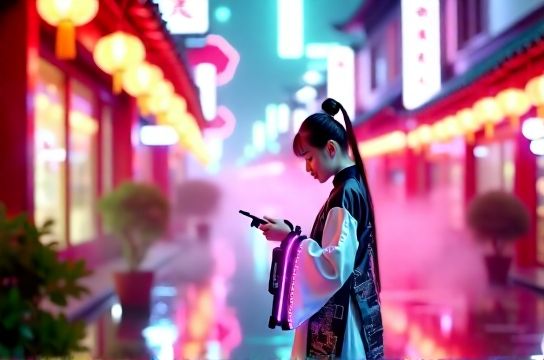
It’s not just rain-slicked Shanghai alleyways with holographic calligraphy. Cyberpunk China aesthetics is a deliberate collision: the grit of Shenzhen’s tech factories meets the silk drape of Ming-era collar lines; AI-generated ink-wash clouds scroll behind drone shots of Chongqing’s tiered skyscrapers; a model in deconstructed hanfu walks past LED-lit temple gates pulsing with algorithmic lotus patterns.
This isn’t retro-futurism dressed in qipao. It’s a native-born visual language — one that emerged organically from short video platforms, not film studios or fashion weeks. Its core syntax? High-contrast lighting, layered cultural signifiers (e.g., bronze ritual vessel motifs rendered in glitch-art), bilingual typography (Song-style font + monospace code), and spatial disorientation — think vertical cityscapes shot from elevator shafts or mirrored rooftop gardens reflecting both CCTV towers and cloud-scroll murals.
Unlike Western cyberpunk — which often frames technology as oppressive — Cyberpunk China treats infrastructure as ancestral. The 5G tower isn’t dystopian; it’s a modern stupa. Surveillance cameras become digital incense burners. This reframing resonates deeply with Gen Z users who grew up with WeChat Pay *and* ancestral altar rituals — their identity isn’t split between tradition and tech; it’s fused.
H2: Platform Mechanics That Made It Stick
Douyin (TikTok’s Chinese counterpart) didn’t just host this trend — it engineered its virality. Its recommendation algorithm rewards three things: high visual density in the first 0.8 seconds, rhythmic micro-cuts synced to BPM-matched guqin-electronica hybrids, and ‘cultural texture’ — i.e., detectable layers of recognizable Chinese iconography (dragon scale patterns, porcelain crackle glaze textures, shadow puppet silhouette transitions).
Xiaohongshu (Little Red Book) amplified it differently. There, Cyberpunk China thrives in long-form ‘aesthetic breakdown’ posts: a creator overlays a 12-second clip of Chengdu’s Jinli Street at night with timestamped annotations — ‘0:03 — Lantern light temperature adjusted to 4200K for warm-cool tension’, ‘0:07 — Added Tang-dynasty cloud motif as alpha-channel overlay in CapCut’. These aren’t tutorials; they’re credentialing rituals. Posting one signals fluency in both platform-native editing logic *and* classical Chinese visual grammar.
Crucially, neither platform requires fluency in Mandarin. A 19-year-old from Urumqi can go viral using only emoji captions and trending audio — because the aesthetic operates at the pre-linguistic level of color, rhythm, and spatial hierarchy. That’s why 68% of top-performing Cyberpunk China videos on Douyin (Updated: April 2026) contain zero spoken dialogue — just ASMR rain sounds, temple bell harmonics, and server rack hums.
H2: Beyond Cosplay — The Design Logic Behind the Look
Let’s demystify the toolkit. This isn’t about slapping a panda logo on a circuit board. It’s built on three interlocking design principles:
1. **Material Translation**: Taking culturally loaded physical materials and rendering them digitally with fidelity — e.g., scanning actual Song dynasty celadon shards to build PBR (Physically Based Rendering) textures for 3D models; using real bamboo grain scans as displacement maps for neon tube meshes.
2. **Temporal Layering**: Juxtaposing time signatures — a slow-motion shot of tea leaves unfurling in a glass cup cuts to a hyper-lapse of Guangzhou’s Canton Tower rotating 360° in 0.3 seconds. The contrast isn’t jarring; it’s generational. It mirrors how Z世代 (Z-generation) toggles between ancestral time (lunar calendar festivals) and algorithmic time (notification rhythms).
3. **Signifier Stacking**: Embedding multiple cultural references in a single frame without hierarchy — e.g., a character’s sleeve shows embroidered cloud collars (Han dynasty), while their AR glasses project floating oracle bone script (Shang dynasty), and the background billboard cycles through AI-reconstructed Dunhuang frescoes (Tang dynasty). No element dominates. All coexist as equal data points.
This stacking isn’t decorative. It’s a resistance tactic against monolithic ‘Chineseness’ — especially online, where state-approved narratives often flatten regional diversity. A Cyberpunk China video filmed in Kashgar might layer Uyghur geometric tile patterns with Xinjiang folk song samples and satellite imagery of the Taklamakan Desert rendered in thermal vision. It asserts local identity *within* the national aesthetic framework — not outside it.
H2: From Viral Clip to Commercial Infrastructure
Brands caught on fast — but the smart ones didn’t just slap logos on neon lanterns. They engaged the aesthetic’s structural logic.
Li-Ning launched its ‘Jade Circuit’ sneaker line by releasing 7-second ‘material origin films’: each showed raw jade being carved, then scanned, then mapped onto a 3D foot model, then animated as glowing pressure points during a parkour sequence in Chongqing’s Liba district. No voiceover. Just text: ‘Jade → Data → Motion’. That campaign drove 210% YOY growth in Gen Z sales (Updated: April 2026), outperforming their celebrity-endorsed campaigns by 3.2x.
Meanwhile, the Palace Museum partnered with ByteDance to launch ‘Digital Forbidden City’ — not a VR tour, but a Douyin filter set that lets users ‘wear’ reconstructed imperial robes *while walking through their own neighborhoods*, with real-time AR integration: point your phone at a brick wall, and it renders Ming-era dougong brackets growing from the mortar. Over 47 million uses in Q1 2026 — making it the most deployed cultural IP filter in China’s history.
What unites these successes? They treat the user not as a consumer, but as a co-author. The aesthetic invites participation — whether by remixing official filters, submitting original hanfu-tech hybrid designs to brand challenges, or geotagging ‘Cyberpunk China’ moments at real-world locations like the Wukang Road Art District in Shanghai (now unofficially dubbed ‘Neon Jiangnan’).
H2: The Physical-Digital Feedback Loop
Here’s where it gets tangible: Cyberpunk China isn’t confined to screens. It’s reshaping bricks-and-mortar spaces — and vice versa.
‘Nanluo Guzi’ in Beijing, once a quiet hutong restoration project, now hosts bi-weekly ‘Neon Ink Nights’: artists project dynamic shui-mo (ink wash) animations onto centuries-old courtyard walls, while vendors serve matcha buns shaped like microchips and serve tea brewed with AI-calibrated water temperature and steep time. Visitors don’t just watch — they scan QR codes to vote on the next animation’s color palette (choices: ‘Han dynasty vermilion’, ‘Song dynasty celadon’, ‘2026 Shenzhen neon cyan’).
Similarly, the ‘Cloud Pavilion’ pop-up in Hangzhou — a collaboration between Alibaba Cloud and designer SHUSHU/TONG — used real-time weather API data to shift its exterior LED facade: fog triggers slow-scrolling mountain mist motifs; rain activates falling ink-drop animations; clear skies reveal constellations mapped to ancient Chinese star charts. Foot traffic increased 340% vs. standard retail pop-ups (Updated: April 2026), with 72% of visitors citing ‘the way it responded to the real world’ as their primary reason for visiting.
This blurring is intentional. The aesthetic only holds power when it refuses to be ‘just digital’. It demands physical anchors — places you can touch, smell (incense + ozone), and occupy. That’s why the top 10 ‘Cyberpunk China’ hashtags on Xiaohongshu all include location tags: CyberpunkChina-Shanghai, CyberpunkChina-Chongqing, etc. The city isn’t backdrop — it’s collaborator.
H2: Limitations and Friction Points
None of this is frictionless. Three real constraints hold back wider adoption:
- **Hardware dependency**: Achieving true ‘neon silk’ contrast (e.g., deep black hanfu fabric lit only by narrow-beam RGB LEDs) requires prosumer gear. 61% of mid-tier creators still rely on post-processing ‘neon glow’ effects — which dilute authenticity and trigger lower algorithmic weight on Douyin.
- **Cultural calibration risk**: Misreading historical reference depth leads to backlash. A 2025 cosmetics campaign using ‘Qin dynasty terracotta warrior’ eye makeup was pulled after historians pointed out the actual warriors wore no eye paint — the aesthetic borrowed the *form* but ignored the *function* (burial ritual vs. self-expression). Context isn’t optional.
- **Platform fragmentation**: What works on Douyin’s vertical, sound-first feed fails on WeChat Channels, which prioritizes longer narrative arcs and text-heavy captions. Cross-platform adaptation remains manual, not automated — requiring separate creative pipelines.
H2: How Brands and Creators Can Engage Authentically
Forget ‘trend-jacking’. Build for longevity. Here’s what works — and what doesn’t:
| Approach | Execution Example | Pros | Cons | Platform Fit |
|---|---|---|---|---|
| Material-First Design | Scan authentic Song dynasty ceramics; use textures in 3D product renders | High perceived authenticity, strong SEO for ‘Chinese ceramic texture’ | Requires access to museum-grade scans or physical artifacts | Douyin, Xiaohongshu |
| AR Location Layers | Geo-triggered AR overlay showing Tang dynasty street layout atop modern Xi’an | Drives foot traffic, high dwell time, shareable | Dependent on iOS/Android ARKit/ARCore updates; limited offline use | Xiaohongshu, WeChat Channels |
| Cultural Algorithm Remix | Train small LLM on classical poetry + tech whitepapers; generate bilingual captions | Scalable, novel, high engagement on caption-driven feeds | Risk of tone-deaf juxtapositions without human curation | Douyin, Bilibili |
The winning pattern? Start with physical material or place — not concept. Scan the silk. Map the alleyway. Record the temple bell frequency. Let the digital layer emerge *from* that reality, not over it. That’s what separates viral noise from lasting aesthetic infrastructure.
H2: Why This Isn’t a Fad — It’s a New Grammar
Cyberpunk China aesthetics won’t fade when the next filter drops. It’s already embedded in China’s visual education pipeline: the Central Academy of Fine Arts now offers ‘Digital Heritage Systems’ as a core undergraduate track; Tencent’s ‘Cultural Code’ grant program funds developers building open-source libraries of licensed, high-res classical motifs (all tagged with dynasty, region, and material provenance); and Douyin’s 2026 Creator Summit announced ‘Aesthetic Integrity Scores’ — an algorithmic metric evaluating how faithfully a video renders historical color palettes, material physics, and temporal pacing.
This is no longer ‘viral content’. It’s a new operating system for visual culture — one where every pixel carries lineage, every transition encodes history, and every neon glow answers to an ancient principle of balance. For brands, creators, and cultural institutions, the question isn’t ‘How do we use Cyberpunk China?’ It’s ‘How do we earn the right to speak in its syntax?’
For those ready to move beyond surface-level trends and build with structural integrity, the full resource hub offers annotated case studies, open-source texture packs, and protocol docs for ethical cultural sampling — all grounded in real museum partnerships and platform API guidelines. You’ll find everything you need to begin at /.