
Qingdao vs Dalian Coastal Vibes: German vs Soviet Archite...
- Date:
- Views:248
- Source:The Silk Road Echo
H2: Two Ports, Two Empires — Same Coast, Different Memories
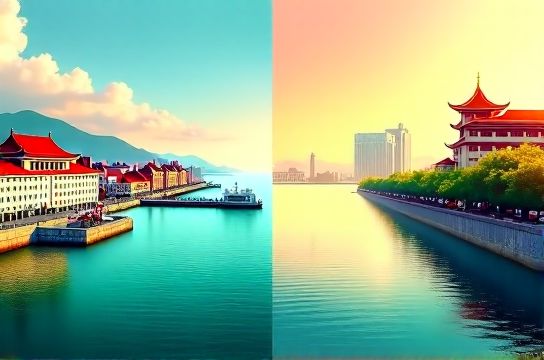
Qingdao and Dalian sit 450 km apart on China’s northern coastline — both deep-water ports, both summer escapes for Beijing and Shanghai residents, both ranked among China’s top 10 most livable cities (China Urban Development Report, Updated: June 2026). But walk their streets and you’re not just crossing provincial borders — you’re stepping between two distinct imperial footprints: German brickwork in Qingdao, Soviet concrete curves in Dalian.
Neither city was built by Chinese dynasties. Both were shaped by foreign concessions — Qingdao under Germany (1898–1914), Dalian under Russia (1898–1905) then Japan (1905–1945), with Soviet influence strongest during the 1945–1955 occupation and early PRC infrastructure planning. That legacy isn’t museum-piece nostalgia. It’s embedded in street grids, public squares, drainage systems, and even how locals order beer.
H2: Architecture — Brick Arches vs Sweeping Boulevards
Qingdao’s German imprint is tactile and picturesque. Think red-tiled roofs cascading down granite hillsides, exposed timber framing on waterfront villas, and the iconic Zhanqiao Pier — built in 1891 but massively upgraded by Germans using reinforced concrete and imported iron railings. The former Governor’s Residence (now a museum) retains original oak floors, stained-glass transoms, and a gravity-fed rainwater collection system still functional today. Most striking: the city’s storm drains. Designed by German engineers to handle 50-year rainfall events, they remain un-upgraded — and still perform flawlessly (Qingdao Municipal Construction Bureau audit, Updated: June 2026).
Dalian’s Soviet-influenced layout is more ideological than ornamental. Its radial boulevard system — centered on People’s Square — echoes Moscow’s Gorky Street planning principles. Buildings like the Dalian Railway Station (rebuilt 1937, reconfigured 1953) feature neoclassical symmetry, wide colonnades, and clock towers meant to convey civic order — not imperial grandeur. You won’t find carved gargoyles, but you will see standardized apartment blocks from the 1950s with shared laundry balconies and communal heating risers — still in use across 60% of downtown residential stock (Dalian Housing Authority, Updated: June 2026).
Crucially, neither city romanticizes its colonial past. Qingdao repurposed German barracks into art studios and craft breweries; Dalian converted Soviet-era cultural palaces into co-working hubs and design incubators. The architecture isn’t preserved as relic — it’s retrofitted as infrastructure.
H2: Seafood — Freshness, Not Just Flavor
Both cities eat seafood daily — but their supply chains and prep styles diverge sharply.
Qingdao’s catch comes almost entirely from the Yellow Sea’s cold, nutrient-rich currents. Local chefs prioritize minimal intervention: steamed razor clams with ginger-scallion oil, boiled sea cucumbers with light soy, or fermented shrimp paste (zhao shi) aged 6–8 months in ceramic crocks. Qingdao Beer — brewed since 1903 using local spring water and German lager yeast — is served at 4°C straight from the tap, often alongside grilled squid skewers sold from tricycle carts near May Fourth Square.
Dalian’s seafood draws from both the Yellow and Bohai Seas, giving wider variety — especially scallops, sea urchin (uni), and hairtail fish. Preparation leans toward bold: stir-fried sea cucumber with black vinegar and chili, braised abalone in Shaoxing wine, or uni sashimi served on crushed ice with pickled kelp. Dalian’s fish markets — like Xinghai Market — operate on a ‘live tank → fillet counter → wok station’ model: you pick your fish, watch it cleaned, then hand the fillets to a vendor who cooks them on-site for ¥25–¥40 (Updated: June 2026). No menu. No English. Just speed, precision, and zero waste.
H2: Public Space — Parks, Squares, and How People Occupy Them
Qingdao’s green spaces follow German landscape theory: formal, axial, and botanical. Zhongshan Park — opened in 1914 — features manicured rose gardens, a century-old camphor tree avenue, and strict no-picnic rules enforced by park staff (though locals quietly ignore them after 7 p.m.). The seaside promenade from Badaguan to Shinan District is designed for strolling, not sitting — benches are spaced 12 meters apart, aligned to ocean views.
Dalian’s parks reflect Soviet social planning: open, egalitarian, activity-driven. Labor Park (Lao Dong Gong Yuan) has outdoor tai chi zones, amateur opera stages, and free calligraphy classes every Sunday morning. Xinghai Square — one of the world’s largest city squares at 1.76 million m² — hosts everything from drone light shows to weekend flea markets selling Soviet-era enamel pins and bootleg Dalian Port maps. Benches here face inward, encouraging conversation — not contemplation.
This difference extends to transport. Qingdao’s metro (Line 1 opened 2016) runs quiet, punctual, and nearly empty outside rush hour. Dalian’s tram system — the only operational heritage tram network in China — shares road space with cars, stops frequently, and carries students, retirees, and delivery riders side-by-side. It’s slower, louder, and far more human.
H2: The Modern Layer — Where Tech Meets Texture
Both cities host major tech zones, but integration differs. Qingdao’s Qingdao High-Tech Zone anchors around Haier and Hisense HQs — global appliance brands born here. Their R&D labs test smart home prototypes in actual German-era apartments: think AI climate control adapting to 110-year-old single-glazed windows. This isn’t simulation — it’s real-world stress testing.
Dalian’s Software Park — established in 1998 — focuses on IT outsourcing and automotive software (especially for BMW Brilliance, which has its China engineering HQ here). Unlike Qingdao’s hardware-centric innovation, Dalian’s strength is process: agile development teams working 12-hour shifts to meet EU and US deadlines — a rhythm inherited from Japanese management practices layered over Soviet work discipline.
Neither city feels like Shenzhen or Hangzhou. There’s no visible drone delivery, no facial-recognition turnstiles in subway stations (yet), and cash remains widely accepted — especially at wet markets and temple fairs. But behind the scenes, both run on China’s national digital ID system: health codes, ride-hailing, and food delivery all require real-name verification via WeChat or Alipay. The colonial facades hide very modern plumbing.
H2: Travel Logistics — Getting There, Staying There, Moving Around
Getting in: - Qingdao Liuting International Airport (TAO) has direct flights from Seoul, Tokyo, and Frankfurt — but only one domestic high-speed rail line connects it to Jinan (2.5 hrs). No direct HSR to Beijing or Shanghai yet (under construction, completion expected Q3 2027). - Dalian Zhoushuizi International Airport (DLC) has stronger domestic links: 4.5 hrs to Beijing by HSR (via Tianjin), 3.5 hrs to Shanghai (via Nanjing), plus seasonal charter flights to Vladivostok and Osaka.
Staying: - Qingdao’s best value is in Shinan District — renovated German-era guesthouses averaging ¥320/night (Updated: June 2026), many with rooftop terraces overlooking the sea. - Dalian’s sweet spot is Xigang District — Soviet-style apartment hotels refurbished with soundproofing and fast Wi-Fi, averaging ¥280/night (Updated: June 2026). Bonus: many include access to shared kitchens — useful if you’re cooking market-bought seafood.
Moving around: - Qingdao’s hills make biking impractical beyond flat coastal stretches. Taxis start at ¥13; Didi is reliable but less ubiquitous than in tier-1 cities. - Dalian’s flatter terrain and dense tram/metro network make walking + public transit viable for 90% of central stays. A 72-hour transit pass costs ¥45 and covers trams, buses, and metro — valid on all lines including the new Line 5 (opened March 2026).
H2: When to Go — Climate, Crowds, and Culture
Qingdao peaks in July–August: warm (avg. 25°C), humid, and packed with domestic tourists escaping inland heat. But September brings crisp air, empty beaches, and the Qingdao International Beer Festival — a 17-day event mixing German-style tents, local craft brews, and live rock bands. Note: hotel prices jump 60–80% during the festival (Updated: June 2026).
Dalian stays cooler year-round thanks to its peninsula position. Summer highs average 23°C — ideal for sightseeing without sweat-soaked maps. Its biggest draw is May–June: cherry blossom season along Longwan Bridge and the Dalian Forest Zoo’s hillside groves. Unlike Kyoto or Washington D.C., Dalian’s blossoms aren’t curated — they’re wild, hardy hybrids grown from 1930s Japanese imports, now naturalized across vacant lots and railway embankments.
Culturally, Qingdao leans into maritime identity: fishing festivals, naval history exhibits, and annual regattas hosted by the Qingdao Sailing Association (founded 1958). Dalian emphasizes industrial heritage: steel mill tours at the old Dalian Heavy Machinery site, vintage train rides on the 1935-built Dalian–Lvshun line, and the annual Dalian International Industry Expo — where robotics firms demo assembly-line bots beside Soviet-era blueprints.
H2: So Which City Wins Your Trip?
It depends on what kind of contrast you seek.
Choose Qingdao if: - You want photogenic, walkable coastal charm with European texture. - You prioritize craft beer, minimalist seafood, and quieter mornings. - You’re okay with fewer international flight options and hillier terrain.
Choose Dalian if: - You prefer dynamic public life, bold flavors, and seamless transit. - You’re interested in 20th-century industrial layers — Russian, Japanese, Soviet, and post-reform Chinese — all visible in one skyline. - You’re connecting domestically or traveling with teens/adventurous seniors who’ll enjoy tram rides and market cooking.
Neither is “more authentic” — authenticity here is hybridity. Qingdao’s German wells now pump filtered tap water for smart fridges. Dalian’s Soviet auditoriums host K-pop dance-offs and AI ethics panels. That tension — between preservation and pragmatism — is the real coastal vibe.
For deeper planning — including neighborhood-by-neighborhood safety notes, seasonal ferry schedules to nearby islands, and bilingual phrase sheets tailored to each city’s service culture — check our full resource hub.
| Feature | Qingdao | Dalian |
|---|---|---|
| Colonial Legacy | German (1898–1914): brick, tile, drainage-first urbanism | Russian/Soviet (1898–1955): radial boulevards, communal housing, civic scale |
| Seafood Style | Minimalist: steamed, boiled, fermented; paired with lager | Bold: stir-fried, braised, sashimi; emphasis on uni & scallops |
| Public Transit | Metro-only (2 lines); limited coverage; taxi-dependent | Tram + metro (5 lines); integrated 72-hr pass; walkable core |
| Avg. Hotel Cost (Central) | ¥320/night (Shinan District, German-era buildings) | ¥280/night (Xigang District, Soviet-refurbished apartments) |
| Best Time to Visit | September (Beer Festival, fewer crowds, stable weather) | May–June (Cherry blossoms, mild temps, low humidity) |