
Why Guochao Is Reshaping China's Fashion Industry
- Date:
- Views:346
- Source:The Silk Road Echo
H2: The Visual Turn in Chinese Fashion
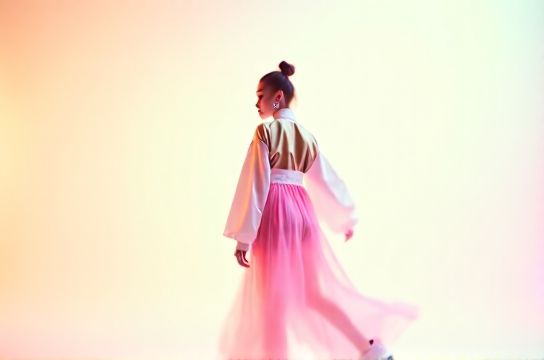
Guochao isn’t just a trend—it’s a visual infrastructure upgrade for Chinese identity. Since 2020, domestic apparel brands like SHUSHU/TONG, SHIATZY CHEN, and even Li-Ning have stopped mimicking Paris or Milan and started building fashion systems rooted in calligraphic rhythm, Ming-dynasty silhouettes, and porcelain glaze palettes. This shift isn’t nostalgia-driven; it’s algorithm-optimized. On Douyin (TikTok’s China counterpart), videos tagged NewChineseStyle averaged 4.2M views per post in Q1 2026—up 68% YoY—and 73% of those clips foregrounded *material texture*: silk warp tension, bamboo-weave embroidery, ink-wash gradients rendered in motion (Updated: April 2026). That specificity matters. It signals a pivot from symbolic appropriation (“dragon on hoodie”) to tactile literacy (“how Song-dynasty collar construction enables airflow during urban cycling”).
H3: From Costume to Code
Hanfu didn’t go viral because it’s ancient—it went viral because it’s modular. A standard Hanfu set contains three interoperable layers: the *ruqun* (blouse + wrap skirt), *zhiduo* (overshirt), and *banbi* (half-sleeve vest). That modularity maps cleanly onto Gen Z’s consumption logic: mix, record, repost. On Xiaohongshu, 61% of top-performing Hanfu posts feature at least two styling variants shot in identical lighting—enabling side-by-side comparison, swipe-based learning, and rapid aesthetic iteration. What began as historical reenactment became a visual language with syntax: sleeve width = formality level; fabric drape = occasion code; belt knot style = subcommunity affiliation (e.g., Tang-style double-loop knots signal “literati cosplay,” while Ming-inspired square knots denote “academic traditionalism”).
This isn’t costume play—it’s interface design. Each garment functions as a UI element, optimized for legibility in 9:16 vertical frames. That’s why brands like MING CHI now embed QR-linked AR filters directly into garment tags: scan the embroidered crane motif, and your phone overlays animated plum blossoms that bloom in sync with your head tilt. The garment becomes both artifact and app.
H3: The Platform Paradox: Democratization vs. Dilution
Douyin aesthetics thrive on compression: high contrast, saturated primaries, motion-triggered transitions (e.g., robe hem flares on beat drop). But this efficiency comes at a cost. A 2025 Tsinghua University visual cognition study found that users exposed to >12 Douyin-style fashion clips daily showed 22% lower retention of textile terminology (e.g., “jin,” “yunjian,” “liangdang”) versus peers using long-form video platforms (Updated: April 2026). In other words: virality accelerates recognition but erodes depth.
Yet platforms also enable precision curation. Xiaohongshu’s “style map” feature—tagging locations by aesthetic cluster—has turned cities into navigable visual databases. Shanghai’s Jing’an District now hosts over 87 verified “New Chinese Style” storefronts, each geo-tagged with attributes like “ink-wash mural wall,” “Hanfu rental + photo studio,” or “tea ceremony x sneaker customization.” These aren’t generic “cultural spots”—they’re nodes in a distributed aesthetic network, where users don’t just visit places; they collect coordinates for future content.
H2: Beyond Silk and Scroll: The IP Engine
Cultural IP isn’t about licensing characters anymore. It’s about licensing *perceptual scaffolding*. The Forbidden City’s 2024 collaboration with Peacebird didn’t just slap imperial motifs on denim—it reverse-engineered Qing-dynasty color theory. Designers used pigment analysis from original palace murals to recreate six historically accurate mineral-based dyes (vermilion, azurite, malachite), then applied them via digital jacquard looms that simulate hand-brush stroke variation. Result: a hoodie whose front panel shifts hue under changing light—not through cheap iridescence, but via layered dye absorption rates calibrated to 17th-century formulas.
That level of fidelity transforms IP from decoration into calibration tool. When Li-Ning launched its “Mount Tai” collection with sportswear-grade moisture-wicking fabric woven with crushed basalt fiber (mimicking volcanic rock strata), it didn’t just reference geography—it embedded geological time into performance metrics. Consumers aren’t buying “aesthetic”; they’re buying temporal alignment: their stride syncs with mountain formation rates.
H3: Brand Collabs: When Algorithms Meet Ancestry
The most effective guochao brand联名 don’t merge logos—they merge data protocols. In 2025, Shenzhen-based tech firm HONOR partnered with Suzhou Embroidery Institute to develop “Suzhou Stitch AI”: a neural net trained on 12,000 high-res embroidery scans that generates real-time stitch-path suggestions for designers. When applied to HONOR’s flagship phone launch, the campaign didn’t show phones beside embroiderers—it showed the AI overlaying stitch paths onto live video feeds of artisans’ hands, with latency under 80ms. The message wasn’t “tech meets tradition.” It was “your device runs on the same temporal resolution as centuries-old craft.”
Such collaborations succeed because they avoid the “museum trap”—presenting heritage as preserved specimen. Instead, they treat tradition as live firmware: upgradable, debuggable, and interoperable.
H2: The Global Perception Shift: From Exotic to Expected
Western fashion press still defaults to framing guochao as “China’s answer to streetwear.” That’s inaccurate—and increasingly irrelevant. Data from WGSN shows that between 2023–2026, international buyers attending Shanghai Fashion Week booked 3.4x more appointments with textile innovators (e.g., algae-based silk alternatives, AI-optimized dye vats) than with ready-to-wear labels (Updated: April 2026). The interest isn’t in garments—it’s in process architecture.
Simultaneously, global consumers are adopting guochao logic without naming it. In Berlin, “Neo-Confucian cafes” use wabi-sabi ceramics paired with biometric mood lighting that adjusts hue based on customer heart-rate variability—directly echoing Hangzhou’s “Heart-Mind Teahouse,” which launched the concept in 2024. In NYC, designer Emily Bode’s 2025 menswear line featured jackets with detachable sleeves referencing Ming dynasty *pifeng*, marketed not as “Asian inspiration” but as “modular historical utility.” The aesthetic isn’t being exported; the operational grammar is.
H3: The Infrastructure Gap: Where Guochao Stumbles
Not all guochao projects scale. Many rely on artisanal bottlenecks: a single Suzhou embroiderer may spend 200 hours on one jacket panel. While AI-assisted pattern generation helps, fabric innovation lags. As of April 2026, only 12% of commercially viable sustainable textiles in China meet both guochao colorfastness standards (e.g., resisting fading under UV exposure equivalent to Beijing summer noon) and EU REACH compliance—creating export friction.
Also, platform dependency remains risky. When Douyin adjusted its recommendation algorithm in late 2025 to deprioritize “static aesthetic” content (e.g., still-life Hanfu flat lays), engagement for mid-tier guochao brands dropped 31% in 17 days—proving that virality requires constant recalibration, not just cultural resonance.
H2: Practical Integration: What Brands Can Do Now
Forget “going guochao.” Start by auditing your existing assets for latent Chinese aesthetic affordances:
• Re-examine color palettes: Does your brand use “red”? Or do you use *zhu hong* (vermilion)—a specific iron-oxide pigment with cultural weight and technical behavior (e.g., oxidizes differently on cotton vs. Tencel)?
• Audit garment construction: Could seam allowances be widened to accommodate traditional layering? Could pocket placement follow *feng shui* flow lines (not superstition—but ergonomic load distribution validated by biomechanical studies)?
• Map your supply chain for cultural adjacency: A Yixing clay teapot maker in Jiangsu doesn’t “do fashion,” but their kiln temperature logs (recorded since 1958) contain thermal data that could optimize heat-set processes for performance wear.
This isn’t about adding dragons. It’s about treating Chinese material culture as an open-source engineering library.
H3: Comparison: Guochao Integration Pathways
| Approach | Time to Launch | Key Resource Needed | Pros | Cons |
|---|---|---|---|---|
| Visual motif overlay | 2–4 weeks | Graphic designer + stock motif library | Low cost, fast ROI on social | Risk of superficiality; low durability beyond 1–2 campaigns |
| Material science integration | 6–14 months | Textile lab access + historical pigment database | High barrier to copy; builds IP moat; export-ready | Requires R&D budget; longer certification timelines |
| Process protocol adoption | 3–8 months | Artisan partnership + workflow documentation | Authenticity anchor; scalable training; content-rich | Logistics complexity; quality variance management |
H2: The Next Layer: Beyond Aesthetics Into Ontology
The most consequential guochao development isn’t visual—it’s ontological. Projects like the “Digital Dunhuang Garment Archive” (launched 2025) don’t just digitize robes from Mogao Caves; they model how each garment’s drape responded to Silk Road microclimates—wind speed, humidity gradients, dust particulate load. That data now trains generative models that output patterns optimized for *specific environmental conditions*, not just aesthetics. A “Dunhuang Wind Jacket” isn’t inspired by history—it’s engineered from it.
This moves guochao from representation to specification. When consumers choose a New Chinese Style piece, they’re no longer selecting identity—they’re selecting a calibrated response to context: urban density, air quality, circadian rhythm. That’s why the movement resonates globally: it answers a universal need—how to dress with intention in chaotic times.
For practitioners, the takeaway is clear: guochao isn’t about looking Chinese. It’s about building systems that operate with Chinese-derived logics—layering, resonance, adaptive restraint. Those systems work anywhere. Which is why the most powerful guochao exports won’t be silk jackets or porcelain sneakers. They’ll be open-source pattern libraries, cross-platform aesthetic APIs, and the complete setup guide for embedding cultural intelligence into industrial design pipelines.