
Nanjing vs Xi'an Imperial Heritage and Warring States Lan...
- Date:
- Views:254
- Source:The Silk Road Echo
H2: Two Capitals, Two Eras — Why This Comparison Matters
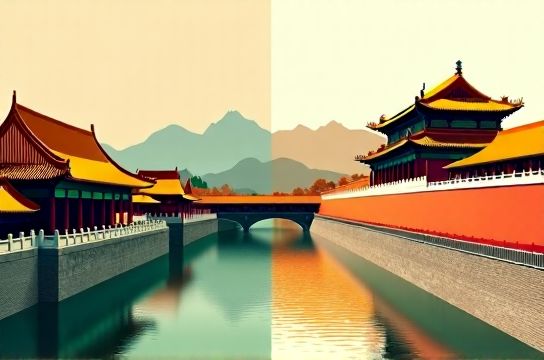
If you’re mapping a China itinerary focused on deep historical immersion—not just photo ops—you’ll quickly hit a fork: Nanjing or Xi’an? Both claim imperial legitimacy, yet they anchor radically different chapters of Chinese civilization. Xi’an was the cradle—home to the Qin Terracotta Army (210 BCE), Zhou ritual bronzes, and Han dynasty cosmology. Nanjing rose later as the Ming founding capital (1368 CE), then briefly as the Republic’s seat—and its Warring States-era presence is indirect, mediated through regional Chu and Wu state artifacts now housed in its museums.
This isn’t about ‘which city is older’—it’s about *what kind of history you want to walk through*. A Xi’an visit delivers visceral, stratified time travel: stand where Emperor Wu of Han held court, then descend into pits where 8,000 life-size warriors guard a tomb sealed for over two millennia. Nanjing offers layered continuity: a Ming city wall still standing (21.3 km intact, longest surviving in China), Confucius Temple complex rebuilt across dynasties, and the Sun Yat-sen Mausoleum anchoring Republican memory—all within a modern metro city of 9.4 million (Updated: June 2026).
H2: Imperial Architecture — Stone vs. Symbol
Xi’an’s imperial fabric is archaeological first, architectural second. The 14th-century Ming City Wall sits atop Tang-Sui foundations—but it’s the *subsurface* that defines its authority. The Qin Shi Huang Mausoleum complex covers 56 km²; only 1% has been excavated. What’s visible—the Terracotta Army pits, the earthen tumulus, the bronze chariots—is merely the ceremonial perimeter. You don’t enter a palace here; you witness the scale of command made permanent in clay and earth.
Nanjing’s imperial architecture is tactile and navigable. Its Ming City Wall isn’t a ruin—it’s functional infrastructure. You can rent bikes and cycle the entire Zhonghua Gate section (3.5 km), passing arrow slits still scarred by Qing cannon fire. The Presidential Palace compound merges Ming-era foundations, Qing administrative halls, and 1912 Republican offices under one roof—no museum curation needed. It’s history *in use*, not just on display.
Crucially, Nanjing lacks a single, unified imperial ‘set piece’ like Xi’an’s兵马俑 (Terracotta Army). Instead, its power lies in density and juxtaposition: walk 10 minutes from the Confucius Temple’s Song-dynasty layout to the Nanjing Museum’s Ming porcelain galleries, then to the nearby Fuzimiao snack street—where stinky tofu vendors operate steps from a 1,000-year-old canal lock.
H2: Warring States Footprints — Direct vs. Curated
Here’s where expectations need calibration. Xi’an *was* the western frontier of the Zhou dynasty and later capital of Qin—the state that conquered all others in 221 BCE. So its Warring States presence is physical and political: the Qin陵 (mausoleum precinct) contains sacrificial pits with real horse skeletons and bronze waterfowl (excavated 2012); the Shaanxi History Museum holds the ‘He Zun’ bronze vessel—the earliest known inscription of ‘China’ (‘Zhongguo’) dated 1038 BCE (Updated: June 2026).
Nanjing wasn’t a Warring States capital. It lay in the domain of the Wu and Yue states—rivals to Chu and Qi—but no major Wu/Yue royal tombs survive near modern Nanjing. What *does* exist is exceptional curation: the Nanjing Museum’s ‘Warring States Gallery’ displays 127 excavated bronze bells from the Tomb of Marquis Yi of Zeng (a Chu vassal state, unearthed in Hubei—but studied and conserved in Nanjing since 1980). These aren’t replicas. They’re the original bianzhong chime set, tuned to equal temperament—played live for visitors twice daily. That’s scholarly access, not spectacle.
So if you want to *stand where Warring States rulers governed*, Xi’an wins. If you want to *hear how their music sounded*, Nanjing delivers—with rigor, not reenactment.
H2: Food as Cultural Syntax
Both cities serve dumplings—but the grammar differs. Xi’an’s jianbing is a handheld, sesame-crusted crepe folded around scallions and chili oil—street food born of northern wheat belts and garrison culture. Its roujiamo (‘Chinese hamburger’) uses biang-biang noodles’ cousin: a crisp, baked flatbread stuffed with stewed pork belly. Texture is paramount: chewy, crunchy, fatty, sharp.
Nanjing’s food reflects its Yangtze delta location and Ming bureaucratic roots. Nanjing salted duck isn’t just cured—it’s dry-brined for 36 hours, air-dried for 24, then poached at precise 92°C to retain collagen. The result is tender but resilient, served cold with ginger-scallion oil. It’s food engineered for preservation in pre-refrigeration bureaucracy—just like the city’s imperial archives were stored in cedar-lined vaults.
Don’t miss Nanjing’s ‘duck blood vermicelli soup’—a bowl that reads like a timeline: duck offal (Wu state hunting tradition), cellophane noodles (Song-dynasty starch tech), and pickled mustard greens (Ming-era fermentation). Xi’an’s liangpi cold skin noodles, meanwhile, are pure Qin pragmatism: gluten-based, shelf-stable, eaten year-round.
H2: Logistics & Travel Realities
Let’s talk transit, crowds, and fatigue. Xi’an’s key sites cluster tightly: Bell Tower → Muslim Quarter → City Wall → Terracotta Army (38 km east, 1h by tourist bus or high-speed rail shuttle). But ‘tight’ doesn’t mean easy. The Terracotta Army site receives ~14,000 daily visitors in peak season (Updated: June 2026). Timed entry slots sell out 72h ahead—book via WeChat mini-program ‘Xi’an Cultural Relics’, not third-party vendors.
Nanjing spreads wider. The Presidential Palace and Confucius Temple sit in the southern old town; the Ming Xiaoling Mausoleum (Zhu Yuanzhang’s tomb) is 6 km northeast, requiring Metro Line 2 + bus. But Nanjing’s metro is newer (Line 3 opened 2015), fully English-signaled, and rarely exceeds 70% capacity—even during National Day week. Wi-Fi is free and stable across stations; Xi’an’s public Wi-Fi requires ID registration and often drops at the Terracotta site.
Accommodation pricing reflects this: average mid-range hotel near Xi’an’s Bell Tower runs ¥420/night (Updated: June 2026); Nanjing’s Confucius Temple area averages ¥360. Not a huge gap—but Nanjing’s subway fare is ¥2 flat (vs. Xi’an’s distance-based ¥2–¥6), saving ~¥15/day for multi-site days.
H2: The Table: Practical Side-by-Side Comparison
| Feature | Nanjing | Xi’an |
|---|---|---|
| Key Imperial Site | Ming City Wall + Presidential Palace compound | Qin Terracotta Army + Ming City Wall (reconstructed) |
| Warring States Access | Curated artifacts (Nanjing Museum), no on-site ruins | On-site Qin mausoleum complex, Zhou bronzes in Shaanxi Museum |
| Food Signature | Salted duck, duck blood vermicelli | Roujiamo, liangpi, yangrou paomo |
| Avg. Metro Fare | ¥2 flat rate | ¥2–¥6 (distance-based) |
| Crowd Pressure (Peak) | Moderate (avg. 4,200/day at Ming Xiaoling) | High (14,000+/day at Terracotta Army) |
| Best For | History as lived continuity; scholar-traveler pace | Monumental archaeology; visual impact per hour |
H2: Which City Fits Your Trip?
Choose Xi’an if: - You prioritize *first-hand archaeological immersion*—standing inside a 2,200-year-old tomb complex. - Your group includes teens or visual learners who respond to scale and spectacle. - You’re combining with a Silk Road extension (Dunhuang, Turpan) — Xi’an is the natural gateway.
Choose Nanjing if: - You want *history that breathes alongside modern life*: students biking past Ming gates, street vendors using Song-era recipes. - You’re building a longer China itinerary including Shanghai (1h by G-train) or Hangzhou (2h), making Nanjing a logical pivot point. - You value logistical ease: fewer timed tickets, lower language friction in transit, and museums with English audio guides included in admission (Nanjing Museum: ¥10, includes 45-min guided track in English; Xi’an’s Terracotta Army audio guide: ¥30 extra, limited headsets).
Neither city is ‘more authentic’. Xi’an’s authenticity is in stratigraphy; Nanjing’s is in sedimentation—layer upon layer, still settling.
H2: Pro Tips You Won’t Find in Brochures
- Skip the ‘Terra Cotta Warrior Show’ in Xi’an. It’s a 45-minute dance revue with plastic helmets. Instead, arrive at the Terracotta site at 8:30am—before tour buses—and head straight to Pit K99 (the unopened pit currently under conservation). You’ll see archaeologists brushing dust from a newly exposed warrior’s face—no glass, no rope, just shared silence.
- In Nanjing, book the ‘Nanjing Museum Night Session’ (Thurs–Sat, 18:00–21:00). Only 500 tickets/day, ¥60. You get the Warring States gallery to yourself for 30 minutes—and curators rotate out fragile bronzes under low-light conditions you’d never see in daytime.
- Neither city does ‘temple fairs’ in winter like Beijing—but Xi’an’s Muslim Quarter hosts spontaneous New Year lion dances in late January (unadvertised, follow drumbeats down Daxi Alley). Nanjing’s Confucius Temple holds lantern-making workshops every Saturday 10:00–12:00—free with museum admission.
H2: Final Call — And Where to Go Next
There’s no universal ‘best’—only best *for your purpose*. If your goal is to grasp how imperial ideology materialized in earth and bronze, Xi’an is non-negotiable. If you want to understand how tradition persists—not as relic, but as operating system—Nanjing reveals more, quietly.
For travelers needing deeper context on regional museum networks, archival access protocols, or bilingual signage reliability across Tier-2 heritage sites, our full resource hub offers verified field reports from 37 Chinese cities—including transport hacks, seasonal crowd calendars, and which sites actually enforce ID checks versus scanning QR codes. Explore the complete setup guide to plan with confidence.
(Updated: June 2026)