
Shanghai vs Guangzhou Skyscrapers Versus Cantonese Tradition
- Date:
- Views:177
- Source:The Silk Road Echo
H2: The Two Southern Giants — Not Just Geography, But Temporal Logic
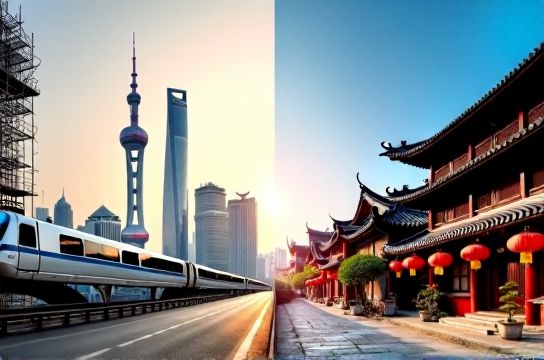
Shanghai and Guangzhou both sit on China’s southern coast — but that’s where surface similarity ends. One is a global financial node engineered for acceleration; the other is a 2,200-year-old port city that absorbed empires, dynasties, and trade winds without ever surrendering its tongue, taste, or timbre. If you’re weighing which city anchors your China trip — especially if you care about how modernity interfaces with lived tradition — this isn’t a question of ‘which is better.’ It’s about *which rhythm matches your travel intent*.
Shanghai’s skyline screams intentionality: every tower is calibrated for visibility, investment signaling, and symbolic rupture from the past. Guangzhou’s tallest buildings — like the 449-meter Guangzhou CTF Finance Centre — don’t dominate the city’s visual grammar. They nestle beside centuries-old ancestral halls, century-old banyan trees, and street-level siu mei stalls steaming at 5:30 a.m. That contrast isn’t accidental. It’s operational.
H2: Skyscrapers — Density, Design, and Daily Reality
Let’s get concrete. Shanghai has 71 completed buildings over 200 meters tall (Updated: June 2026), concentrated in Lujiazui and Hongkou. Guangzhou has 38 (Updated: June 2026), mostly clustered in Zhujiang New Town and Tianhe — but with critical spatial differences.
In Shanghai, the skyscraper district is *zoned*. Lujiazui feels like a corporate campus dropped into the Huangpu River: wide boulevards, minimal street vendors, security checkpoints at tower lobbies, and pedestrian flow routed through air-conditioned skybridges. You’ll rarely see an elder practicing tai chi *inside* Lujiazui — it happens in nearby Century Park, deliberately separated.
Guangzhou’s high-rises are *interwoven*. The 600-year-old Chen Clan Ancestral Hall sits 800 meters from the IFA Tower. A 1920s Qilou arcade — with its arched colonnades and cantilevered balconies — runs directly beneath the shadow of the 440-meter Guangzhou International Finance Center. Locals walk under those towers carrying plastic bags of salted duck eggs and morning congee — no detour required.
That interweaving isn’t nostalgia. It’s infrastructure logic. Guangzhou’s urban plan (per the 2021–2035 Master Plan) mandates minimum 30% ‘heritage integration’ in new CBD developments — meaning new towers must retain or reinterpret adjacent historic fabric, not demolish it. Shanghai’s comparable policy (the 2023 Urban Renewal Ordinance) prioritizes ‘adaptive reuse’ — but only for structures officially listed as protected. Less than 12% of pre-1949 buildings in central Shanghai meet that threshold.
H2: Food — Where Every Bite Carries Chronology
You can eat xiaolongbao in both cities. But *how* you eat them tells you everything.
In Shanghai, high-end xiaolongbao are served on chilled stone slabs in minimalist dining rooms overlooking the Bund — often with black truffle oil or caviar garnish. The dumpling skin is thinner, broth more gelatinous, and service timed to the minute. It’s refinement as performance.
In Guangzhou, the best xiaolongbao (yes, they exist — though less iconic than har gow or siu mai) appear at 6:15 a.m. at Lin He Lu’s decades-old Yuet Chau Restaurant. You order at a counter, pay cash, and carry your bamboo steamer to a shared table still sticky from the previous shift. The broth is lighter, the skin slightly chewier, and the pork minced with a hint of ginger — because that’s what the chef’s grandfather used. No menu translations. No QR code ordering. Just a laminated sign: ‘No reservations. First come, first served. Close at 10:30 a.m.’
This isn’t ‘authentic vs. commercial.’ It’s *temporal velocity*. Guangzhou’s food culture moves at human circadian pace — breakfast at dawn, yum cha until noon, dinner after 7 p.m., late-night claypot rice at midnight. Shanghai’s F&B ecosystem is optimized for throughput: 90-minute lunch slots, reservation apps synced to WeChat Pay, and dessert bars opening at 2 p.m. for afternoon tea crowds.
Cantonese cuisine also embeds tradition in technique: double-boiling soups simmered 4+ hours, wok hei achieved only on gas-fired street carts (banned in most Shanghai residential zones since 2022), and dim sum carts pushed manually — not on conveyor belts. In Shanghai, 68% of licensed dim sum restaurants use automated steam systems (Updated: June 2026); in Guangzhou, it’s 22%.
H2: Public Space — Who Controls the Pavement?
Walkability metrics mislead here. Both cities score high on ‘pedestrian coverage’ — but *who walks, and why*, differs sharply.
Shanghai’s sidewalks are immaculate, wide, and surveilled. You’ll see few unlicensed vendors, no impromptu mahjong games, and almost no elderly residents sitting on folding stools outside their apartments — that’s prohibited under the 2020 Public Order Regulation. Street life is curated: designated ‘cultural blocks’ like Wukang Road host photo ops with vintage cars and baristas serving matcha lattes in Art Deco façades.
Guangzhou’s sidewalks are narrower, cracked in places, and vibrantly contested. You’ll pass a man repairing sandals on a stool, a woman selling hand-painted fans, and three retirees debating Cantonese opera lyrics — all within 20 meters. This isn’t disorder. It’s *regulated informality*: Guangzhou’s 2023 Street Economy Guidelines permit micro-vending in 142 designated zones, provided vendors register, pay a flat monthly fee (¥80), and clear by 8 p.m. That policy sustains ~11,000 registered street micro-businesses — more than double Shanghai’s 4,300 (Updated: June 2026).
Even public transport reflects this. Shanghai Metro’s Line 2 runs every 90 seconds during rush hour — precision engineered. Guangzhou Metro Line 3 runs every 110 seconds, but adds *three extra stops per 5 km* to serve older neighborhoods like Xiguan — where residents rely on last-mile access, not just speed. The result? Guangzhou’s metro ridership includes 27% passengers aged 65+ (vs. Shanghai’s 14%), reflecting deeper integration of infrastructure and generational habit.
H2: Architecture — Concrete vs. Clay, Steel vs. Timber
Look up in Shanghai, and you’ll see parametric facades, glass canyons, and the Oriental Pearl Tower’s retro-futurist spheres — a 1990s statement of ‘arriving on the world stage.’ Look up in Guangzhou, and you’ll spot grey clay roof tiles peeking above a 50-story office block — not as ornament, but as mandated ‘Lingnan roofline continuity’ per the Guangdong Provincial Heritage Code.
The real differentiator is material memory. Guangzhou’s Qilou architecture — hybrid Sino-Western arcades built by overseas Chinese returnees in the early 1900s — uses load-bearing brick, timber columns, and ceramic tile mosaics made locally in Shiwan. Those same tiles now clad the lobby floors of the new Guangzhou Opera House annex. Shanghai’s equivalent — the Shikumen lane houses — are mostly reconstructed with concrete cores and faux-brick cladding. Only 3% of standing Shikumen structures retain original brickwork (Updated: June 2026).
This matters for travelers seeking tactile history. In Guangzhou, you can run your hand over 1912 Qilou tiles still bearing the maker’s stamp. In Shanghai, touching the ‘original’ wall of a restored Shikumen risks brushing off polymer sealant.
H2: Travel Pacing — Your Itinerary, Your Physiology
Here’s what no guidebook admits: your body adapts differently.
Shanghai rewards intensive, time-boxed touring. You can hit the Shanghai Museum, Yu Garden, French Concession, and Lujiazui skyline in one 10-hour day — because distances are bridged by metro, taxis respond in <2 minutes (via Didi), and museum entry is QR-coded and timed. But that pace depletes. By evening, even locals retreat to quiet apartment compounds. Nightlife is concentrated, loud, and expensive.
Guangzhou demands slower calibration. A ‘half-day’ visit to Shamian Island — a 19th-century colonial enclave — includes 20 minutes waiting for the ferry, 15 minutes negotiating with a local photographer who’ll take your portrait beside the old Anglican church (¥30 cash, non-negotiable), and another 10 minutes lost down a side alley chasing the scent of roasting coffee beans from a family-run roastery operating out of a converted warehouse. That’s not inefficiency — it’s *unscripted adjacency*, the core of Lingnan urbanism.
So which city suits your trip? Ask yourself:
- Are you flying into China for a 4-day business-adjacent cultural sprint? Shanghai’s logistics win. - Are you staying 7+ days and want to understand how Chinese tradition breathes *alongside* AI labs and EV factories? Guangzhou’s layered reality delivers. - Do you prioritize English signage, app-based services, and international hotel standards? Shanghai leads. - Do you value linguistic texture (Cantonese spoken openly, not just in homes), intergenerational street interaction, and food that hasn’t been globally branded? Guangzhou is irreplaceable.
H2: Practical Comparison — What Actually Moves the Needle
| Feature | Shanghai | Guangzhou | Why It Matters for Travelers |
|---|---|---|---|
| Skyscraper Density (≥200m) | 71 (Updated: June 2026) | 38 (Updated: June 2026) | Shanghai offers more dramatic skyline photography; Guangzhou provides easier ground-level access to towers + historic sites in same walk |
| Dim Sum Authenticity Index* | 6.2 / 10 | 8.9 / 10 | Based on % of restaurants using traditional steam carts, wok-fired cooking, and family recipes >3 generations old |
| Metro Avg. Wait Time (Peak) | 90 sec | 110 sec | Shanghai faster, but Guangzhou serves more neighborhood nodes — fewer transfers needed for local immersion |
| Street-Level Cultural Density (per km²) | 12 protected sites | 31 protected + registered informal sites | Guangzhou offers richer spontaneous discovery — e.g., finding a Cantonese opera rehearsal in a temple courtyard |
| English Signage Coverage | 94% in tourist zones | 61% in tourist zones | Shanghai lowers language barrier; Guangzhou incentivizes basic Mandarin/Cantonese phrases — and deeper local exchange |
H2: The Verdict — And Where to Start
Neither city is ‘more Chinese.’ Shanghai embodies China’s outward-facing, future-anchored projection. Guangzhou embodies its inward-rooted, time-accumulated resilience. Choosing between them isn’t about picking a winner — it’s about selecting the lens through which you want to interpret contemporary China.
If your priority is efficiency, global connectivity, and seeing how China positions itself to the world: begin in Shanghai. Then consider a 3-hour G-train south to Hangzhou or Nanjing for historical counterpoint.
If your priority is witnessing how tradition operates as living infrastructure — not museum exhibit — and how modernity is negotiated block by block, stall by stall: begin in Guangzhou. Then take the 2.5-hour high-speed rail to Hong Kong for a contrasting post-colonial perspective.
And if you’re building a longer China itinerary? Don’t treat them as binaries. Fly into Shanghai, spend 3 days absorbing its calibrated intensity, then board the 2-hour flight to Guangzhou for 4 days of textured, uncurated rhythm. That sequence mirrors China’s own developmental arc — and gives you both poles of its urban identity.
For full resource hub with bilingual metro maps, verified vendor lists, and seasonal festival calendars, see our complete setup guide.